A Guide to Complementary Feeding
Discover the essentials of complementary feeding with Professor Sirinuch Chomtho, and why it's crucial for infant nutrition.
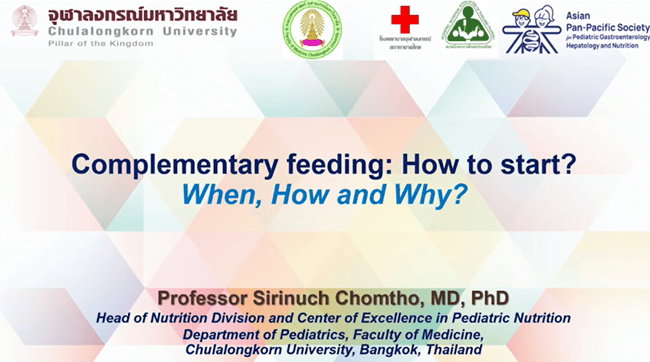
This presentation was delivered by Professor Sirinuch Chomtho, MD, PhD, Head of the Division of Nutrition, Department of Pediatrics, Faculty of Medicine at Chulalongkorn University.
Narrator:
Welcoming Professor Sirinuch Chomtho Head of the Division of Nutrition and the Centre of Excellence in Paediatric Nutrition, Department of Paediatrics, Faculty of Medicine, Chulalongkorn University and Bangkok, Thailand. Following completing her medical and paediatric training, Professor Chomtho was a research fellow at the MRC Childhood Nutrition Research Centre, Institute of Child Health, University College London and Honorary Specialist Registrar in Paediatric Gastroenterology and Nutrition Great Ormond Street Hospital.
She obtained her PhD from University College London and a diploma in Paediatric Nutrition from the UK Royal College of Paediatric and Child Health. Professor Chomtho’s research focuses on the effects of early nutrition on long term health, breastfeeding, medicine, obesity, inherited metabolic disorders, and the ketogenic diet. To date, she has published 54 original articles and 23 book chapters.
She currently serves on the scientific committee of the Paediatric Nutrition Association of Thailand and the Asian Pan Pacific Society for Paediatric Gastroenterology, Hepatology and Nutrition. Please welcome Professor Chomtho.
Professor Sirinuch Chomtho:
Hi. Good morning, everyone, and thank you very much for the organizing committee to invite me here. And thank you for a very nice introduction video here. Today the topic of my talk is about complementary feeding and all the practicality of it.
So basically, we are going to talk with a very simple term and very practical thing that you can use in your clinical practice. And this is my disclosure. And today's focus is going to be starting from the definition of complementary feeding. And then go on to the reason of why we should start complementary feeding and for what purpose and when? And the more importantly, how to give it, what to give as a complementary feeding, how much, how often, as well as what is the responsive feeding behaviour that we are talking about.
And lastly, we're going to talk about the recent WHO recommendation as well as the recent publication in response to that publication. So, let's start with the definition of complementary feeding. This is the latest definition by WHO, which is published in 2023. Complementary feeding is a process of providing foods in addition to milk. When breast milk or milk formula are no longer adequate to meet nutritional requirements, which is much more generous than in the past. So basically, the complementary food would be a nutrients and energy containing either solid, semi-solid, or liquids that fed to the infant in addition to human milk or formula. And this process generally takes taking place during the second half of the first year until the end of the second year of life. Why do we need complementary feeding? You may all have seen this graph before about the gap. This is just one representative of the nutrients that is the energy intake. So basically, you can see that after the first six months, there is a gap for the energy that the breast milk can provide for the growing baby. The body size is bigger. The energy that the breast milk would be providing was like 400 when the baby needs 600 and the gap is wider as a baby getting growing older. Until the second year of life, the energy requirement mainly will come from complementary feeding and the lesser part will only come from breast milk.
This is a nutritional reason, and this also hold true for the protein and other micronutrients as well. Another reason is for the developmental process point of view. As you heard earlier this morning, the progressive change in the food texture is very important for infant development, and that can shape their food preference in later life, not only for the texture, but also for the taste preference.
If they prefer very sweet sugary food or very salty, one that will have detrimental effect on their health. The third one would be to increase the diversity of gut microbiota, which I'm sure you will hear a lot about tomorrow, that is there more diversity and that and how that affect your later life? And the last bit is about the oral tolerance, which is receive a lot of attention in the past ten year. I'm sure there are a lot of expert food allergy here in the audience. And then you hear about it more tomorrow. So, let's come to my first poll very early. When do you think we should advise the parent to start complementary feeding? Actually, I've been asked whether there is any right answer, and my answer is, well, let's see what other people here think that is four month, six months or you would say 4 to 6 months. When the parent asked, when should my baby start their first solid? Or is it varying tell the parent it is vary depending on your child developmental readiness or tell the parent it is vary depending on whether your milk supply is enough or whether your child have any other allergies increase. Or is it your concern your grandparents? What tell you what to do? Is that a cultural concern type of thing? Yes. So, this is a voting question. Yes. Very excited. Most people seem to think that maybe it brought 4 to 6 months. Whatever the parent pick will be the right one.
Okay. If you gather enough respond, maybe we can see the results. To be honest. I mean, most of you would say 4 to 6 months. Not to fix to a very single digit. I mean, my multiple-choice question doesn't have any right or wrong, whichever choice can be the correct answer for different contexts and situation. So, let's move back on the slide.
We see all the what the audience think. So, I would think that the timing of introduction we can discuss is small, whole day long, whether it is four months or whether it is six months. However, it is a balance. The scale is like the developmental readiness of the babies. But whether the baby ready for when is a baby ready for complementary feeding, I would say that neuro development wise, around four months onward is absolutely fine.
They can put your head; they can put their head up even though probably not cannot see it without support. Yet. But if you don't require them to like to put a finger food in the mouth, it absolutely fine. GI renal development is already. But there are pros and cons of starting later or earlier. We are not discussing about later than six months or earlier than four months, but we talk about within this time period. There are pros and cons. The authority that supports later is thought of complementary feeding has been concerned about the breast milk intake. If for however, reason you start complementary feeding very soon, the baby can take complementary feeding very well. That could replace some of the breast milk intake that what? That is why the issue is so insistent on starting complementary feeding at six months. And also, the reason in the past, like for allergy prevention, the delay, the later the better. But now that the tide has turned to become the earlier introduction for the oral tolerance and also the pro of earlier start is for the how the feeding behaviour develop, you can see that the later you start the complementary feeding, the harder for the baby to accept the new texture and new preference.
So, this is the so called guideline I tried to talk to you about. If you haven't actually seen it yet, I will just walk through it with you very briefly and also there are some organization or some authority, because I heard that a lot of you are from Mexico. This is the one that I read recently about the consensus on complementary feeding from the Latin American society. So basically, it more or less very similar to this multi society response that actually is not against the WHO recommendation. Some of it, provide the evidence going along with the WHO recommendation that some very tiny part that might be slightly different in slightly different contexts.
The executive summary for the actual recommendation, there are seven bullet points about how you should feed the baby from six months to 24 months old. And this is the third bullet point answering the question of when, if you follow WHO recommendation is say that the complementary feeding should start from six months. That is exactly 180 days, or only one single digit that you can talk to the parent. However, the previous show did, recognize that some infants may benefit from earlier introduction of complementary food. And also, the mother who have concern about the weight gain of the baby about the breastfeeding adequacy should seek the lactation support as well as it does address a concern about iron deficiency in the recommendation.
So, I would say when should we inform the parent to start complementary feeding. I would say that it may deviate from the six-month milestone a little bit. If the baby have the problem with the weight faltering, and then you have concern about the breast milk adequacy toward the six months like age, you could provide adequate nutritional support to the, to the mother, adequate lactation support, trying to increase the volume of the breast milk. But if that doesn't work, the baby is still not gaining weight very well. Earlier introduction of complementary feeding would be a feasible option, especially in the area where I work that is Thailand. And also, I discussed this with our Southeast Asia colleagues, and they all have the same opinion on this. The other one, maybe you all know about this. For the allergy prevention point of view, I found that this, figure of the baby nicely illustrated this. There are studies showing that earlier introduction of allergenic complementary food at 4 to 6 months, starting from four months and plus continuation of breastfeeding can markedly reduce risk of food allergies. And the evidence is very strong. As Rosean already said in her talk about the peanut as well as the cook egg. So, there are even one study that showed that it did not reduce the rate and the duration of subsequent breastfeeding. You will hear more tomorrow, probably. I guess. So, this month the society responds to the WHO recommendation. Did say it out loud that in the population affected by food allergy, I'm sure in the context that you work, the prevalence of food allergy has been like very up and down and with different type of food as well. But this, the two one that had the most evidence is the egg and the peanut. It can be introduced earlier from the allergy prevention point of view. And so, let's move on. Just transition from when to what. Which is the most common complementary food in your country? I'm not sure if my choice cover everyone in this like large hall, whether you start with the rice porridge and from Mexico you may not have rice, but a kind of starchy carbohydrate as a first complementary feeding. Or you would start with, the most popular in Southeast Asia is banana like mashed banana. Yeah, it's very easy and texture is very good. You start with the egg yolk, like, the egg yolk, liver or the iron fortified type of thing. For example, iron fortified cereal or iron 45 commercial baby food. I'm really excited to see the voting result, just to see that is in any like. As I say, no checkmark. Whatever you give in your country. Oh, nobody actually give liver at all.
So I guess we have a lot of Southeast Asian, delegate here. So basically the first one is the rice porridge. And banana. Okay. Rice porridge and banana. It is the practice here in Southeast Asia. The grandparent will start with the rice porridge and banana like 10, 20 years ago. It will start from even three months onward, like starting with rice and banana and egg yolk good, liver as well as yes, I can see that you work your clinical setting. Where you work is a setting where the socio-economic status of the parents is not very low. They can afford and iron fortified cereal, as well as the iron 45, commercial baby food.
So, in theory, what to give as complementary feeding, what would you like to give? It should provide sufficient energy to meet the energy gap from breast milk, provide enough protein and micronutrients. Namely, I would propose the problem micronutrient. That is, the iron, zinc, calcium and vitamins. Now several of vitamin which the prevalence of deficiency may be different in different regions of the world. To meet a growing child nutritional need and it should not provide excessive calories in form of like, sugar and to not provide excessive protein, especially when obesity is a concern in your clinical settings. It should have dietary diversity. You may ask me, what is dietary diversity? I mean, this is in theory what should be given. It should be safe, hygienic, store and prepare and clearly fat. Actually, WHO did address all of this theory in their recommendation. Dietary diversity means, as many ingredient or many food source, not ingredient. I'm sorry. Many foods source as possible. Starting with animal source food. People have asked me as well the parents or if the grandparents come, they will ask whether it is okay to give like egg or fish to the baby at a weaning age, like six-month-old, isn't it better or milder? Gentle to give banana and, rice first, I would say that you can give rice together with the meat, to make the diet more diverse and give banana as well to, to be a fresh fruit and vegetable. The more diverse across the fruit group it is, the better. Is there any concern about the food allergy now the focus has shift from avoidance in order to combat the food allergy into oral tolerance. Earlier introduction is probably better, but you must be concerned that the evidence only exists for a few. I mean, not a few, but a certain food that is easy to do the experiment on. However, I think this recommendation is how you should make that the diet very diverse, having fresh fruit and vegetables every day to train them to learn to accept the broccoli. So, call. And also, if the meat is not very frequent, the process and nut may be a good protein source as well. And avoid all the unhealthy food and beverages high in sugar, high in salt, and high in trans-fat. That should be totally avoided. Tell the parent that don't put that sugar in your complementary food. Don't seasoned it with soy sauce like in Thailand, or fish sauce or the salt to make it tastier. That is tastier for the parents, but for the baby, it probably is too much. It doesn't really, prefer that very tasty complementary feeding and the sugar non-sugar. If you say avoid sugar, parents might ask whether I can use sweetener. It's not that sugar it has no carry. The sweetener should be avoided as well because that is processed food very, very much.
And the last one the previous show did talk about the supplementation and food fortification, which I agree that in the area where we work, at least in Southeast Asia, nutritional supplement and food fortification is still a good way to combat the heat and hunger or to combat micronutrient deficiency, namely the iron deficiency as well as the iodine we have salt iodination program in several of our country, and also the food fortification.
There is a debate whether you should fortify iron in the food, or you should give it as a supplementation, as a medication, and it can go on for like a daylong of which way it should be, do it. So basically the WHO recommend this, it has in the bracketed it is context basically of how you would give that supplements and how would you give that fortification. It's depending on the context that you work in. I just want to show you, a little nice picture the language here is Thai, so you cannot read it. Definitely. But there is a picture with the spoon. You see the picture with the spoon with the yellow thing. That is for six months the texture should be very fine, very good match. And then getting lumpier with a lot of grain in there, you can see to what you can see. The number like 11 in blue 11 months. This is how the Ministry of Health in Thailand teach the parent how to give complementary food. Instead, the type that you be given the texture as well as the amount in the household measure, like how many spoons should be given at different age.
Does the parent follow these guidelines? I mean, it is in the baby book when the baby was born and vaccinate. And I think, the paediatrician should familiarise that themself as well with this. And this is like plan, either the, the base at the top or the pyramid where the base is wider is different in different country. But this is what we provide. That is 11 to 23 months. You can see the number there. So let me summarize about micronutrient aspect that it could lead the deficiency could lead to compromised immune response, impaired growth as well as a long-term neurodevelopmental outcome. So, for the baby, I just emphasize again, more than six months old, it should be given the food that rich in iron and zinc.
And the richest source of iron is actually in the liver. But I as I can see that for the board, no one actually recommend the liver as a first complementary feeding. But to be honest, the texture is very easy to magnify. For example, chicken liver. The pork liver is a bit too thick, but if you put it in the blender, well. But that is a very good source of iron. And the meat is also a good source of iron and zinc, as well as the dairy product to provide a source of calcium. You should provide as many fresh fruit and vegetable as possible. I'm not sure if you see it in your clinical practice, but we see it several new cases in a year of scurvy because the baby doesn't actually eat fresh fruit and vegetable. It actually mostly come from the family with a lower socioeconomic class when they stop breastfeeding to early, cannot afford proper fortified formula, and they put that baby on the UST milk for like a very large amount of the whole cow’s milk from very early on, from like six months onward. And scurvy will turn up before one year, with, limb pain, unable to walk as well as the gum bleeding, we see it in the clinic, very quiet. Every now and then. And also, this is another nutrient that is of concern. That is the vitamin D. I would suggest that you adjust the food to combat vitamin D deficiency because you get that from the sunlight exposure. Really. But this is a graphical illustration of the food that high in vitamin D. But I would say that how to combat these probably go through the root of the supplementation rather than, to change the diet. Really. And we and the Malaysian colleagues, as well as the Indonesian colleague, has developed the e-learning platform about the early life nutrition that is also a chapter about complementary feeding that is suitable for Southeast Asian country. You can go to the website and have a look around. There are some nice graphical displays of the food source as well. And so, I would say give them as diverse as possible diet. However. But for the food allergy prevention there are some specific dose and frequency that you have to be aware of. What is the responsive feeding behaviour?
You can see the baby in the two photos. I'm not sure what you practice in your region, but this is called traditional spoon feeding and that is called baby led weaning a lot messier. There are pros and cons of this, and I cannot go into very much detail, but you have to consider the parents that ask for your advice. Whether should I do baby that led weaning with my baby? Should we do that? You have to assess and discuss with them whether that, they were concerned about the choking risk, whether the parents is educated enough to know, to pick the food, that reduce the risk of choking down intake. If the baby just selects all the broccoli, but not the average food that we painstakingly prepare for them. What do we do? And how about the growth? Whether the growth is enough, there are a lot of randomized controlled trial that try to compare the baby led weaning with a traditional spoon feeding to answer this question, but I don't have enough time to go into the details of this. You can all see the keyword and then the study will come up.
They also do encourage the responsive feeding, but that does not necessarily mean baby led weaning. I would say that there would be a balance between the traditional way of spoon feeding. To be responsive to the baby needs doesn't always necessary to go through the extreme of having like starting from six month and trying to make the baby feed themselves. And this is the last part of my talk. Time is running up. Question three and four. You can read it on the screen, right? For the infants 6 to 11 months who are fed milk other than breast milk, you have to accept that not everyone has the breast milk 100% and two to three years old. So there would be a case scenario in your practice when 6 to 11 months old have some other milk, a process apart from that breast milk, will you feed them whole cow’s milk, other animal milk, goat, buffalo, whatever you have, plant based milk that is a soy, or whether you suggest the skim animal milk, it would be the infant or follow on formula in your practice. That is what we have very little time. Yes.
Oh. Nearly consensus. We can stop the vote. Otherwise, I run out of time. Yes. And move on to this question number four, which is very similar. You don't have to read a lot. That's changing the age from 6 to 11, from 12 to 23 months old. The choice is the same apart from number E which change to follow on a young child formula according to the age.
Let's vote again to see if the answer is different. Yes. More on the whole cow milk for the second year of the baby's life, there isn’t right or wrong on this is depend on the context where you practice. Really? Yes. This is the answer that I think I would see on the screen. Yes. So, shall we move back on the slide presentation?
Yes. Actually, WHO advocate breastfeeding continuation to the second year of life. However, it stayed on recommendation number two. That is number two out of seven that for the baby who cannot fully breastfed 6 to 11 months that that the baby should be fed either milk formula or animal milk with has changed from some of the ideas because to be honest, I would have more concern for the 6 to 11 months old baby to be put on the whole cow’s milk which is, iron fortified which I think I share the same view with the audience in this room, because almost all of you actually answer that it is the infant on follow on formula which classifies as in fortified formula and for the older WHO, recommend that animal milk and no follow on. Indeed, there are evidence from the systematic review which I give you the reference at the bottom that, pull all the study together and follow that for the younger infant, receiving cow’s milk instead of the fortified formula can increase the risk of anaemia, the blood loss, and also the iron deficiency anaemia as well as it, but it have no significant effect on the growth. And for the older one, receiving more than one portion of fortified milk for a certain period of time may have a positive effect on the anaemia and haemoglobin, as well as the iron and vitamin D status. You have to accept that, the whole cost milk can make the baby grow in terms of the weight and the linear growth, we see a lot of fat baby like, receiving from receiving the cow’s milk. But a lot of them do have micronutrient deficiency, namely the iron deficiency, as well as vitamin C and vitamin D deficiency. And in that, in the settings where obesity is a concern, giving animal milk, which is very high in protein content around 4 or 5g per decilitre, instead of the modified or fortified formula, which has a lot lower protein content, can lead to obesity risk as well. So, this multi society response, which we share the opinion with because I am from the PASPGHAN and I think a lot of audience here from the NASPGHAN again, from the ESPGHAN again also share the same view. Certainly, continue breastfeeding alongside complement well continue breastfeeding as well as a complementary feeding that if the infant formula are available, affordable and can be safely prepare, it should be used alongside complementary feeding to reduce the risk of nutrient especially. Well, this is my bracket is my the iron deficiency a later obesity from excessive protein intake. However, if you work in the setting where infant formula cannot be affordable, unavailable and cannot be safely prepare, you could perhaps you would offer full fat animal milk as a substitute, but it should be in appropriate amount. The AP recommend not more than 500 ML, which I do agree no more than two portion of milk to allow the baby to have other type of food source for their dietary diversity. And for the older infant breastfeeding should continue as part of a healthy diet, but the consensus is weaker, or the voice that say you should continue to breastfeed in the second year of life is weaker than in the first year, and then the WHO recommendation. And from this, the multi-society agree that it probably be safe to use animal milk, the whole animal milk, in the second year of life, but that has to come together with the promotion of dietary diversity, as well as considering the fortified food in order to combat micronutrient deficiency, it may not be necessary to use the fortified formula. However, it can be used as a part of the strategy as a some form of food fortification to increase the intake of iron, vitamin D, and in in the Europe may decide the entry pool for I mean is true for us as well, even though the fish intake probably more prevalent while decreasing the intake of the protein compared to the whole cow milk where if where you work, obesity is also a concern.
So here comes my take home message. This is the definition of complementary feeding again. And in addition to meeting the nutritional requirement, the process of complementary feeding can shape the future food preference, gut microbiota diversity as well as the oral tolerance. Generally, it should be started as six months, but some infant may be benefit from earlier introduction from four months onward. And dietary diversity should be offer from animal source food, fruit and vegetable as well as the dairy product. And you should advise the parent to avoid all unhealthy food additive. And we could consider or doing further research on the area of nutrient supplement and food fortification. Breastfeeding, this is my take home message should always be protected and support alongside complementary feeding. And the recommendation for animal milk versus formula milk is very much context specific, depending on the availability in your setting as well, as you have to concern about the risk for iron deficiency and the risk of double burden of malnutrition.
Thank you for your attention.