Key Take Outs
Ashley C. Patterson, PhD
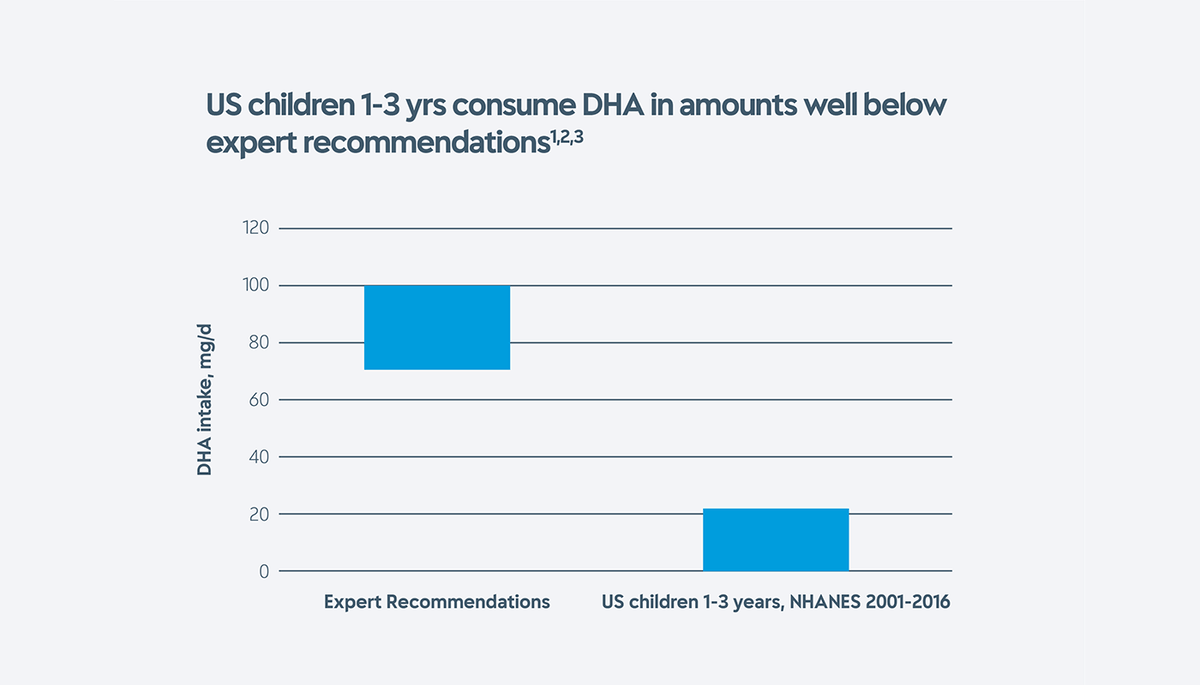
Less than 3% of US toddlers meet expert recommendations for DHA intake
Global experts recommend that toddlers should have around 70-100 mg of Docosahexaenoic acid (DHA) per day.1,2 However, analysis of the National Health and Nutrition Examination Survey (NHANES) data indicates that most American toddlers consumed less than these expert recommendations, getting only about 25% of the recommended amount.3,4 It is thought that the drop in consumption is partially due to the transition from breast milk, or a DHA-fortified infant formula, to cow’s milk. Similar dietary gaps have been observed in older children.3
How can you increase a toddler’s DHA intake?
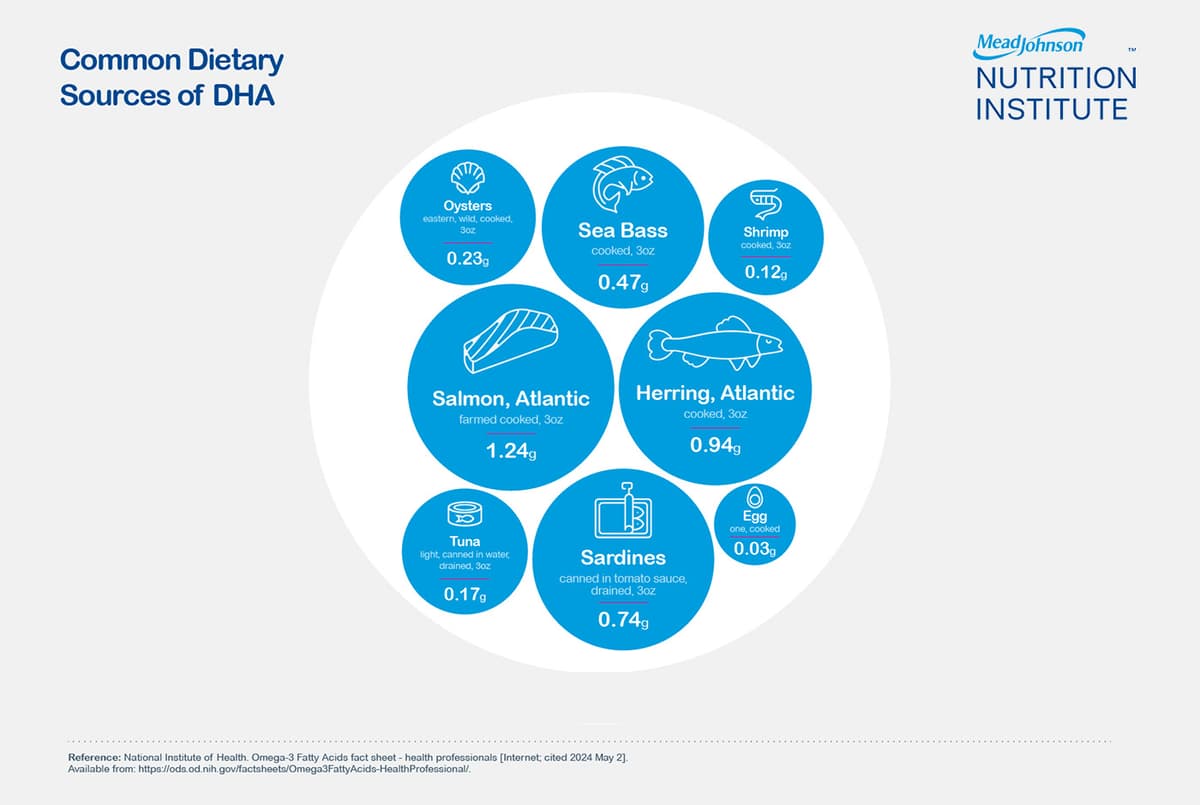
As the primary source of DHA is oily fish (e.g. salmon, mackerel, trout), toddlers should be encouraged to eat a few portions each week.3 Some familiar dietary sources of DHA are included in the visual below.
The role of DHA in toddlers’ development
The first 1,000 days of life are an important window for brain development; at birth, the brain is ~25% of its adult size and by age three, the brain has grown to 85% of its adult size.6 During this period of accelerated growth, DHA accumulates rapidly as the main structural lipid in the central nervous system.7 An expert panel of the European Food Safety Authority (EFSA) has concluded that there is a cause-and-effect relationship between DHA intake and normal brain development.8
DHA doesn't just aid in brain development; it may also support the immune system. It influences immune cell membrane composition and function, which can lead to a lower incidence of respiratory illnesses in toddlers.9 In a randomized controlled trial, toddlers consuming a formula providing 130 mg DHA/serving for 60 days had significantly lower incidence of respiratory illness (i.e. 17%) compared with those fed with control formula (i.e. 46%).10
Download the PDF below as a quick guide for the dietary sources of DHA.
- EFSA Panel on Dietetic Products, Nutrition, and Allergies (NDA). Scientific opinion on dietary reference values for fats, including saturated fatty acids, polyunsaturated fatty acids, monounsaturated fatty acids, trans fatty acids, and cholesterol. EFSA J. 2010, 8:1461. https://doi.org/10.2903/j.efsa.2010.1461
- AFSSA (France). Opinion of the French Food Safety Agency on the update of French population reference intakes (ANCs) for fatty acids. AFFSA-Request No. 2006-SA-0359. [Internet; cited 2024 May 10]. Available from: https://www.anses.fr/en/system/files/NUT2006sa0359EN.pdf
- Bailey A, Fulgoni III V, Shah N, Patterson A, Gutierrez-Orozco F, Mathews R, Walsh K. Nutrient intake adequacy from food and beverage intake of US children aged 1–6 years from NHANES 2001–2016. Nutrients 2021, 13(3):827. https://doi.org/10.3390/nu13030827
- Walsh K, Ye Q, Piekarz A. Dietary intake of omega‐3 long‐chain polyunsaturated fatty acids (n‐3 LCPUFA) by US toddlers. FASEB J 2012, 26(S1). https://doi.org/10.1096/fasebj.26.1_supplement.811.6
- National Institute of Health. Omega-3 Fatty Acids fact sheet – health professionals [Internet; cited 2024 May 2]. Available from: https://ods.od.nih.gov/factsheets/Omega3FattyAcids-HealthProfessional/
- Dobbing J, Sands J. Quantitative growth and development of human brain. Arch Dis Child 1973, 48(10):757-767. https://dx.doi.org/10.1136%2Fadc.48.10.757
- Martinez M. Tissue levels of polyunsaturated fatty acids during early human development. J Pediatr 1992, 120(4):S129-S138. https://doi.org/10.1016/s0022-3476(05)81247-8
- EFSA. Scientific opinion on the substantiation of a health claim related to DHA and contribution to normal brain development pursuant to Article 14 of Regulation (EC) No 1924/2006. EFSA J 2014, 12(10):3840. https://doi.org/10.2903/j.efsa.2014.3840
- Calder P. The relationship between the fatty acid composition of immune cells and their function. Prostaglandins Leukot Essent Fatty Acids 2008, 79(3-5):101-108. https://doi.org/10.1016/j.plefa.2008.09.016
- Minns L, Kerling E, Neely M, Sullivan D, Wampler J, Harris C, Berseth C, Carlson S. Toddler formula supplemented with docosahexaenoic acid (DHA) improves DHA status and respiratory health in a randomized, double-blind, controlled trial of US children less than 3 years of age. Prostaglandins Leukot Essent Fatty Acids 2010, 82(4-6):287-293. https://doi.org/10.1016/j.plefa.2010.02.009