Artificial intelligence: Exploring the frontiers to unleash the future of healthcare
Discover how Digital Health Technologies and AI are revolutionizing healthcare development. Dean Ho, explores how these innovations can transform healthcare beyond diagnostics, leading us towards a truly personalized approach to medicine.
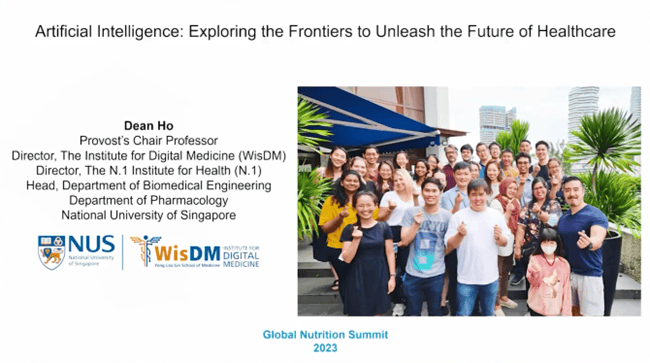
This presentation was delivered by Dean Ho, PhD, Provost’s Chair Professor & Director, The N.1 Institute of Health & WisDM, Singapore.
Narrator:
Introducing Professor Dean Ho. Professor Ho is known for his work in the areas of artificial intelligence and its applications in medicine, and has been involved in developing many successful platforms such as CURATE.AI, IDentif.AI and WisDM Green. He is the recipient of multiple awards. He is currently an elected fellow of the US National Academy of Inventors, American Association for the Advancement of Science, the American Institute for Medical and Biological Engineering, and the Royal Society of Chemistry.
Professor Ho currently works as the Provost, Chair, professor and director of the N-1 Institute of Health and the Institute for Digital Medicine, and as the head of the Department of Biomedical Engineering, Department of Pharmacology, Yong Loo Lin School of Medicine at the National University of Singapore. Please welcome Professor Ho.
Professor Dean Ho.
Thank you so much for having me. Hope everybody can hear me. Okay. Thanks for sticking around for the last session. It's a privilege to be here. I wanted to thank the organizers for having me. Today, we're going to think a little bit differently about what personalized medicine means, and we're going to explore the journey that we have taken to bridge innovation with actual implementation, validation and deployment in the clinic.
And this team here, this remarkable team, are the people that do what we do at the Institute for Digital Medicine, also known as WisDM at the National University of Singapore. Quick disclosures. I have a startup. I do some work with the W.H.O.. A number of companies support our work. And then finally, we have disclaimers here. I'm going to kick things off by talking about what WisdDM is, what our institute does, and then look at different technologies that take our work forward into the clinic with some specific use cases.
I think something unique about WisDM is that we focus almost exclusively at the clinical stage. We currently have over ten first in human clinical trials underway at our institute, and every single one is interventional. We have taken AI platforms into the clinic to modulate how we treat patients for a number of indications, ranging from oncology to hypertension to health and wellness, and beyond.
And to do this, it takes a truly unique team to make this happen. Go back one slide here for you. So how did we get there? If you look at the left side of the screen, this is what I call the ideation arm. This is a team of clinicians, of radiation oncologists, of hematologists, of oncologists, cardiologists and beyond, as well as engineers, AI and ML experts.
But something that I think separates our institute from traditional technology institutes is what's on the right side here. An implementation and evaluation arm in order to truly take technologies and bridge them into clinical practice. We need to understand who the users are. The users are not always the patients. The users can be the clinicians. They can be the nurses, the pharmacists.
Allied health and beyond. At the same time, we also have to think about the economics of what we do. So if you look at this team, we have health economists, user engagement researchers, implementation and scientists and beyond. And in fact, the very first person that I hired into the institute is not an academic, not a clinician, not an engineer
He actually hails from insurance so that we can be assured that the technologies that we develop have an actual chance to be deployed at scale to help as many patients as possible in an economical way. We even have industrial designers to do UX and UI. Those from industry, including from big pharma companies, to learn digital from us while we learn large scale clinical trials from them.
So if there's one thing that I want the message to be taken home with from this meeting is that when we think about personalized medicine, we all know that we are different from each other, that we know, but more importantly, we have to remember that we are different from ourselves over time. Broadly speaking, in the world today, when we think about personalized medicine, we think about it at a very fixed time point.
But if we think about dosing, the best dose for a patient today may very well be a different dose for that patient a few days later, even a few hours later, we are different from ourselves over time. True personalization is a dynamic process. It is longitudinal. So we have to serially adjust how we optimize care for our patients.
When we think about artificial intelligence largely in the world, we think about big data, taking big data to train algorithms to then treat the next person that walks in the room. We don't do that at wisdom. We use only a patient's own data to manage only their own care dynamically. Right. In that sense, we don't use preexisting data. And why do we do what we do? What kind of outcomes can we expect? Well, as I'll show you in a little bit, sometimes giving patients a lower dose than what we think they need can lead to better outcomes. But in an even more profound end point, we have had patients that appear to not respond to treatment at all, but without changing the drugs just by lowering the dose at the right time, we have flipped non-responders into responders. This is what it means to use only a patient's own data for only their own care. And if you look at this, this animation here, this is actual data of how the right doses evolve over time. So this is how we do it. The digital avatar. Right. When you see this, what looks like a computational a purely modeled image, this is an actual patient and when this animates, it allows us to serially adjust doses to optimize at all times. Again, we don't use big data. In fact, I argue that we use small data to generate this approach, and I'll show you how we do it. But I would argue even more that when a patient walks through the door, we have no data, right?
When a patient walks in, we don't know how to dose this patient. We don't yet have this avatar made. The doctor working with our team calibrates the user to make this avatar just for them. You'll note here it says ten years. Why ten years? Well, ten years ago I went to our first oncologist and said, I think we have an idea on how to make sure we can individualize treatment. I had a little bit of data, had a little bit of in vitro data, cell data at the time. And you can imagine what they said ten years ago. Really. They said, no way. Wait, we will never use this type of approach. Giving any dose lower than the maximum tolerated dose would be unethical. That was ten years ago.
Ten years later, for those unfamiliar, we presented at the American Society of Clinical Oncology, or ASCO, the premier clinical oncology conference in the world. This past summer, we spoke at ASCO. We spoke at ASCO. And at the same time we made it into what's called the ASCO Educational Book, the cornerstone educational resource for clinical oncologists in the world.
Right. It took ten years to take this from an idea into broader clinical validation. And this is the actual workflow that I'm going to talk about that ultimately ended up about few weeks after I presented this workflow at ASCO, the US FDA reached out to me and said, can you talk about this workflow and how you do what you do at an FDA ASCO joint workshop, right.
So what a journey it's been. Let's take a look at some use cases. Right. A few years ago we collaborated with the UCLA transplant department and we worked on a small cohort study of using our AI platform to dynamically optimize dosing in transplant patients. Quite common in transplant titration happens already. What you're looking at is three of the patients in that trial, a small sample.
And you can see everybody's different from each other. However, again, these avatars animate over time. And what were the outcomes? Well, we discharged our patients with CURATE AI about a month earlier compared to standard care. While discharge in and of itself is not a typical clinical endpoint, as a first in human study, this was an important outcome. We didn't keep people in the hospital longer.
For those who are unfamiliar with US health care costs one night at an ICU at UCLA can be tens of thousands of dollars. That's one night, right? Imagine a month earlier compared to standard care, that's a substantial cost savings. But more importantly, these are immunosuppressed patients getting out of the ICU faster. Alright. We also outperformed standard care in every single metric staying in range, etc., etc..
We published in Science and Translational Medicine a few years ago. Not long after this, we were approached by a cancer patient. Stage four prostate cancer metastasized to the bone. This patient had failed. Every line of treatment was on a last line of therapy with an investigational inhibitor plus an FDA approved drug. And to make this avatar, we need two things.
We need to be able to give the patient variable doses of the drugs, all within allowable range. And we also need the biomarker response. Right. So this is easier for some cancers than others. With this variable dosing we can craft the avatar. If you look at that red data point over there and you take a bird's eye view, what this told us was that if you drop the dose, if we drop the dose by 50% of the inhibitor, we could actually increase efficacy for the patient.
The doctor said, we're not going to do this in oncology. We give high dose and we give fixed dose. Anything lower than that's not okay. The patient said, look, I cannot tolerate this treatment anymore. I have no more options. Where do I sign? Patient signed. Consented. We dropped the dose and within one week the patient had the lowest prostate specific antigen levels they had ever seen.
A week later, we kept the dose low again. The PSA went down even more. And during the course of treatment, we started dynamically changing the dose well below what most other patients were getting. Achieving stable disease. Not too long after that, we expanded into cohorts for other cancers, colorectal cancer, blood cancers, so on and so forth. And this was even more profound.
There was another patient that seemed to not respond to second line therapy, which is actually quite common. But after crafting their avatar and reducing the dose at the right time, this patient flipped from a non-response into a response. Imagine that. Don't change the drugs, just change the dose. And they flipped from non-responder to responder. I want to be very clear.
Our goal is not to low dose all cancer patients. That is not our goal. Our goal is to find more responders when we take population approaches and apply them to everybody. When we currently define dose optimization as just finding the maximum possible dose, we are missing responders. If we take a more scalable but individualized approach to dynamically personalizing care, we will find more responders.
And for each patient, we will ensure that we're giving them the right dose at the right time. Truly.
So let's move on a little bit. Let's not only talk about pharmacologic dosing. Right? So I, I currently come from Singapore. I live in Singapore where healthy aging and health span are important considerations right? In our part of the world, the lifespan is continuing to increase, but the health span also needs to match. We need to make sure that patients while living longer don't spend time being unhealthy in those last ten plus years.
Right. And so how are we addressing this? Well, instead of just pharmacologic or drug treatments, we're also looking at another area that we call digital therapeutics, right? As in various parts of the world, we're starting to see increased use in this space. Digital therapeutics is not the use of AI to optimize drug treatment. It's actually the use of software as the treatment, using apps as treatment, using computer programs as treatment.
And what you're looking at here is actually a multitasking game originally developed by NASA, open source, and it allows the player to do multiple things at once. Move a target address some dials here, and then respond to audio commands. It's three tasks at the same time. Think of it as three drugs, but instead of changing the dose dynamically, we are on the back end, changing the difficulty of each game dynamically and what that allows us to do.
On the right side there is to craft a digital avatar for cognitive training, and you can do this remotely. We can do this for seniors, and we're now even doing this for brain cancer patients remotely, right? We've trialed hundreds of patients. We're expanding into a much larger trial soon. We call this medicine without meds an ability to remotely optimize, not just monitor, but optimize cognitive performance.
This can be done in combination with supplements. It can be done in combination with pharmacologic treatment as well. How do we do this? How have we been able to launch and decentralize these trials? When we developed that platform, Covid hit, we could no longer bring people into the clinics to undergo that treatment. We had to remotely deploy all of it.
We have an amazing implementation sciences team to understand who the users are and to ask the question, what do the users actually want? How do you design a digital therapeutic that users will use and will continue to use over time? What are the incentives that they need to stay engaged? This is how we do what we do. What is this culminated in actually at ASCO this year we had another presentation where we deployed that DTX or digital therapeutics for brain cancer patients.
Right. And we were able to understand why they wanted to participate in this trial. For some patients. They participate to help other patients. For some patients they participate because they want to rejoin society after radiation therapy to the brain. This allows us to have a better understanding of what our users want, to maintain the effectiveness and the sustainability of our treatment.
We also have to understand what doctors want right when we develop new therapeutic regimens. When we develop new software to integrate into clinical workflows, we have to have an understanding of what doctors are willing to use, what doctors go through on a daily basis to make sure that they will actually want to do what we do. Right. And so this is the same thing we did.
We did user engagement for the clinical community to help us have that true understanding of the clinicians mindset. All right. So what I've shown you so far is that we dynamically modulate dosing to help patients over time. Patients are dynamic. The same treatment will not always yield the same outcome for clinicians. And to prove this even further, let's not only think about treating sick patients.
I'm going to offer to you my own data to show you how dynamic I am when I undergo different regimens for myself. So this is not my arm, by the way. Okay? It's not my arm. The arm is courtesy of the of the internet by Abbott. All right. Many of you may have seen this device already. Right. It's a continuous glucose monitor.
Some of you may have used it already. So starting several months ago I tried one out. Right. It works for two weeks. Right. And I wanted to monitor my own glucose response, but not just purely for monitoring. All right. What I did, quite simply put, is since it lasts for two weeks, I undergo some interesting eating regimen. Some of you may do this yourselves, right?
I do intermittent fasting, but the typical intermittent fasting regimen is sixteen eight, where you basically skip one meal of the day and you eat the other two. That was that was years ago. More recently, I've undergone, 20/4 22/2 or the popular OMAD, which means one meal a day, right? Which I typically do. Right. And so as a function of weighing the glucose monitor as well as tracking fasting ketosis for myself, this is all me right here.
I wanted to understand how I could combine fitness with certain fasting regimens to optimize ketosis for me. Alright. And so for the two weeks on week one, I would do cardio training every morning and eat my one meal in the afternoon. Large meal for week two I would do strength training or weights in the morning, and then I would do my one meal in the afternoon.
And it was a very consistent meal. Quite boring in fact, but necessary to look at this data. If you look at the first round of experiments I did in May, the green boxes show you when I was in ketosis, right? The production of ketones to elevate my fat burning potential. And you can see I reach ketosis very quickly.
In fact, within within two days or so I was in ketosis. Quite surprising to me. But if you look at the right, I tried this again a few months later and it took me over a week to reach ketosis. And not only that, I was unable to stay in deep ketosis for long term, even though it was exactly the same regimen, right?
Different people respond differently, but we even respond differently on our own. And so what I started to do was in the black lines track my glucose trajectories, and then in the blue this was my ketone trajectory, taking ketones three times a day, once in the morning before working out once in the morning, after working out where my glucose goes up, ketones go down and then one more time in the afternoon before I eat, and day after day you would see this shape take place and something that I did not know for myself until eventually was.
Maintaining this profile here gamified myself into sticking into this regimen. Make no mistake, I love food. I love eating every day in the afternoon around 3 to 4:00, right? That pastry in my house starts to look pretty good. All right. But I did not want to give up this trajectory, this profile every day. And I stuck with it every single day.
And in fact, I'm sticking with it right now. Right. My first meal today will be several hours from now. Right? I'm actually taking my own readings back in my room every single day. Right. And so if we continue to look at this right, again, my goal was to come up with optimal ratios of weights to cardio, to fasting, to meal intake, to optimize my ketone output and interesting findings.
I eventually expanded my fasts into 48 hour fasts. I've done 72 hour fasts, as some of you know as well, but something I did learn if I really want to optimize my ketone production, I actually don't have to fast super long. I just need to fast a threshold amount of time into the 20 hours and make sure I do weight lifting to go with it, right, so I don't have to keep doing long fasts, right?
To drive myself into ketosis. Right? And so again, finding these optimal regimen, I wanted to try it for myself. Right. Interesting learnings about how I myself am dynamic over time to take some ownership over my own health management. All right. So I get asked a lot of questions right. At WisDM. We've got over ten fasting kind trials underway using digital actually treating people.
How did we develop such an extensive portfolio of trials. So in about four weeks, in about four weeks, my group, I'm actually releasing a new book called Medicine Without Meds, where we use digital therapeutics as a use case for how we launch our programs. This was actually written, in collaboration with Agata and Yoann in our team. And this book is not an academic textbook.
There's actually no data in this book at all. This book is a blueprint for how to accelerate digital innovation to patients faster, and to do so safely at scale. Right. And for, by the way, for those of you who've ever seen the movie La La Land, DA Wallach is in the movie. He's a prolific investor, musician and actor who wrote the forward for the book right, to talk about accessibility of innovation to more patients in the world, as well as closing remarks from Doctor Eddie Martucci, founding CEO of one of the first digital therapeutics companies in the world.
Right. We're actually giving away all of our royalties, all of the proceeds from this book are being given back to patients to support their care, to help as many patients as possible. Right. So to summarize the talk, when we think about AI in the world, we largely think about big data, but it's not always about the big data.
Of course, we collaborate with those who do big data all the time. It's important work for diagnostics. It's important work for discovering new therapies. But for treating patients, sometimes it's not about how much data you get, it's how the data is acquired, right? We can rethink how we design clinical trials in our past several weeks. Speaking to regulators, that's an area of focus we've had put.
Importantly, A.I. is not only there for diagnostics, it's also there for intervention, for optimizing treatment over time for patients. With the one minute that I have left, why am I showing everybody some pictures of spinach? All right. Well, I've talked about drug treatment. I've talked about digital therapeutics. Well let's talk a little bit about nutrition. All right. I've shown you how to optimize treatments for dosing for combinations.
But we asked ourselves the question how do we optimize combinations to go this way. We usually optimize to shrink cancer, to suppress Covid, etc.. How can we go upward? Well, we ran an experiment using our platform to optimize combinations in peat moss, in soil to increase the yield of spinach of agriculture. And we did in our very first experiment, we increase yield by 30%, but increase in yield alone is not enough.
It's about the nutritional content. We sent this sample to an independent lab that showed us that by using less ingredients, we increased the yield 30% with no impact on the nutritional content. Remember, sometimes less is more. We took the same combination, applied it to other plants, and we achieved yield increases as much as 200% with no impact on the nutritional content as well.
Right. So beyond treating patients, I think AI has a responsibility to create less patients, right, to help with the health spectrum, not just health care, but of course helping both. Right. So these are areas we're looking at as well. So in conclusion, the core ethos of our institute is that technology alone cannot transform health care. It takes a multidisciplinary approach of engineering, AIML, implementation sciences, user engagement, our clinical community all the way to adoption in health economics to make sure that our innovations can actually make it into health care workflows.
I wanted to thank the organizations that sponsor our work, over here. And then finally, I'm happy to stay in contact with everybody. You've got my email here, various social media platforms. Please feel free to reach out. If you'd like to stay in contact. Wanted to thank the organizers again for having me today. I know I'm keeping everybody from, lunch maybe or not.
So, we'll do a you a Q&A session after that. Everybody's going to intermittent fast with me for a little bit longer. All right. Thank you for having me.