
Disrupting allergic march - Changing the path for a lifetime journey
Discover how early nutrition shapes lifelong health with experts Dr. Maria Carmen Collado and Dr. Benjamin Gold as they explore the critical role of diet and nutrition during pregnancy and infancy in influencing allergic manifestations and supporting allergy management.
Learn about the impact of early nutrient intake on gut microbiota, breast milk composition, and infant health. Understand the windows of opportunity to modulate the microbiota and improve childhood development, as well as the potential of nutritional interventions, including probiotics and prebiotics, to manage cow's milk allergy and support long-term allergic outcomes.
These presentations were delivered at the 55th Annual Meeting of the European Society for Paediatric Gastroenterology Hepatology and Nutrition (ESPGHAN) by Dr. Maria Carmen Collado, Institute of Agrochemistry and Food Technology, Spanish National Research Council (CSIC), Spain, and Dr. Benjamin Gold, FAAP, FACG, NASPGHAN-F, Pediatric Gastroenterologist, Children’s Center for Digestive Healthcare. Founder, Aerodigestive Center and Program at Children’s Healthcare Atlanta, USA
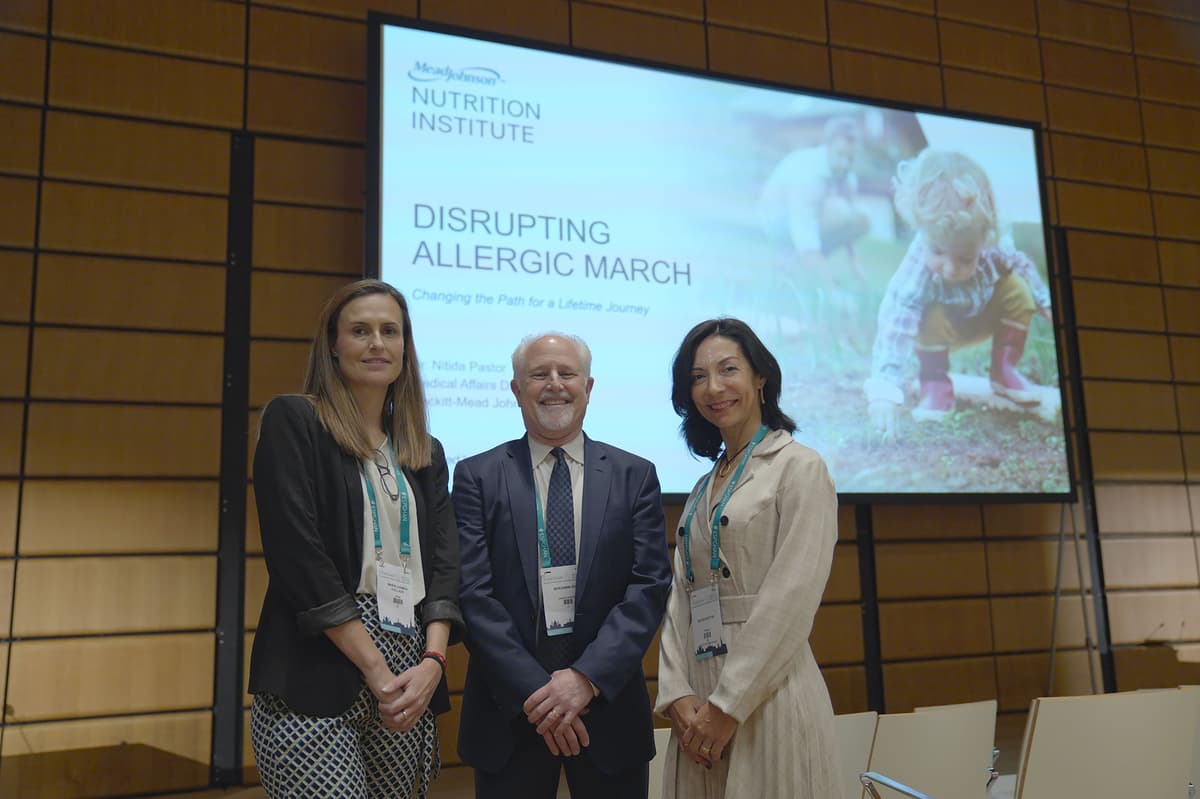
Nítida Pastor:
Welcome to the Mead Johnson Nutrition Institute Symposium. It's a pleasure to have all of you here, and it's a pleasure to share the panel of speakers that will be with us, giving all the best and even unpublished data today. If you see this slide, the title is clear. Let's say Disrupting Allergic March. That's a good year for all of us.
But what makes our work really, really important is that about what we learn which changes the path for a lifetime journey. And for me, this is an inspiring message. And this is exactly what we want here. Why we prefer to be in this room versus even a site seeing in Vienna is because we want to learn something to apply as soon as we go back home. The child there, see what we want to end today. And meaning we want to do something smart. We want to learn how to do it. Then saying that, let me tell you the main topics. The first would be how pregnancy is diet and early nutrition, impact allergic manifestation. We have the privilege to listen from the talk of Dr Collado. Her latest research study. She will show data that it is not available yet, but you will be fascinated with this information because she's talking about how the pregnancy diet impact the baby allergic symptoms impact the microbiome and vice versa. Then it's a fascinating journey through the breast milk implications. And then our second speaker, Doctor Gold will talk about what kind of diet, food supplements accomplished in the management of CMPA and other GI allergy in infants. And what is amazing here is that our early intervention has a long-lasting effect on is going to define the allergic manifestation later in life. Then, we will have Q&A challenging questions. This is what I expect. And for sure we are here to have answers. Then please, this is your time. To give you a bit more background of the speakers. Dr Collado coming from Spain. She has been training in Finland also. She has multidisciplinary research focusing on microbiology, food science and nutrition areas. Her interests are on probiotics, microbiota, health and nutrition during pregnancy and every life period. She does pre-clinical but do a follow up with babies and mums which make her work incredible. More than 200 papers. More than 10 PHD’s going on. I mean enough credentials to dedicate all of our attention.
Moving to Doctor Gold. Again, his research focuses on microbiota, diet, IBD, GI allergy and EOE. But he has also a key organizer of the clinical practice guidelines for H.pylori infections. His management skills allow him to establish the Aerodigestive centre of health care in Atlanta. He is the director of quality, co-investigator on paediatric inflammatory bowel disease. They approach to this. Again, more than 200 papers, co-director of the GI Care for kids and recognize and immediate past-president of NASPGHAN. With such a level of speakers. We don't want to finish in the same voice. And it is going to be hard for us to do that. Thank you so much. Enjoy the time.
Dr Collado:
Well, good morning, everyone. Thank you very much for coming to listen to us. It's a pleasure today to be with all of you and to talk about the pregnancy diet and early nutrition how impact in, in, allergy manifestations. Well, this is my disclosure, conflict of interest. And we are going to start about what happened in early life. We know that according to the developmental origins of fallacy hypothesis, we know that the oral health is determined by events experienced in utero and also during early infancy. We know that the maternal microbiota is being recognized as a one of the most essential factors determining the maternal infant to a healthy outcome. We know that gut microbiota and most of you know, are influencing our health, and it's important that early establishment and development that the microbiome in early life. Written studies has been shown that paternal microbiota during pregnancy change, through an increase through microbiota with the inflammatory conditions we got from mums gaining weight, but also an increase in mainly Bifidobacterium. And you know, these bacteria, Bifidobacterium is the most abundant organism in the infant gap. And we know that when there are some dysbiosis early life Bifidobacterium are the most sensitive genes, most of the problems related with these viruses in infants are related with that increase in Bifidobacterium levels. We know that these diagnostics early in life are associated with imbalances in the immune system, migration and development being or giving us the higher risk to develop noncommunicable diseases, including allergy related ones. But we know that diet is the most powerful tool to modulate the microbiome. Why? Because we know that in the diet, there are some factors that are not being used by humans but are being used by bacteria. Example oligosaccharides present in human milk or polysaccharides on the fibres that can be present in diet. We know that these diet influences specifically the activity of these microorganisms.
Different microbiotas are going to produce, according to the diet by different metabolites. For example, we know that the specific bacteria and Bacteroides and lactobacillus are able to produce searching fatty acids like us and others that are relevant because regulating this homeostasis and also increase the better mineral absorption. We also know that some bacterial groups are able to produce specific vitamins, like vitamins B and vitamins K, that are important for their metabolism and human physiology, and most important as well, some bacteria are able to produce, some metas like Gaba, for example, then can modulate the nervous system. Well, you know, the gut our brain access. But this is a topic for another full hour, another session meaning. What is the relevance of the maternal diet in the microbiome, in the allergy risk on the offerings? Well, there are many data in the literature that suggest that the maternal diet influenza allergy disease. This is a study data the by Carina Venter in the U.S. show called the Maternal Diet Index was associated with offspring allergy diseases.
She found that vegetables and yoghurts were associate with the prevention of allergy, like all of the products like white and red meat, cold cereals, fried potatoes and fresh grains were associated with an increased risk. You can see in the bottom. Other studies as well, showing that that maternal fibre, in this case resistant starch were association between the different manner to infant with an infant etc. Discussing with Carina Venter we were trying to understand what's happening with a cohort, MDI cohort that contains around 250 mothers in comparison to Spain. We collect We collect biological samples for pregnancy questionnaires and other things. We use this maternal diet index. Of course, we, we make some specific adaptations because, you know, the diet in the US is different than the diet in Valencia in Spain, the Mediterranean diet. And we make some adjustments. But we found as well that the vegetables and yogurt were associated with good with a good health outcome. But in this case, we wanted to know if microbiota would play a role. Then as we can have information of the microbiota, we combine the diversity the maternal index with the microbiota and health outcomes. And we found a distinct, microbiota in the, in the babies with small had lower or higher maternal index, lower index means and balance in diet pattern, an upper group or upper index is a balanced pattern. And we found, for example, that, this influences the alpha diversity in the microbiome richness and diversity. As I mentioned, the gut microbiome of the babies have been characterized by the presence of Bifidobacterium.
And that's means lower diversity because abundance is mainly predominant by BPO. And we found that in France who were following, this imbalance had a higher diversity, meaning that there are other organs. And as you can see here as well, we found an association between yogurt and vegetable proteins and, and vegetable intake in the moms with Bifidobacterium in the heatmap as well. I know that this is more sorry, but you can see here this is the diet vegetable intake. Mainly and negative associations with a specific, lower group. While in the other one there are other things, but more we also in cohort wanted to see which kind of, which factors can explain the microbiota variation. And we found like two clusters in the microbiota of that month time. These clusters were associated with the maternal diet. We found one cluster that was characterized like a high diversity of richness, high prevalence of Prevotella and high intake of fatty acids. Maybe in the cluster two or in the group of two was characterized by a lower diversity, androgynous, high presence of blautia, roseburia, faecalibacterium, Bacteroides. And these were also was associated with a high intake dietary fibre, omega three fatty acids and polyphenols. We also found that the take in the moms were associated with a higher maternal ability. And you know that maternal ability and maternal permeability were associated with many different problems in, in, in the human body. Interestingly, these changes that we found according to the microbiota and the diet were also reflected in the immune profile of the cord blood. We found differences according to the maternal diet, unbalanced diet or diet characterized by high intake of fat and red meat was characterized by an increase in adiponectin, IGG and also most of the C-section babies were located in these. In this group also, these grew this influence of them from diet. It wasn't selected in the first pass fiscal microbiota of the babies. You can see in the small size sorry the different groups. Whereas it in a different way with red and blue with a specific maternal index.
And even more, we found that this high maternal ability that was associated with high intake of, fat was related with an adult diet microbiota. And we know that diet is high, is characterized by the higher diversity. And as we mentioned, lower diversity is important in the early life, mainly by the predominance of Bifidobacterium. Now we are going to talk about the infant diet microbiota and allergy.
Well, you know that in the literature there are many, many studies showing that infants who develop allergy related problems, eczema. We need this, food protein, food allergies, etc. had a distinct microbiota profile. In most of these studies, the risk of allergies were associated with us C-section, people by C-section antibiotic expression. You know that C-section is, combining with antibiotic exposure, of course, lack of breastfeeding environment, you know, more organic environment, etc. and, and this makes a reflection in changes in diversity in composition, but not just bacteria are relevant in allergy. The allergy of studies that are so many studies showings that Foley and other organisms also are playing an important role in the development of allergy problems of course, we don't know if it's cause of consequence, of course, but we know as well that these viruses in the fungal and this part of the microbiome are also associated with allergy related problems. As you can see in the different the studies, I would like to highlight this one led by Marie-Claire Arrieta in in Canada, where she analysed the microbiota bacteria, but also the microbiota in terms of the to the fungal. And she found differences in infants who develop later atopic with. More things. We already talked at the beginning of my presentation that bacteria or microbiota is able to produce some microbial metabolites. And in the literature, you can also find different the studies showing how originate that is one of the most common or the most well-known microbial metabolites is related with other allergy and other etopic, asthma, etc., but home microbial metabolites may influence the risk of disease. Well, I like to present this this, this is a fever from one recent study that they showed that dysbiosis, due to the different causes, as we explained before, influences the dysbiosis in the gut and not just in composition and adversity. Also reduce the bacteria that can produce specific metabolites. Searching for the ethics including butyrate and interact with specific receptors in the epithelial and influenced the immunomodulatory activity of the Trex, including or increasing the risk of potential, excessive immune responses being prone to develop this is. We know about diet, what about breast milk breast feeding? Well, we know that the human, human like immune factors, including immunoglobulin, cytokines, oligosaccharides, bacteria, would associate with a low risk of food allergy. We know that that low amount of bifidobacteria was present in the breast milk samples from moms, from allergies moms, compared to healthy moms, and this is also important because of low Bifidobacterium are going to be low Bifidobacterium.
Yeah. We also participated in one study where we followed the babies. That at seven years of life develop allergy and we form different mike milk and microbiota profile in those babies. And also, lower diversity in babies, lower diversity in breast milk in babies who later developed allergy diseases. In the same respect that I mentioned, you know in this disease, where we have some differences according to the infant allergy statement we compare healthy this diversity healthy babies, co milk allergy babies and atopic baby. We found a review in in the breast milk diversity in a lot of babies. But an increase in communal babies. We are still trying to understand what would be the cause of this increase in diversity. Well, we know that the maternal diet also influences in the in the milk microbiota.
Here you have a different study and among them some of them. But we were we were participating but also the maternal diet influences the right oligosaccharide and oligosaccharide profile also the baby refinement, as you know, in this study. So, we were interested to take into account the impact of her maternal diet. And we found that the diet, maternal diet was able to modulate the diversity occurred in or dependent on infant mortality status.
We are working in this study, but this is real promising because maternal diet would provide a new tools to manage the risk of disease. Then the question is can we modulate the name of the microbiota and enough also the risk of disease? Well, I think the answer would be yes. But it's important to understand when and how. During pregnancy, during lactation and in the lactation, we have to take into account that that is a single thing. This is a global thing, mom and babies we have to consider as a single, single system, because things that happen to the mom are going to be reflected in the breast, in the present, that are going to be transferred to the baby and think of examples infections that can happen in the baby late in the mother to try to cover the requirements, and also in the infancy and at home with that.
But that's all we have for them are powerful tools. Maybe probably the prebiotics. Still, we need more information and then would like to highlight like three examples. Hope, provided that you can help to improve or to induce the presence of specific compounds in breast milk for example, this is TGF beta tool that we know this is an anti-inflammatory cytokine. That also induced all of us hope other to study consuming probiotics, increasing the the diversity and the quantity of milk and co the consumption of probiotics in these cases, as an LGG can expand the different microbes. Then just to conclude they come messages nutrition and impact on the cycle of life starting before baby born and continue during the breastfeeding and have uterine intakes from pregnancy to early stages, has shown that the impact on allergy in allergy manifestations, maternal diet, influenza, microbiota and also the breast milk composition with effects on infant health and maternal microbiota is recognized as the main determinant of child health, providing a specific sequence to guide the immune system development and maturation. Of course, I would like to conclude, I of all my team, my collaborators, funding agencies and all these things and of course, all of you for listening, thank you very much to all of you. Thank. Thank you.
For me, it's a pleasure to give to turn to my colleague Professor Gold, the floor is yours.
Professor Gold:
Good morning. At least in, my home in the southern part of the United States, that there's a little bit of a call and response. So just to see that you're awake, I say good morning, and then you say good morning back. Good morning, good morning. Good, I like that. All right. And there will be a test at the end of this. All right. So, I will first, I want to thank the sponsors and organizers for the invitation to come here. My, colleagues, from yesterday beginning, particularly the organizing committee, with involvement Sonia Colecheck and others, they come to this wonderful meeting. I get thrilled by the Vienna’s boy choir, which was fantastic. In the plenary session, my talk at now is going to focus sort of after birth and what you can do in terms of, manipulating and potentially preventing, allergy development later on in life. And hopefully stimulate some thought in terms of how we can change the paradigm that we're seeing, around the world.
These are my disclosures. None of the relationships had anything to do with the content and preparation of this presentation. So, the course of my talk, what I'd like to do is really get at three basic concepts. First, to describe how cow’s milk protein. And remember there's two main basic proteins. And each has subcomponents in cow’s milk and the allergic march and progress over time and particularly when to make the diagnosis and how to potentially, intervene. Second to understand and you heard in an elegant presentation, done by my colleague about how dietary manipulation and interventions can change the microbiota to potentially change outcomes. And I'll talk about how potentially you can do that in the child and interrupt the allergic march. And lastly, how, awareness of the microbiome. And it's not just bacteria affects outcomes and how potentially you can intervene, to affect long term outcomes during child development. Why is this an important issue for us to talk about? Well, it's very clear. And you can see some of these that, particularly got highlighted during the pandemic. Food allergy is making the headlines no matter what source of media that you look at whether it's the scientific literature or the literature that's focusing on health, everything, in, from the U.S., across the Atlantic, in the UK. My daughter lives in London, so she makes sure that, I have, relevant information with respect to what I do from the UK.
But you can see there's a lot of focus on the increasing prevalence of allergies and particularly food allergies in paediatric patients, even in the last couple of months. And this is just in, quick searches in the literature looking at this focus on food allergy. The recent quality I'm eating, which focused on this evolving story of understanding food allergy, in children and in particular, at least as somebody who has a four-legged child, that being a dog. Why actually, this may be important in terms of enhancing our microbiome and even more importantly, based on the concept I'm trying to get across you today, how it may actually intervene early on and manipulate the microbiome and of course, arrest the allergic march. Now, when we think about, food allergies, of course, the most important, at least from a clinical standpoint, is anaphylaxis. We know about Ige mediated anaphylaxis. But one of the things we're seeing in this, paper published in allergy just a year and a half ago, is that it's actually dairy products and not necessarily peanuts and tree nuts that is starting to emerge as the most important, allergen that infants and children and older are reacting to.
Why is this an issue? And data is an important thing. So, work from my colleagues at the CDC, the National Health and Nutrition Evaluation Survey. And the NIH has seen a dramatic increase if you look over time. So, the y axis is percentage of the population survey. The x axis looks at year cohorts and you can see with respect to food allergy and the 91% increase over the last, a decade and a half and with respect to skin allergy may be a marker if you will, of ATP and allergies. That's increased, by 70%. Now in 20 years, the number of specific, allergies that have been, hitting this sort of top ten, if you will, has risen from five to less than 15 years ago now to nine. And these are the nine food proteins, at least, that at the, FDA and NIH and CDC are labelled as, important causes of food allergies. And you can see sesame seeds, really is some of the most recent additions. But a number of them and in particular, dairy, remain an important issue. And particularly one of the most common in in infants under 12 months of age. A more recent review, this published about two years ago, highlighted specific key points.
One, it's very clear that IgE-Mediated or classic food allergy appears to be on the rise. The prevalence of allergies varies based on the specific allergy. And I think it's important as clinicians to recognize that many more people believe that their children or they themselves have allergies than actually are, exist. So, it's important to be able to separate out what's true allergy and HPV and that, that, is, perceived. Now, what are the mechanisms? And my colleague went through some elegant approaches to how we can think about it, and I'm sort of going to divide it into two main pathways, which I think are important with the relevance to what I'm going to show you as far as intervention. So when there's ingested food, proteins and milk is shown here on the top, left of your slide, that gets down into the intestinal epithelium. Managed, if you will, by dendritic cells, your APC cells, and then the pluripotent pathway from PH not cells that go into, ICP or Ace2 mediated pathway at the bottom and one mediated pathway, which is more of the inflammatory or autoimmune, pathway. And that's not just allergy. And there's a number of sessions at this meeting about essential focus allergies, eosinophilic gastrointestinal disease. And these all actually relate to this stage PH1 pathway, which is some of them having a mixed component of IgE and not IgE mediated approach. And so, the interventions can be very different. It's also important to recognize that a potential target both with dietary approaches pre and probiotics as well are these T regulatory cells because they can influence the pathway either towards TH1 or TH2. Now how do we understand the difference between tolerance, which is our ability to ingest food proteins that might be perceived as causing risks and allergies. And that's shown schematically on this particular slide. The key takeaway points here are and these were highlighted in the previous presentation. Diversity is good. Whether it's a there's ions and people. Diversity is good when it relates to our microbiome.
It's also important for a definition standpoint that the microbiome has two main components. And we often confuse them. So, the microbiome is the microbiota plus the byproducts which is contained within that isolate layer. And so, a diverse microbiota, decreases risk for allergy HP and even autoimmunity. And that's the composition of the gut microbiota may impact the development of tolerance later in life. Now schematically shown here. Again, I talk from a gastroenterologist would be, if I didn't have and it's got big pictures, or pictures of vipers that my, parents have brought in on their child that has that, in the lower right hand in the slide, causes a protein allergy. But you can see here there's a lot of examples that we have to deal with in a number of exciting, a data presented in this meeting about gastrointestinal inflammation and non-mediated allergy.
So what is the thing that Doctor Gold is talking about in the allergic march. And what happens early on in life that might influences well the basic concept is that allergic march of childhood describes this association between atopic dermatitis often called eczema. And IeG is food allergy and then allergic asthma and allergic rhinitis later on in life. And that can be shown on this particular slide schematically where the y axis is incidence. That's cases in a cohort over time. And the x axis is years. And you can see that as there's a high rise in a type of dermatitis early in life. And as that drops down, that's sort of a predictor of, food allergy and asthma as well as rhinitis later on in life. This is shown in a number of papers, summarized in this particular slide. And that early life causes associated allergies. Maybe one of the first stages, if you will, of the allergic march. There's a two and a half times increased risk of eczema, 2 to 3 and a half times increased risk for respiratory allergies. And if you follow these cohorts out through early childhood allergy to adolescent years, almost 4 to 5 times increased risk of allergic asthma.
And remember, asthma can have both an IeG or allergic component and an inflammatory component as well. In these particular cohorts, the schematics here, again, an incidence, in the cohort is on the y axis and age and years as shown, on the x axis. The key is that risk is raised in infants where there are multiple food allergies and a thousand times eating present now in this particular schematic.
And they were highlighted in the previous top, there are a number of strategies that we use to fall, from the gut barrier breastfeeding, special formulas, probiotics, the skin barrier, which is important, breastfeeding, microbial exposure. And good aggressive skin care in the child. There's a type of dermatitis and then respiratory tract area. Diet and this is focused on in the previous lecture is, is an important approach that we use in modulating the immune system and potentially halting the allergic march, breastfeeding and, special formulas. And it's not just what's contained in breast milk, but it's also the skin-to-skin contact with mom that help induce tolerance and reduce allergic, sensitization. Now, why is this important in terms of what we think clinically? And if you think about this from the standpoint time, when the American Academy of Paediatrics abbreviated AAP back in 2003, if there was a presence of allergy or APPS in the family waited to introduce allergic, or allergenic foods, milk and ear eggs for two years, and that's in three years. But an incredible observation that was done that led to the least leading study, which looked at Ashkenazi Jewish populations in Israel and compared to an identical cohort in New York. And it looked at when the peanut containing products were given, and the risk for allergy later on in life. And that led to the lead study, published in the New England Journal in 2015, which completely flipped the American Academy Paediatrics on a steer in terms of how we think about introducing allergenic foods.
So, in 2019, the AAP, pivoted. This was what they recommended is that there doesn't seem to be any evidence for delaying introduction of allergenic foods. And I would venture to say that actually, early introduction has been shown in a number of disease states. Elegant work done being done, for example, by Alessio Fasano and his colleagues, at MDH in Boston, that even in celiac disease early introduction gluten may potentially modulate or influence the development of celiac in at risk patients. And you see milk eggs and tree nuts 4 to 6 months of age and peanuts in 4 to 6 months of age. Now, how can we modulate or change how proteins are given? And there's a lot of, interesting and exciting research going on clinical trials and oral immunization, abbreviated OYT in the allergy world and actually influencing allergy development.
So then take the schematic shown on the far left. We have intact, casein a way milk protein. And you start to break it down into smaller pieces. You then by changing its three-dimensional conformation influence how our immune system processes it and then whether or not allergy exists and potentially both from a therapeutic standpoint and from using tolerance, you can change out all the way down to the basic building blocks or amino acids. And it's important to recognize that there have been a number of studies looking at extensively hydrolysed formula, whether extensively hydrolysed tasting or extensively hydrolysed way, where it's devoid of the potential allergenic protein, fragments, and that you can actually treat the disease and induced tone. It's also important to recognize, and that's why I've shown in the box on the on the far right, that amino acid formulas are good for, treatment but are not good for inducing tolerance later on. Now, when we think about the microbiome, we've been focusing on the gastrointestinal tract. And I like to venture to say that at each of the body compartments has its own unique microbiome and microbial signature. My ophthalmologist, because I used to be, a contact producer from way back and developed a lot of colonial ulcers due to, falling asleep, if you will, in, like, contact lenses. Show unique studies, because he likes to challenge me thinking about other microflora because he knows I'm interested in about the microbiome on the cornea and how actually contact lenses actually influence and decrease the diversity of the microflora on the cornea and thereby increase the propensity for developing ulcers. Also, it's also important to recognize that it's not just bacteria, it's fungi, it's protozoa and viruses. And each of those plays a unique role in that microbial community that acts on a specific body surface. So taken together, the gut microbiota with us human, the host make up this super organism. And when we think about why the data I showed you about the dramatic rise in prevalence, which is the number or frequency of cases at one point in time or incidence, if you forgot your statistics, which is you take one cohort and you follow it over time and you look for new cases, much more difficult to do that.
Maybe we need to think about, ways that we, influence our microbiome. The image in the very opening slide about the little child is playing in the dirt. Or I'm not necessarily recommending this, but the five second rule, you know, when you drop some food on the floor, five seconds later, you can pick it up. Maybe we need to change it to a little bit longer.
I'm not telling you to go out and lick the floor to enrich your microbiome, but, you know, we need to really think about what we're doing in terms of what are our children from early on in life are exposed, or a perfect example for my household, my son, who now is 33 and expecting our first grandchild, we thought he was going to graduate from high school with his pacifier.
Now, mind you, he was gone after first grade, but when his pacifier fell out, you would either see me diving through the air, trying to catch it before it hit the ground, or my wife looking at me and saying, I've got $6 in my purse, just pick it up, will sterilize it when we get home, and I'll give him a new one.
Or my mother, who's a really good way of embarrassing me at the right time when the wrong time to say, oh, you had pacifiers when you were little then when we fell on the floor, I'd pick it up and lick it off, and I'd shove it right back in my mouth. Well, in fact, use data, a number of elegant studies that have actually showed and this is a whole example of the oral microbiome or oral microflora that pacifier sucking by perhaps I'm not recommending is necessarily, actually can influence atopic outcomes later on in life.
So again, we need to start changing the paradigm of how we look at these things. And what about probiotics? And what about their influence? An allergy. An LGG, which is probably the most widely studied of the probiotics. There's a large amount of literature that looks at, its relationship to a topic outcome, even giving it, during gestation, the last semester pregnancy in infants, born to mothers, where you influence outcome later on in life. And it has effects on our inflammatory system, the cascade that I showed you. And I'll show you a schematic in just a minute or two in terms of how it influences the regulatory cells and the pathways that, our inflammatory system goes. But essentially a down regulation of inflammatory processes was and this is shown on this particular slide here. So then remember the schematic that I showed you. There's not a allergy appear more of a autoimmunity run inflammatory. And this is I immediate allergy down here. And with the administration of probiotics affecting this, you actually can change outcomes with respect to these pathways. And they influence the T regulatory cells in terms of driving that pathway, in different directions. And they explain why there's still an active clinical trial going on looking at administration of parasites to patients with Crohn's disease. Again, Crohn’s disease being a TH1 predominant response and driving the pathway because parasites are very strong. And invoking that TH2 response and potentially influencing disease outcome. Now what about combining the probiotic plus changing the formula? And in this particular, set of data, looking at eco cow protection, a objective biomarker that we look at in managing our patients with inflammatory bowel disease, it's a neutrophil derived protein, and their objective scores, for inflammation at different age groups. It's elevated in cows with associated colitis. And if you combine a probiotic plus extensively hydrolysed casein-based formula, you can see here's enrolment four weeks later. And there's a dramatic decrease in an objective marker of inflammation as well as clinical improvement. In these instances. Or if you take a group of babies these 260, in this particular trial, subdivided into five groups with extensively hydrolysed casein alone, extensively hydrolysed casein plus the probiotic hydrolysed rice formula, soy formula, and, you know, acid base formula. You can see that any and then the food challenge was used as the gold standard of assessing tolerance. You can see that the extensively hydrolysed casing is shown here by the gold bar plus the probiotic. Helps build tolerance of calcium associated allergies in this cohort. When you look at separating out this is the same cohort but subdivided into IgE versus non-IgE mediated allergy.
And you can see again where Ige mediated allegiances panel and anonymous mediated allergies. This panel that again the extensively hydrolysed casein. So, change in three-dimensional confirmation of the protein plus add in the probiotic influenced outcome. But what about if you follow these babies over time. And in this study published by the Italians, Bernie Kanani and his colleagues, which looks at three years follow up. So, the y axis is incidence and new cases of allergic manifestations. And those are shown here. So, eczema over the carrier abdomen right up into and then over a three-year period of time, you can see by the blue dot here that the extensively hydrolysed casein formula, plus the probiotics actually influence new cases and so mediated this effect on time. Now three years out over time. 50% reduction of new cases. And if you look at this in another way, these next two slides shows that if you look at the y axis, which is incidence of subjects over a three year period of time, and the x axis looks at different, challenge groups, and you can see that allergic manifestations of new cases were reduced by 50% in those babies that were given extensively hydrolysed casein, plus LGG. Also 80% of these babies that were given both the, extensively hydrolysed casein plus LGG, were able to tolerate milk. So, it induced not only, the overall incidence of new cases, but it actually allowed those babies that were allergic to then tolerate, the protein by 36 months. So, to conclude what I hope you've seen in a fairly, rapid fire way, looking at the epidemiology of allergy, looking at potential ways that we can influence outcomes that IGG immediate allergies have quicker onset specific indications and known mechanisms.
And all the tests that were used in the clinical setting are targeted IGG allergy, food allergies are increasing in both incidence new cases over time and problems. And they may be precursors for the allergic march later on in life, and also demonstrated that diversity in the microbiome enriches the microbiome. Whether it's with diet, with probiotics, or both. You can actually enhance, outcomes later on in life and both skin in the GI tract and overall immunity. We still need to understand. I mean, the probiotic market is an unregulated market. You can go into even a quick food store. You can see a whole panel of probiotics, each which have a wide variety of claims, and the relatively, very few that truly have data that look at their effect in clinical conditions. We still need to look at the different strains and diving into deeper, aspects of this and understanding how the diet can be manipulated, the microbial, microbial richness and hence and looking at clinical outcomes. So, what I'd like to propose to you is that we have influences from the environment. We have the host genetics, from mom-and-pop influence in the child. There's the opportunity for gut microbiome modulation. And then with the addition of prebiotics and probiotics, we can actually, decrease the risk for dysbiosis and enhance, you by essentially good outcome. So, thank you so much for your kind attention. And at this point, I'm going to turn it back over to our moderator and open it up for question and answer.

.webp?width=1200&quality=75&auto=webp)