Puntos Clave
Desarrollo digestivo infantil
Una nutrición adecuada es crucial para apoyar el crecimiento y desarrollo saludables durante los primeros 1000 días de vida, a medida que se desarrolla el sistema digestivo.
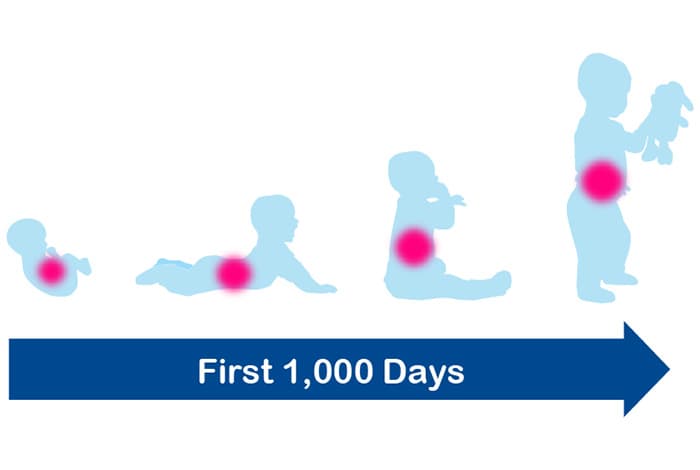
Ilustración de los primeros 1000 días
Los primeros 1000 días de vida son un periodo de rápido crecimiento y desarrollo, que incluye el tracto digestivo y el cerebro del bebé, ya que continúan desarrollándose fuera del útero. Durante este tiempo, el sistema digestivo aún desarrollándose a medida que maduran ciertas enzimas, el microbioma y la motilidad.
Vea ‘Cómo los cambios nutricionales pueden afectar el bienestar digestivo y favorecer la salud intestinal’
Desarrollo enzimático
La inmadurez en la actividad enzimática proteica puede dificultar la digestión de las proteínas.1,2 Por ejemplo, las enzimas proteicas como la enteroquinasa, la quimotripsina y la carboxipeptidasa no alcanzan la madurez hasta los 2 años de edad.3,4 De manera similar, la actividad de la enzima lactasa puede ser menor al nacer, lo que puede reducir la capacidad de digerir la lactosa.5,6
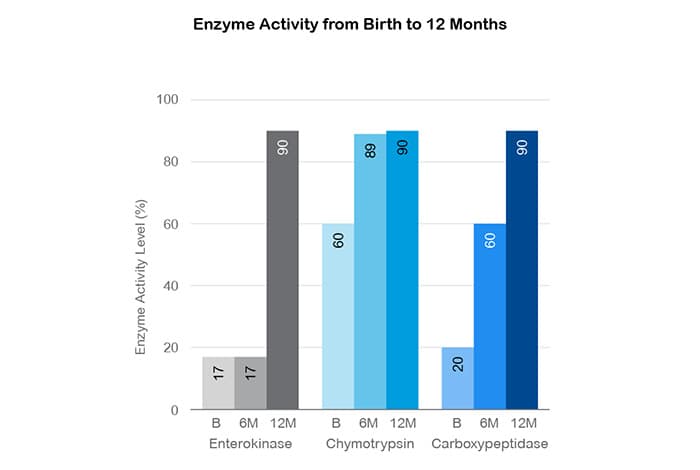
Durante este tiempo, el sistema digestivo aún está desarrollándose a medida que ciertas enzimas, el microbioma y la motilidad maduran.
Desarrollo de la motilidad
La motilidad del tracto gastrointestinal, o peristalsis, también continúa madurando durante el primer año de vida.7 Además, el esfínter esofágico inferior, que controla el paso de alimentos desde el esófago hasta el estómago, no funciona de forma madura durante la infancia y puede permitir que el contenido del estómago fluya de regreso al esófago.8,9
Desarrollo del microbioma
El microbioma intestinal, compuesto por microorganismos que viven en el tracto digestivo, también desempeña un papel importante en la digestión y la absorción de nutrientes.10 La composición microbiana cambia gradualmente y alcanza una composición similar a la de los adultos alrededor de los 3 años de edad.10
- Berseth CL: Probiotics in the prevention of necrotizing enterocolitis in preterm infants: A multicenter, randomized, controlled trial. Clin Pediatr (Phila) 2009, 48(1):58-65.
- Neal-Kluever A, Pavlidis P, Matthews T, et al.: Drug metabolism and disposition in pediatric populations. Drug Metab Dispos 2019, 47(3):296-313.
- McClean P, Waver LT: Pediatric gastrointestinal problems: A review of clinical issues. Arch Dis Child 1993, 68(1 Spec No):62-65.
- Cuadros-Mendoza CA, Barrera C, Palacios-Moreno D, González-Monroy M: Prevalence of functional gastrointestinal disorders in Mexican children. Acta Pediatr Mex 2017, 38(3):182-201.
- Romero-Velarde E, López-Teros V, Hernández-Bonilla D, et al.: The effect of dietary interventions on pediatric gastrointestinal disorders. Nutrients 2019, 11(11):2737.
- Fawley R, Heitlinger L: Lactose Intolerance in Children. American College of Gastroenterology website [Internet; updated 2021; cited 2024 Aug 29]. Available from: https://gi.org/topics/lactose-intolerance-in-children/
- Jadcherla SR, Berseth CL: Gastrointestinal disorders in neonates: Nutritional strategies and management. In: Neu J (Ed.), Gastroenterology and Nutrition: Neonatology Questions and Controversies. Elsevier Inc.; 2012:27-37.
- Stanford Medicine Children's Health: GERD (Gastroesophageal Reflux Disease) in Children [Internet; cited 2024 Aug 7]. Available from: https://www.stanfordchildrens.org/en/topic/default?id=gastroesophageal-reflux-disease-gerdheartburn-in-children-90-P01994
- Yale Medicine: Pediatric Reflux Disease [Internet; cited 2024 Aug 29]. Available from: https://www.yalemedicine.org/conditions/pediatric-reflux-disease#:~:text=The%20muscle%20in%20their%20lower,they%20are%202%20years%20old.
- Yang I, Rhee C, Wu M: The role of nutritional interventions in pediatric reflux disease. Nurs Res 2016, 65(1):76-88.

.webp?width=1200&quality=75&auto=webp)