Key Take Outs
Junnan Gu, PhD & Rebecca Hill, PhD
Gut microbiota imbalance is widespread among healthy US infants
A 2021 metagenomic study highlights that dysbiosis, an imbalance in gut microbiota, may be an unappreciated issue for healthy infants in the US. This first-ever US-wide survey found a low abundance of Bifidobacterium, especially Bifidobacterium infantis (B. infantis), together with a high abundance of potential pathogens in the fecal samples of 227 healthy infants studied. This finding is striking when considering how our modern lifestyle may shape gut microbiome development in early infancy and what we might be able to do to modulate microbiome development during this key period.1
How may probiotics support infants’ health?
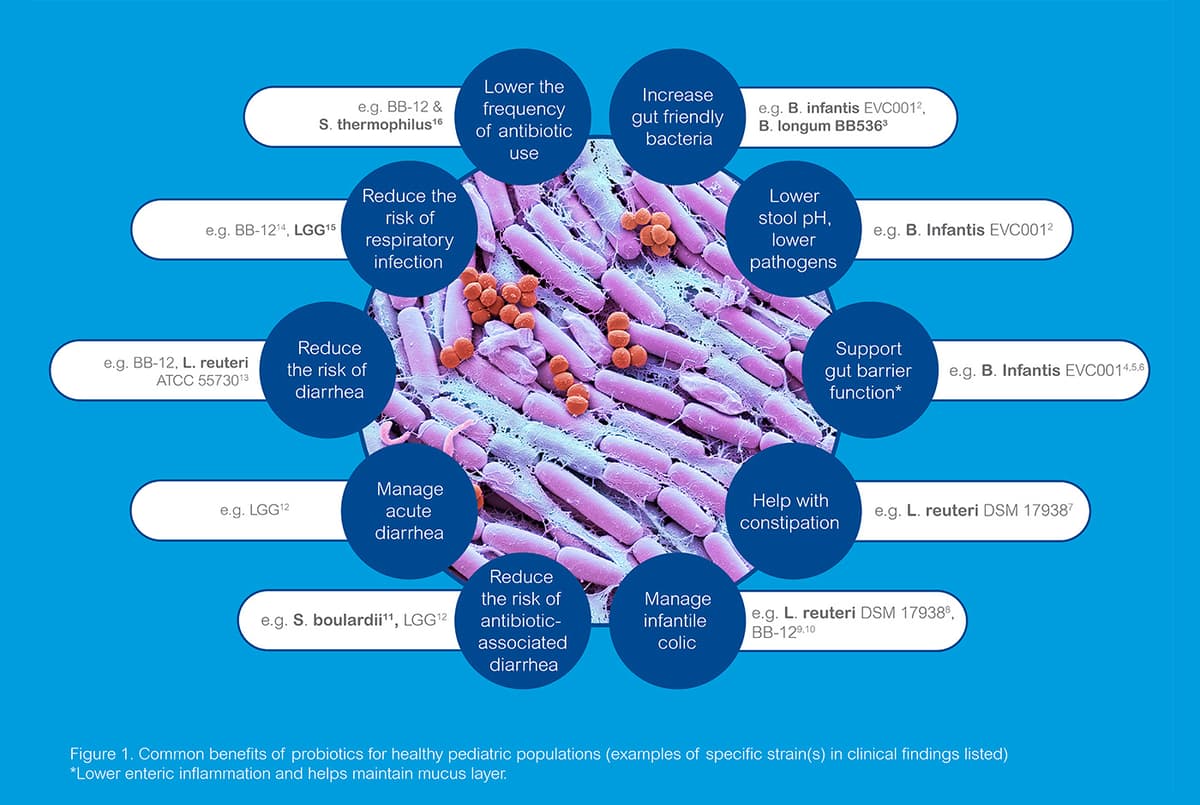
Probiotics have the potential to positively impact the composition and/or activities of infants’ gut microbiota, and so influence the health of babies. Many probiotics on the market for infants and young children are strains of Bifidobacterium and Lactobacillus. Common benefits for healthy pediatric populations include supporting the balance between beneficial/pathogenic bacteria, gut barrier protection, colic relief, reducing the risk of infections, and diarrhea management.
What are the challenges in studying probiotics?
Scientific support for probiotics continues to grow rapidly, but challenges remain when interpreting the evidence and developing guidelines for probiotic usage, largely because there are differences in:
- Clinical study design (e.g. well-designed randomized controlled trials versus observational studies; outcome measures);
- Target populations (e.g. healthy versus disease states; age ranges);
- Probiotic strain, including whether used in combination or alone;
- Levels of probiotics used.
Although the safety and tolerability of some probiotic strains in healthy infants and children have been supported by scientific evidence, more studies are warranted to better understand the efficacy and long-term health effects of specific strains within this population.
Abbreviations:
Bifidobacterium longum subsp. infantis (B. infantis), Bifidobacterium longum (B. longum), Bifidobacterium animals subsp. lactis BB-12 (BB-12), Lactobacillus reuteri (L. reuteri), Lactobacillus rhamnosus GG (LGG), Saccharomyces boulardii (S. boulardii), Streptococcus thermophilus (S. thermophilus)
- Casaburi G, Duar R, Brown H, Mitchell R, Kazi S, Chew S et al: Metagenomic insights of the infant microbiome community structure and function across multiple sites in the United States. Sci Rep 2021. 11(1). https://doi.org/10.1038/s41598-020-80583-9
- Frese S, Hutton A, Contreras L, Shaw C, Palumbo M, Casaburi G et al: Persistence of Supplemented Bifidobacterium longum subsp. infantis EVC001 in Breastfed Infants. mSphere 2017. 2(6). https://doi.org/10.1128/mSphere.00501-17
- Wu B, Yang Y, Xu X, Wang W: Effects of Bifidobacterium supplementation on intestinal microbiota composition and the immune response in healthy infants. World J Pediatr. 2016. 12(2):177-182. https://doi.org/10.1007/s12519-015-0025-3
- Chichlowski M, Shah N, Wampler J, Wu S, Vanderhoof J: Bifidobacterium longum Subspecies infantis (B. infantis) in Pediatric Nutrition: Current State of Knowledge. Nutrients 2020. 12(6):1581. https://doi.org/10.3390/nu12061581
- Henrick B, Chew S, Casaburi G, Brown H, Frese S, Zhou Y et al: Colonization by B. infantis EVC001 modulates enteric inflammation in exclusively breastfed infants. Pediatr Res 2019. 86(6):749-757. https://doi.org/10.1038/s41390-019-0533-2
- Karav S, Casaburi G, Frese S: Reduced colonic mucin degradation in breastfed infants colonized by Bifidobacterium longum subsp. infantis EVC001. FEBS Open Bio 2018. 8(10):1649-1657. https://doi.org/10.1002/2211-5463.12516
- Coccorullo P, Strisciuglio C, Martinelli M, Miele E, Greco L, Staiano A: Lactobacillus reuteri (DSM 17938) in Infants with Functional Chronic Constipation: A Double-Blind, Randomized, Placebo-Controlled Study. J Pediatri 2010. 157(4):598-602. https://doi.org/10.1016/j.jpeds.2010.04.066
- Hjern A, Lindblom K, Reuter A, Silfverdal S: A systematic review of prevention and treatment of infantile colic. Acta Paediatrica 2020. 109(9):1733-1744. https://doi.org/10.1111/apa.15247
- Nocerino R, De Filippis F, Cecere G, Marino A, Micillo M, Di Scala C et al: The therapeutic efficacy of Bifidobacterium animalis subsp. lactis BB-12® in infant colic: A randomised, double blind, placebo-controlled trial. Aliment Pharmacol Ther 2019. 51(1):110-120. https://doi.org/10.1111/apt.15561
- Chen K, Zhang G, Xie H, You L, Li H, Zhang Y et al: Efficacy of Bifidobacterium animalis subsp. lactis, BB-12® on infant colic - a randomised, double-blinded, placebo-controlled study. Benef Microbes 2021. 12(6):531-540. https://doi.org/10.3920/BM2020.0233
- Su G, Ko C, Bercik P, Falck-Ytter Y, Sultan S, Weizman A et al: AGA Clinical Practice Guidelines on the Role of Probiotics in the Management of Gastrointestinal Disorders. Gastroenterol 2020. 159(2):697-705. https://doi.org/10.1053/j.gastro.2020.05.059
- Szajewska H, Hojsak I: Health benefits of Lactobacillus rhamnosus GG and Bifidobacterium animalis subspecies lactis BB-12 in children. Postgrad Med 2020. 132(5):441-451. https://doi.org/10.1080/00325481.2020.1731214
- Weizman Z, Asli G, Alsheikh A: Effect of a Probiotic Infant Formula on Infections in Child Care Centers: Comparison of Two Probiotic Agents. Pediatr 2005. 115(1):5-9. https://doi.org/10.1542/peds.2004-1815
- Taipale T, Pienihäkkinen K, Isolauri E, Jokela J, Söderling E: Bifidobacterium animalis subsp. lactis BB-12 in reducing the risk of infections in early childhood. Pediatr Res 2015. 79(1):65-69. https://doi.org/10.1038/pr.2015.174
- Hojsak I, Snovak N, Abdović S, Szajewska H, Mišak Z, Kolaček S: Lactobacillus GG in the prevention of gastrointestinal and respiratory tract infections in children who attend day care centers: A randomized, double-blind, placebo-controlled trial. Clin Nutr 2010. 29(3):312-316. https://doi.org/10.1016/j.clnu.2009.09.008
- Saavedra J, Abi-Hanna A, Moore N, Yolken R: Long-term consumption of infant formulas containing live probiotic bacteria: tolerance and safety. Am J Clin Nutr 2004. 79(2):261-267. https://doi.org/10.1093/ajcn/79.2.261

.webp?width=1200&quality=75&auto=webp)