The Effects of Delivery Mode on the Babies’ Gut Microbiota and Their Life-Long Health
The impact of delivery mode on infants' gut microbiota is explored by Dr. Juan José Díaz Martín, emphasizing the importance of understanding the differences between cesarean section and vaginal birth. Learn how breastfeeding can help restore a healthy microbiome in cesarean-born infants, which plays a key role in their long-term health. The potential for techniques such as vaginal seeding and fecal maternal transplant to restore microbiota are also discussed.
This presentation is delivered by Dr. Juan José Díaz Martín, MD, PhD, Consultant in Pediatric Gastroenterology and Nutrition at Asturias Central University Hospital.
Narrator:
Introducing Doctor Juan José Díaz Martín, an esteemed expert in pediatric gastroenterology, hepatology and nutrition. Doctor Díaz Martín has held significant roles, including President of the Scientific Committee for the Spanish Society of Pediatrics and the working Group Chair for the Spanish Society of Pediatric Gastroenterology, Hepatology and Nutrition. Currently a consultant in the Pediatric Gastroenterology and Nutrition section of the Central University Hospital of Asturias. Doctor Díaz Martin also serves as an associate Professor of Pediatrics at the School of Medicine, Oviedo University. Please welcome Doctor Juan José Díaz Martín.
Doctor Juan José Díaz Martín
Good morning to everyone. Buenos dias a los colegas de México, estas serán mis ultimas palabras en Español por hoy. I want to thank all team to having me here. Thank you. Panote. Thank you. Theresa. Thank you Nitida.
But I want to save my special thanks to Jorge. It's been a pleasure meeting you for all these years, and we are missing you already. Thank you. So, this is the outline of my of my talk. I want to I want to cover all these topics.
So, as you all may know, the gut is the main organ of our immune system. This makes sense because it's just the single layer of epithelial cells that are, making the frontier between an outer space that is, heavily crowded of microorganisms of, toxins, drugs, food, and an inner space that should be kept sterile and only should be let inside. What's interesting for our system and this whole population of microorganisms that live there is known as the gut microbiota, these gut microbiota consist of more than 100 trillion cells, not only bacteria, also virus and archaea and, fungi. And they are an important organ of our system. They develop many functions that we don't have. They have more than 600,000 genes that outnumber our human genes by 20, 30, 40 times. And they are really important for us.
So we can say that only at this moment of development, when we are a fetus in the womb, we are 100% human. Even this, paradigm is being under question. We don't exactly know if we are human, at that moment because there are, some data indicating that maybe even in utero, the fetus will get colonised by a pioneer bacteria. There are not so many data this. Is that still. And the under debate is an unresolved question, but, this study, they took samples from placenta, from amniotic fluid, from meconium and from colostrum and from, those, close to 75 OTUs filler families found in meconium. 41 of them were also found in amniotic fluid and placenta, and 15 of them only in the amniotic fluid so there are data indicating that maybe the colonization of, microorganisms begins in utero. But even if that is true, well, then we can change. Are we 100% human? Any time. Well, that's not so important, because even if there is no colonisation or even if there is colonisation in utero, there is a huge amount of bacteria that is coming to colonise the infant's gut at the moment of birth and that's the important moment of, the beginning of the establishment of the microbiota.
This, starts immediately after birth at first, it's colonised by, proteobacteria, by enterobacteria that creates an anaerobic environment and then, a strict anaerobes like Bifidobacteria will appear and will dominate the, microbiota of the infant for, 3 to 4 months and when the, complementary feeding starts, then this predominance of Bifidobacteria will be replaced by Clostridium and both the Bifidobacterium peak and the Clostridium bloom that that will appear. There are two hallmarks of a healthy microbiota establishment. This, for example, with the metabolites that bifidobacteria produce, they produce short chain fatty acids like butyrate. That will be an important factor developing the, establishing the, favouring the establishment of a direct population that will help tolerance and also will, produce indole lactic acid that's also important for the immune system, development. This, evolution will continue until the age of three, when the microbiota will be close to the microbiota, often of an adult. So we can say that if we want to find what is the gold standard for healthy microbiota in an infant, that will be the gut microbiota that that is hold by a baby, that is vaginally born, that is exclusively breastfed for the six first months of life and receives no antibiotics in the first year of life.
This will be for, let's say, the gold standard for a healthy microbiota. So, there are plenty of insults that this microbiota can receive. It depends if they are breastfed or formula fed. It depends if they receive antibiotics in the in the labour or later of if they are pre-term or if there are plenty of siblings at home or no sibling at all.
So this will, impact the composition of the, of the microbiota. You have heard about eubiosis and dysbiosis. And just to make it clear, if you have a balanced microbiota, that's we'll call eubiosis. You will get health outcomes. If you have an unbalanced microbiome with a predominance of, pathobionts instead of symbionts, this will be called dysbiosis.
This will be related to disease outcomes. And we know for several years and even decades that dysbiosis is related to a number of non-communicable diseases, this dysbiosis is related to obesity, is related to diabetes, is related to asthma and allergies, is related even to lung cancer, but is also related to, neurocognitive problems and behavioural problems. So, just to see if you are still awake and you're with me, please answer this simple question.
So which combination is considered the gold standard for infant healthy microbiota?
The combination of C-section plus breastfeeding plus frequent antibiotic use
Vaginal birth, infant formula feeding and frequent antibiotics in the first year of life
Vaginal birth, infant formula, feeding and no antibiotics in the first year of life or
Vaginal birth, breastfeeding and noantibiotics in the first year of life.
I hope to get the 100% right answers. Please.
Close. Really close. We are moving to, 100%. Thank you so much. Okay, okay. Thank you. I'm moving to the next. Okay. You're right. Of course. Of course. It's, vaginal birth, breastfeeding and antibiotics for the first year of life.
Okay, so, C-section is a lifesaving procedure. Is a necessary procedure. Sometimes I, according to the WHO, close to 10 to 15% of pregnancy will need a C-section to save the life of the infant or maybe to save the life of the of the mum. But that's not where we are, see? No, we are not seeing a 10 to 15% of C-section rates. These rates are alarmingly increasing throughout the world, even in places like Eastern Asia. As you can see in the in the panel, it's up to 50% some places in Latin America, also over 50% and rising.
So we are making much more C-sections that we need. And this is critical for, for the microbiota, establishment. I want to focus you. I don't have a pointer. Sorry, because it doesn't work. So you, have to follow me with my language. If I could say that the Spanish will be easier, but let me try.
So let let's take a look on the left panel. Every dot represents a whole microbiota. And, this is in this study they studied microbiota from the mum and from the infant. And for example, it took samples from the oral mucosa of the man that's represented with a green dots. They took samples from mums, vagina that they are the ones that the dots in red and from mum skin. That's in the dark blue dots. Okay. And then they took, samples from the infant and they separate the ones that were born by C-section and the ones that were born vaginally. So those born from the vagina represented on the pale red, you can see that the microbial microbiota is close to the mums vagina and the pale blue.
That's the C-section microbiota of the infants. They are really close to mum's skin, so that means that they are close to where they, are connected. The C-section baby is one through the abdomen, so should be close to the skin on the mother, on the environment node. And the vaginally born is close to the rectum and to the vagina of the of the mum.
So, one of the most important difference that that observed in the composition of the microbiota, between C-section and vaginal birth is that C-section babies display a lower proportion of bifidobacteria and a delayed colonization of bifidobacteria. You can see in the right, in the upper row, in the right panel, you can see that the normal vaginally born babies have higher prevalence, higher count of bifidobacteria, and the red ones that are C-section are lower and delayed.
That is important. And also, the count of Clostridium is higher in the in the C-section babies, and also the Bacteroides is also higher in vaginally born babies. Another difference that is important and sometimes is associated to C-sections is antibiotics. Sometimes mums that should undergo a C-section should need antibiotics as a, as, prophylactic measure, as a treatment measure.
And, the, those that are, are treated with antibiotics, you can see that the Bifidobacteria account is still much lower in the in the red barn right panel, upper row, the blue one, the count of Bifidobacteria is much lower when antibiotics are given. So this difference can be observed at the first, week of life and sometimes even at the first year of life.
As you can see in this, in this picture, the striking difference are observing the in the first three months of life, higher counts of Bifidobacterium, Bacteroides in the vaginal born babies, higher counts of Clostridium in the six second babies. But even at 12 months of age, differences are observed if we go to the SPI. So the species level, you can see that, those born by C-section display higher levels.
The vaginal are the solid lines, higher levels of different species of Klebsiella, Klebsiella oxytoca and Klebsiella pneumoniae. They have higher levels, of this enterobacteria, those born by C section. Can we say that all differences are attributable to delivery because there are confounders that may, appear and may, take the responsibility of the difference. Now, we know that C-section mothers also have lower breastfeeding, rates.
Breastfeeding is sometimes delayed because mum will stay 24 hours, maybe recovering because had a surgery and will not start breastfeeding until 24, 36 hours. There's lower skin to skin contact. There's a higher obesity rates in C-section mothers. And of course there's a higher prevalence of pre-term babies amongst C-section mothers. And the one I told you before, sometimes, antibiotic is needed in in in C-section to just to separate the importance of antibiotics and C-section I am going to show you this study where only, moms that did not need, antibiotics, during labor were included. And as you can see, these dots again represent, a whole microbiota. Starting in the in the upper row, you can see from the day one until month two difference are significant between, C-section babies and vaginally born babies.
And from month two, there's no more difference. So there's differences in microbiota here with no antibiotic use are, different, are clearly different until month two, but no longer difference since month two of, postpartum. Again, if we go to the to the species levels, you can see that Bifidobacterium is lower in C-section babies, Klebsiella is higher in C-section babies.
So we can make a ratio. And we can say that C-section babies have a higher Klebsiella to Bifidobacterium ratio, right? You have higher numbers of Bifidobacterium in in vaginally, lower Bifidobacterium higher Klebsiella. So C-section babies have a higher Klebsiella to Bifidobacterium ratio. And in the in the in the left side of the of the slide, you can see, how the green, the dark green bars represent bifidobacteria the, you can see in the vaginally, that's the that's the most left, panel. You can see that from day one, week one, they are really prevalent while in the right side on week one, there's no, bifidobacteria practically at all. They began to rise but they also you can see that there is a delay in this colonisation of bifidobacteria. There is not only, differences in the microbiota composition, and due to this difference in microbiota composition, we can expect difference in the immune system, development.
Sometimes it also it's, due to, the, the absence of stress response before birth and, due to an altered epigenetic regulation of gene expression, we will find some differences in the immune system, for example, and increased T and Thelper cells, a lower natural killer cells important for tolerance development, decreased Foxp3 and dendritic cells and so on.
So there are differences in the immune system function that are related to C-section compared to vaginally born patients. So, we know we talk about dysbiosis and we know that, this biotic, gut infant can develop later on several types of diseases. I talked about, noncommunicable diseases, obesity, atopic diseases and, neurocognitive problems. I'm going to show you in the next slide some data on this.
This is some meta-analysis showing that C-section babies are more prone to, infectious respiratory diseases, asthma and obesity than, vaginally born, patients. They are more prone. They are at higher risk of developing food allergy. They are half one point close to 1.5 fold higher risk of developing food allergy than vaginally born babies, if you remember that I told you about the Klebsiella to bifidobacteria ratio that was higher in C-section babies. In this study, it was demonstrated that children that have a higher Klebsiella to Bifidobacteria ratio had a higher risk of developing food allergy. As you can see here, when they compare those infants with a higher Klebsiella to Bifidobacteria ratio to those with a lower Klebsiella to Bifidobacteria ratio. The risk of food allergy was six fold higher by 18 months, and nine times, higher in 36 months. So this is important. And remember, those children born by C-section will have higher amount of a lower amount of bifidobacteria. So they will be at the, top part of the Klebsiella to Bifidobacteria ratio.
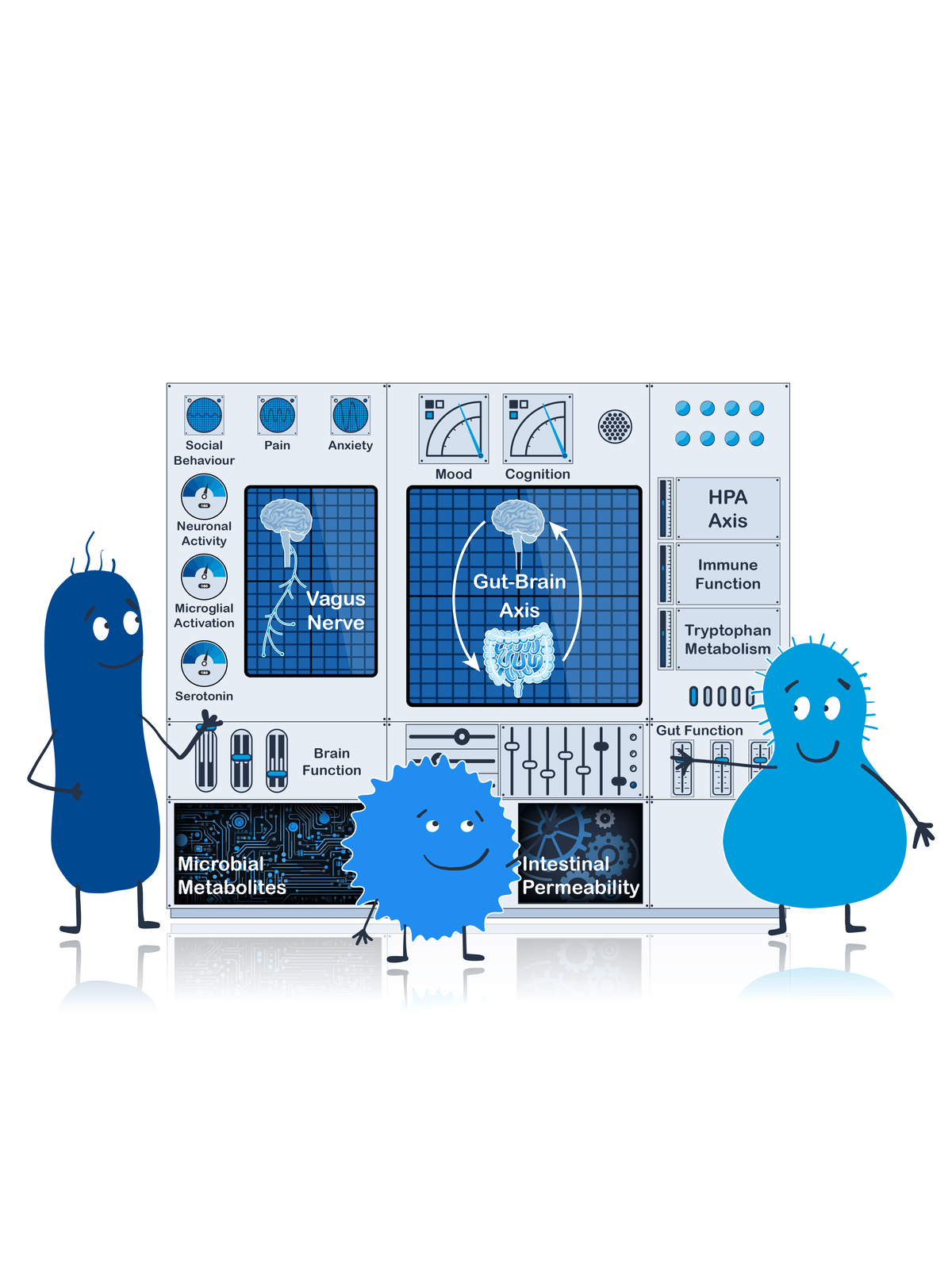
So maybe you all know about this, but you know that the GI tract and the brain are connected to a network of, signaling pathways, that all together, they are known as the gut brain system.
In the last decades, the microbiota has been studied, on its impact on this, pathway signaling, network. So we can talk about the microbiota, gut brain axis. There are studies conducted in animal models of C-section animal models that they indicate that there are, effects on the central nervous system physiology. And also it has been observed that there are, effects on the behavior when these animals are, studied in as adults.
We have also a studied in human. There are not so many data on this, but as you can see here that this is a big study from Japan. They compared more than 50,000, toddlers. They were three years old, against 12,000 C-section, born babies. As you can see, there was a higher risk for motor delay for intellectual disability and form, of autistic spectrum disorder in the children born by C-section.
You can see that only the ASD, still remains significant when it was suggested by confounding factors. But when we split, when they split, the population by gender, you can see then females remain significant, for even after adjustment of the of the value. So in females there is a higher risk of motor delay and ASD, in C-section born babies compared to vaginally born babies.
This is a study from Sweden is a huge study. More than 500,000 people, in adults. And they study their cognitive ability in this, young adult males, as you can see, there is a weak, a slight difference favoring vaginally born adults. They this, those born vaginally have a higher cognitive ability.
But this it was not confirmed. As you can see, when the study was performed only on those who were brothers. And the sibling study this this was not confirmed so there is a slight a weak association between both, between both situations.
Okay. Last question. You have to choose the correct option so;
C-section is associated with higher risk of food allergy.
C-section is associated with lower cognitive ability.
C-section is associated with higher risk of obesity.
Or all of them are correct.
We went to a 96%. Let's move to 100% now. When?
Okay. Thank you so much. Thank you sir. Oh 94 okay. It's a pity. So no more questions. You cannot reach 100%.
So, is it possible to restore this? This balance that is induced by the C-section? Well, maybe we have some options and most of them will be covered in the next, lecture so, I'm just going to underline some just only, few words about this.
So we have the opportunity to, induce by probiotics, for example, or prebiotics. We can do, breastfeeding and we can, introduce maternal microbes in the gut, of the infant. So this is called vaginal seeding or maternal fecal microbiota transplantation. So this is has been done. So, even it appears on the lay press that, could be possible to use mothers’ microbes to, to protect caesarean babies.
And this has been this has been done. So that's the logic under this if you know that vaginally delivered vaginal delivery will put the child on a healthy microbiome and will have a baseline risk, and C-section delivery will induce dysbiosis and will get, higher risk of immune. If we restore this with vaginal maternal microbes, maybe we can balance this and we low the risk of this immunity.
And if you think that, maybe, mums gut microbes are more important in the establishment of the infant's microbiota than vaginally. Why not using fecal maternal microbes? So this is a small study. It's the only I know, seven infants. They used a dilute fecal sample from the, mothers taking three weeks prior to delivery and it was given to the babies.
And as you can see in the in the slide, well, those C-section births who underwent a maternal fecal transplant, they get, microbiota closer to the those boys that were, vaginally born. So just a couple of slides talking about, breast milk. You all know that breast milk is a symbiotic breast milk has its own microbiota, they it contains plenty of bacteria that will come from the maternal gut and also from the breast skin of the mom, also from the infant, mouth that will go back into the into the breast.
And they will appear in the, in the milk. Also, breast milk has, oligosaccharides that will act as a prebiotic. So there's a symbiotic, synergistic effect. You have probiotics symbiotic all together in the same, in the same, product. So this will be important. And this is even more important if the child is C-section born. You can see in this study, again, I don't have a pointer, you have to follow me. Those children that are vaginally birth, the content of their microbiota comes mainly from the mom's feces, from the moms gut, and from the mom's vagina. This is the two big circles on the upper right panel. But in C-section babies, the main component of the main determinant of the component of the microbiota is breastfeeding.
As you compare much higher than vaginally born, babies. So these are my take home messages. The neonatal period is key for the development of a healthy microbiota with a heavy impact on future health status. C-section is a lifesaving procedure, sometimes excessively indicated, that induces important changes in gut microbiota composition, low beneficial and elevated potentially pathogenic bacteria with important implications in future health obesity, allergy, infections, neurodevelopment, and so on. And there are several options to improve microbiota composition. But to date, the encouragement of breastfeeding in C-section born infants is by far the best approach. And please remember, with a vaginal birth, you get your first probiotics. And thank you so much.
.webp?width=1200&quality=75&auto=webp)