The Role of the Microbiome in Early Life Health and Disease
The critical role of the microbiome in early life health and disease is discussed by Dr. Siobhan O'Mahony. Gain knowledge on how gut microbiota influences infant development, immune function, and the potential long-term impact on conditions such as allergies and gastrointestinal disorders.
This presentation was delivered at MJNI’s 2024 Global Nutrition Summit by Dr. Siobhan O’Mahony, PhD. Researcher in Microbiome, Women’s Health at University of Cork.
Narrator:
Welcoming doctor Siobhain O'Mahony, a highly regarded researcher in microbiome and women's health from University College Cork, Ireland. Her work investigates the impact on neurodevelopment in children, stress related disorders and cognition, with a particular interest on how these outcomes may be improved through manipulation of the gut microbiota. Additionally, doctor O'Mahony explores women's health issues such as stress and diet and endometriosis, menopause and pregnancy.
Please welcome Doctor O'Mahony.
Doctor Siobhain O'Mahony:
So good morning everybody, and I really want to thank, the organizers and the sponsors not only for this fantastic event, but for the patience and all of you for your patience as well, for the change in, in the agenda. But I really want to thank Ben for his amazing set up. I really better do a good talk now really.
But the first two speakers were amazing and thank you so much for the change as well. So I'm a neurobiological scientist with about 20 years’ experience working on the gut microbiome. I'm absolutely blown away by the fantastic huge banners of the brain in the foyer. If anybody hasn't seen it, it's going to be like my screensaver. I absolutely love it.
So it's not only a fantastic educational event, but it's also a beautiful event as well. So let's begin. So we've heard about the microbiome, but I might take you through that story again. So we as humans now can be really viewed as holobiont. So a whole of science is discrete ecological units where like us, for example, the host, where we live in harmony with our microorganisms within and on our body.
And I suppose coming to some numbers as well, and maybe these are the important numbers some of us want to hear about. The human microbiome market really is projected to be worth about $2,000 million by the year 2027. Now, this global explosion in microbiome research really was spearheaded by the Human Microbiome Project that was initiated in the US in 2007.
Now, the gut microbiota, including the hundreds of trillion bacteria that reside within our gut. So our gut microbiota is all of the microorganisms. Okay, so they are fungi, viruses, phages, nematodes, protists. But I really focus on the bacteria within a bowel. And when we speak about prebiotics, the fibre, and probiotics, it's really the bacteria that we're talking about.
So I focus on the bacteria. So the bacteria within our bowel are essential for really important functions within our body that help us survive as humans and allow us to be well. So some of these functions include vitamin production, metabolism, hormonal regulation, immunity and also brain function as well. Now it is estimated that we have about one human cell to one bacterial cell in our body, which, if you think about it, is actually enormous.
But when we look at the genome, so the word microbiome, as we heard eloquently from Benjamin earlier is the microbiota. So the microorganisms, what they actually produce, they can produce neurotransmitters. They can produce short chain fatty acids. They can produce cytokines. But it's also they have genetic components as well as cells just like us. And the bacterial genome, which is the microbiome as well encompassed within the microbiome, is a 150 fold greater than our human genome.
Giving you an idea of the power these bacteria have over our body and our brain. So we've, a microbiome is different and it changes. We've heard about it in early life, but it also changes across our lifespan as well. Now it's also different between the sexes. And that's really what I study as well, is the difference between brains and also the gut microbiota between men and women.
And then all of the bits in between. So a gut microbiota changes across our lifespan and is different between the sexes at those different stages as well of life. And this is really because there is a bidirectional communication between our sex hormones. So testosterone, estrogen, progesterone and our gut microbiota a gut bacteria, they actually have the bacteria actually have receptors for the hormones on them to actually allow them to be activated or deactivated or to produce a substance when a hormone comes in contact.
There's also machinery within the bacteria of our bowel that allows them to metabolize hormones as well, to allow the hormones to go back into our body, for example. Okay. Now, in very early life, in utero, for example, as we can see here in utero, the impact of the mother can affect, of course, the growth of the baby, all parts of the baby, including the bowel of the baby.
So studies have shown that stress, for example, affects the maternal gut microbiome and vaginal microbiome. And since these produce metabolites that can impact on the baby's growth, including the gut, it has been shown that certain metabolites are associated with changes or maybe a suboptimal development of the baby's bowel in utero, leading to then suboptimal colonization of the baby's bowel.
For example, in the postnatal period. Of course, the very early stages of life are really a dynamic stage where we see huge fluctuations in normal, healthy, breastfed, bottle fed babies, even when they're compared to each other, when they seem to be in a very homogeneous population, or gathering same culture, same birth mode, same feeding mode. Babies can be still very different to each other.
Okay? And this is just because it's dynamic nature. And each and each individual baby can be different to each other. But what we do tend to see in very early life as well is that this baby girls, baby girls tend to have higher levels of lactobacillus and bifidobacteria in their bowel than baby boys, and these are healthy babies.
And we know that certain neurological disorders, such as ASD, for example, or schizophrenia, are more prevalent in boys and girls, for example. Potentially it's the early protection of these probiotics in the bowel of the baby girl. Now, longitudinal studies have not been carried out of this sort, but this is hypothetical. As we age, then, of course, we see changes in our hormones that affect our bowel, our girls’ bacteria as well.
And especially during puberty, there's this huge shift in gut microbiota as we see a huge shift in the hormones as well. As we tend towards menopause, women's microbiota within their bowel tends to resemble that of a man, and this is because it's no longer receiving the more fuller or higher level influence of estrogen and progesterone. Also importantly as well, and as a neuroscientist, I'm interested in brain or brain development across the life stages as well.
And there are differences in how babies brain develops. Whether you're a boy or a girl. And also as well. This leads to differential behavior between the two sexes as well. Now we've heard about different modes or different, different impacts on which microbiome take up residence within the bowel of the baby. And this starts in utero. And not necessarily that there's microbes in utero, because this is very controversial at this time.
And one of my colleagues has written a paper Jens Walter on the fact that there is no microbes in utero. But again, there is there is some studies to show that there potentially is. But in essence, there are still factors during pregnancy, such as maternal health, maternal metabolism, of course, maternal diet, the changes and impacts, and maternal gut microbiota, which we know produces substances that can impact on the placenta and also the baby as well.
Now, of course, mode of feeding, as we've heard very eloquently as well, whether a baby is formula fed or breastfed really does impact hugely on the gut microbiome. And one of the really amazing components of breast milk is human milk oligosaccharides. And these are fibers or sugars, basically, that are in breast milk solely to feed bifidobacteria in the bowel of the baby.
And studies have shown the bifidobacteria infantis, for example, in very early life, is extremely important for the development of the stress system or the coping system. Now mode of delivery, whether C-section or vaginally born, do have of course have a different gut microbiota as well. And C-section born babies are shown to have a differential microbiome up until about three years of age.
But on the plus side, breastfed C-section born babies then tend to have a microbiome very similar to their vaginal counterparts. For example. Of course, introducing solid food makes an enormous impact on the gut microbiome as well. Now, again, as Ben alluded to as well, it's not just the early phases of life that we need to think about. Our microbiome.
We all need to appreciate that the microbiome within our bowel is affected daily on a regular basis, whether it's from antibiotic exposures, from infections, for example, where you live in the world, if you live in the countryside or the city, for example, and also your dietary habits and exercise impacts hugely on your gut microbiome. Now, this is a really eloquent study that was carried out looking at, mothers and infants and the similarity between mothers and infants, for example, and their infants, for example.
And of course, vaginally born babies had a much more similar microbiota profile to their moms than the C-section born babies. And this was a study that really wanted to find when maturation of the gut microbiome occurred and what actually was driving this maturation towards the baby, being able to deal with different nutrients being consumed and all sorts of different components
And they found that it wasn't actually solid food, it wasn't actually solid food that drove the maturation, but it was actually the cessation of breastfeeding. Again, giving you the concept, of course, that breastfeeding is the best for the gut microbiome and also for the brain as well, where possible. Of course. So I've spoken about nutrition. Maternal nutrition is extremely important and infant nutrition are extremely important.
And they feed of course, the microbiome and are going to allow for the optimum microbiome to actually take up residence. So these two interact. And this is a well known phenomena of course. We can't just leave out another enormous factor. And this is the epigenome. So we do need to appreciate that environmental factors as well the human genome, but also other factors that where I've just mentioned where we live, also stressors, antibiotics and so on.
Impact on nutrition elements but also impact on the microbiome. So when we talk about the growth, the microbiome and different factors, we need to think about these three enormous elements and how they work together to ultimately lead to increase or decrease risk of disease in childhood. Now, there are several disorders now that have been associated with an altered or suboptimal microbiome.
And those of course, as well, there may be easier to grasp our gastrointestinal disorders, such as irritable bowel syndrome in children or inflammatory bowel disease, as well as which can also occur in children as well. We've heard about the association really nicely between allergic disease and of course an altered gut microbiome as well. And then how we can harness the microbiome and actually target it to reduce the risk of allergic disease and reduce immune response as well.
There's also altered microbiome studies showing also studies showing altered microbiome in central nervous system disorders such as autism, ADHD, attention deficit hyperactivity disorder, also depression and anxiety not so much in children, but more in adulthood. Really obesity as well. And metabolic disorders, sometimes seen as a central nervous system disorder, is also associated with an altered microbiome. So I'll go through three of these disorders, ASD, obesity and a little bit of allergic disease.
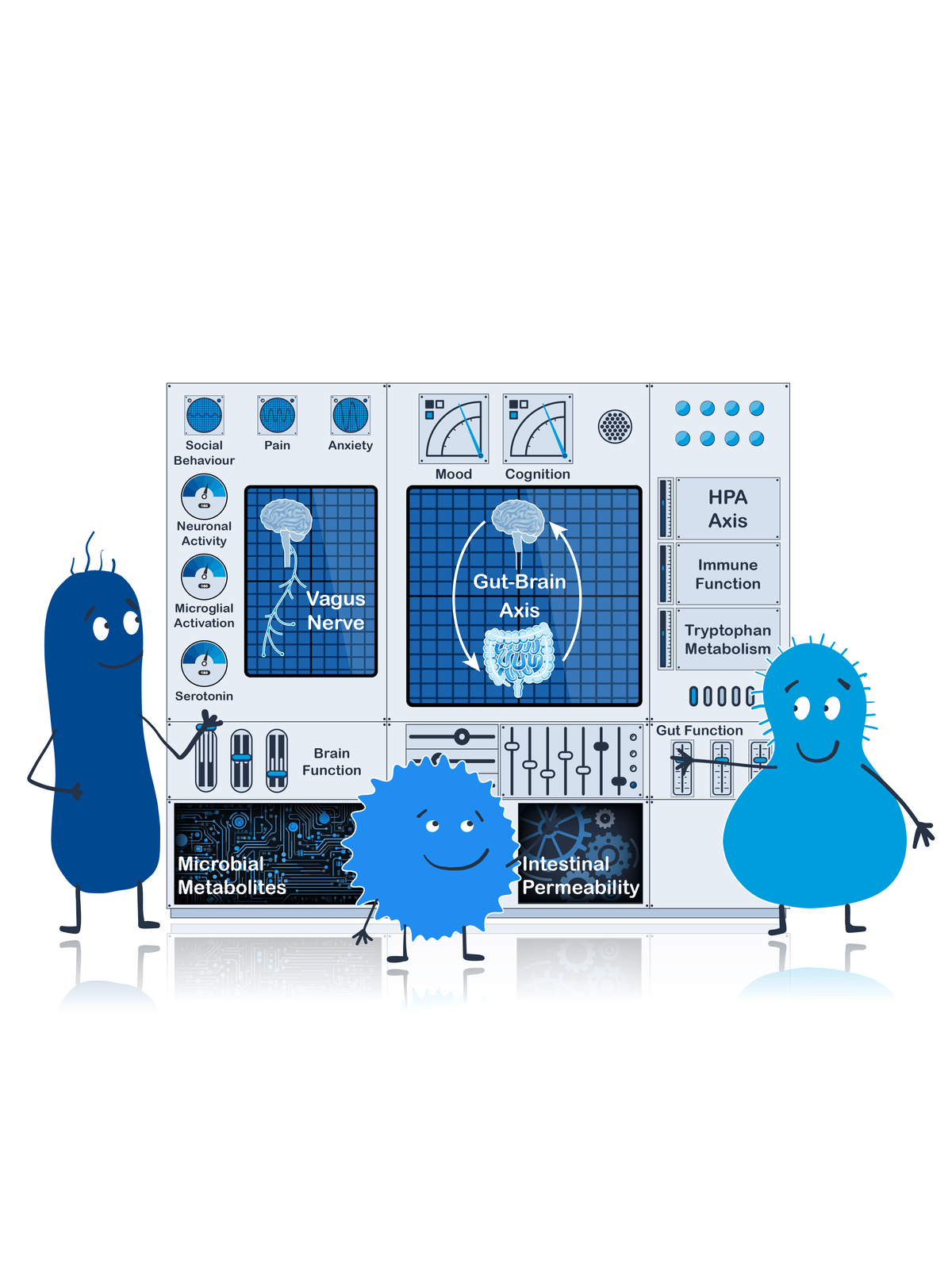
But of course we've heard quite a nice a nice introduction to those as well. So this is what I've studied really for the last 20 years. When I talk about the gut microbiome and its influence in the brain. So there is this access this referred to as the microbiome-gut-brain axis. And it's a bidirectional communication highway that allows our bacteria in our gut and everything they produce.
The neurotransmitters and neuropeptides, all of the cytokines, for example, that they actually produce an impact on the brain. So the three main pathways that this can occur, it can occur either directly via the vagus nerve, which is a direct nervous communication between the bowel and the central nervous system. It can happen via your stress system or your hormonal system, which the hypothalamic pituitary adrenal axis, the adrenal glands is on top of your kidneys, and then also the immune system as well.
So our microbiota is able to produce substances that affect these three main systems and impact on the development of the brain, but also your functioning of your brain on a daily basis as well, vice versa. Then, if we think of the other direction, if we suffer from psychological stress, depression, anxiety, we know that our bowel is probably not feeling that well.
Or when we suffer from psychological stress, even just on a very acute basis, we might get a bit of bloating, a bit of constipation, diarrhea. So your psychological well-being also impacts on your bowel. So this is your bidirectional communication pathway. Now of course proper nutrition is crucial for optimal brain development. And we've heard about the first 1000 days of life.
And as a neuroscientist, I suppose they're amazing dynamic changes to the central nervous system during this period in the prenatal. So during pregnancy and in the very early postnatal period. So really, without going into too much neuroscience talk, some of the elements and crucial developmental events that occur include the development of neurons. So neurogenesis occurs. Sign up to Genesis when these neurons actually come together and send signals from one to the other, from one part of the brain to the other, also pruning.
So when, a baby interacts with different events in life in this early postnatal period, it actually reduces some of those connections between the neurons in its brain as well. To actually show is when to allow the environmental factors to influence, of course, brain development, including your microbiome, and your nutrition as well. Of course, not just actual physical interactions.
So when we talk about brain development and nutrition, the most important factors from our diet include lipids, minerals and vitamins and amino acids. I won't go into an enormous amount of detail, but there is a lot of studies looking at micronutrients and specific vitamins and minerals and how the brain optimally develops as well. Going back to breast milk.
So there is, as we've mentioned, of course, as human milk oligosaccharides, which feed the microbiome, but there's also elements as well. And we've heard yesterday MFGM, milk fat globulin membrane, which intriguingly is the membrane that sits outside the fat globule or the fat, the lipid globule in breast milk. And we and others have shown, I have shown in animal studies, but it's also been shown in human studies, and it's also been applied to infant formula as well that this component, MFGM or milk fat globulin membrane has a positive impact on the microbiome, but a really positive impact also on the central nervous system, including the stress system.
So in a stressed animal model, for example, administered MFGM. During early life, it was able to reduce the impact of stress and reduce the stress response to allow the actual animal to grow up in a healthy coping strategy. I've mentioned that microbiota targeted supplements, infant formulations. They include also HMOs, for example, MFGM, but they also include prebiotics.
Human milk oligosaccharides are prebiotics. These are fibers that feed good bacteria, the probiotics. But you can consume fiber on a daily basis. And I'm sure you all do. Irish people are actually the worst at consuming, I’m Irish. Actually, the worst probably in the world are consuming the correct amount of fiber. I'm not really sure why, but fiber is hugely important.
And excuse me if there's one thing I can tell you all to take away from today is increase your fiber intake, because that will absolutely feed the gut bacteria in your bowel. But there is also specific prebiotics, such as fructooligosaccharide, and galacto-oligosaccharides, that are also added to infant formulas in order to improve their composition, to make them more similar to breast milk.
I don't believe we'll ever get to the actual, complexity of breast milk and to be able to recapitulate in an infant formula, but there is efforts to try and try and do that. And of course, we know as well that there is major bidirectional interactions between a microbiome and nutrients, particularly in early life, to influence brain development.
So autism spectrum disorder is on the rise in Ireland it’s about 1% of likelihood of children being diagnosed with autism. Now, it could potentially be on the rise because we have more awareness of autism and also we have improved diagnostic criteria. Still, the diagnostic criteria and early intervention are not there and they're not good enough at the moment, especially in Europe.
Children might be not diagnosed up until about nine years of age again, depending on the severity, because it's a spectrum. So children may be anywhere along the spectrum and it may take longer to actually, diagnose a child with ASD. But again, the sooner a child is diagnosed, the sooner they can receive early intervention and be happy and healthy.
So with autism, there is a number, an enormous number of genes have actually been defined. And this group, the Simons Foundation Autism Research Institute, have listed about a thousand genes that have been linked to autism. They've also of course, we can't. We can't. And we've talked about the epigenome as well. We can't actually exclude and forget about the environmental factors.
So specific environmental factors such as advanced maternal age, maternal obesity, maternal gastrointestinal issues or disorders, but also maternal immune activation, particularly in the first trimester of pregnancy, have also been linked to autism. And intriguingly as well, women were, I suppose, studied that had maternal immune activation or infections during the first trimester of pregnancy. And those women that consumed paracetamol
And I know that we should consume as little drugs or medication as possible during pregnancy. But those mothers in this study that consumed paracetamol to reduce their temperature had less likelihood to have a child with autism. So it may not be the actual infectious agent during the first trimester, but it may actually be the actual temperature that the mother actually goes through.
Now, when we go to and talk about autism, and I'm sure somebody in the audience knows some autistic children, we know there is extremely restrictive behavior in subsets of these individuals. That means that they may only want to eat, And my nephew is autistic, may only want to eat white food, for example, for a certain number of time.
Then they might change to brown food, for example. Or they might just want to eat sausages or chicken burgers or something. And they do consume really healthy food as well. But what we all need to do is not only consume fiber, we also need to eat lots of different foods because different fibers feed different types of bacteria within our bowel.
And we've heard about diversity. Diversity is the different types of bacteria within your bowel. On one of those TV shows that was trying to, I suppose, talk about the microbiome in layman's terms, but I actually still use it. So I think, look, it's for any type of audience. They described the way you would the optimal gut diversity is a field, for example, with lots of different types of flowers.
So you want in your bowel, you want lots of different types of bacteria because they're just like us. They're community thrivers. They're social interactors they actually want to have another bacteria that helps them strive and thrive in your gut. So not feeding your, your bowel or your gut back to your bacteria within your bowels was different types of foods or fibers will mean that you will have a less diverse or decreased microbiome.
Diversity and decreased are lesser numbers of different types of different bacteria are associated with different disorders and are seen in these children. But it's not a surprise they're restricting their food intake as well. But it is, again, because we know there is a link between the brain and the gut, and the gut microbiome really allows the brain to thrive at your age as well.
At all our ages, we do know that this dysbiosis or this altered microbiome driven by the restrictive food does lead to an altered signaling pathways. Then between the, the, the gut-brain axis, we also tend to see more inflamed central nervous system cytokines, less, numbers of short chain fatty acids which are produced by your bacteria in your bowel.
Also neurotransmitters. We know our bacteria produces neurotransmitters. So if there's decreased number of bacteria, there's going to be a decreased and lesser level of neurotransmitters. Gut permeability is something that's extremely important as well. So all of our bowels in a healthy situation are really there are tube essentially. But what they are is a really nicely tight and knitted together.
So we don't want them leaky for example. So in situations where we have an altered microbiome, we tend, or stress, we tend to have a more leaky gut, which means that more inflammatory factors can circulate. So this can all exacerbate ASD. And we don't expect it to read the table. But I do want you to know that there are intervention studies targeting the microbiome for ASD that have showed improved central nervous system functioning, improved sleep, and also improved behavior in these children.
And the theory behind it is that it improves gut permeability, so reduces it, reduces circulating inflammation of inflammation and also inflammation within the central nervous system. Now an enormous epidemic of course is occurring around the world. It's enormous in Ireland. I don't think there's certain countries that are lesser, exposed to this than our country in Ireland.
But, nevertheless, childhood obesity is now one of the biggest problems and serious global health conditions that we actually need to address. So of course there are going to be concomitant, disorders associated with obesity, diabetes, type two fatty liver disease, which can progress then into adulthood. Now, some studies have shown that there is this increased
Firmicutes/Bacteroidetes ratio in obese adults, that this is difficult to apply to children because it's a more dynamic phase, so it can't yet be applied to obese children.
But there have been studies as well showing that there are specific bacteria in obese children versus non obese children that may predict outcomes and may allow that child then to be introduced into an intervention program, for example, probiotic or prebiotic intervention strategy that reduces the continued risk of obesity. This is a really eloquent study where they took children, 30 or 30 children that had normal weight and 30 children that were obese, and they looked at different lifestyle factors and their oral and gut microbiome.
And they found the microbiome of the obese children was distinctively different to those normal weight children. So probiotic clinical trials do need further validation. But we do need to have more baseline work in children as we go forward in normal, healthy children to be able to see what is normal and then what is actually a deviation from this.
So we've heard a really nice, eloquent story from the two speakers before me about a topic disease in the microbiome. So I won't go into this in a lot of detail. So we know what a topic, disorders are. But basically the human milk or human microbiome, a human milk, breast milk has been shown to be able to, as we heard, reduce the incidence and reduce the impact and severity of atopic disease as well.
And this is really linked to the gut microbiome and the breast milk feeding those bifidobacteria. Again, because we know there's a higher abundance of bifidobacteria in breastfed infants. And these are very much the type of bacteria that reduce your inflammatory response. So these are the types of targeted interventions that we can work on. And some people are working on these around the world looking at how we can use these interventions to actually target childhood disorders associated with the microbiome.
And these include live biotherapeutic products. And these are, excuse me, live bacteria, for example. Of course, we can easily think about changing our diet. It's not easy to change somebody's diet and that includes children as well. But it is something that is easy to devise and easy to actually work out. But it is hard to change a diet.
And even when we change our diet in adults, there haven't been studies in children yet showing this. But in adults, if you change your diet, it still might take three months for that microbiota to stick. Your microbiota will change over a week, but if you stop that diet, then it'll revert right back to your previous microbiome. So you do need to stick to a diet for three months for it actually to have a long term impact on your health.
Of course, probiotics we've mentioned there are can be engineered bacteria as well to reduce the inflammation, and to reduce the incidence of certain disorders as well. Fecal microbiota transplantation is being used for certain disorders. Clostridium difficile is one of those disorders that has had, life threatening outcomes. And this is where FMT was first used. But now it's been proposed that it might be used for childhood microbiota altered disorders as well.
So just take home messages. And I work a lot and have previously worked a lot on animal studies. And now they can be very valuable platforms. But we do need to and they are evolving, with regard to how we be able to translate them to human studies, there is still a real challenge. We think about trying to recapitulate the human genome with regard to the animal genome.
And when we try to correlate some of the structural functional outcomes as well, there are limitations. But they do have their qualities as well to allow us to test interventions initially. But really what we want to see is we want to see baseline data. We need to see data on normal, healthy adults, normal, healthy children as well, to actually be able to inform what is an altered microbiome.
We still don't have that data yet. So really defining directionality of cause and effect in large studies would really provide unprecedented opportunities for generating hypotheses that we can test in. Humans are in experimental models to be able to improve outcomes for children. With that, I thank you.
.webp?width=1200&quality=75&auto=webp)