
Discover how complementary feeding shapes the diversity and richness of the developing gut microbiome, influenced by early-life factors like delivery mode, breastfeeding, and timing of solids. Illustrated through impactful case studies, this presentation highlights the weaning reaction, risks of delayed microbiota development, and how tailored feeding strategies can support long-term immune, metabolic, and cognitive health.
This presentation is by Dr. Ericka Montijo, Pediatric Gastroenterology and Nutrition at Instituto Nacional de Pediatría, Mexico.
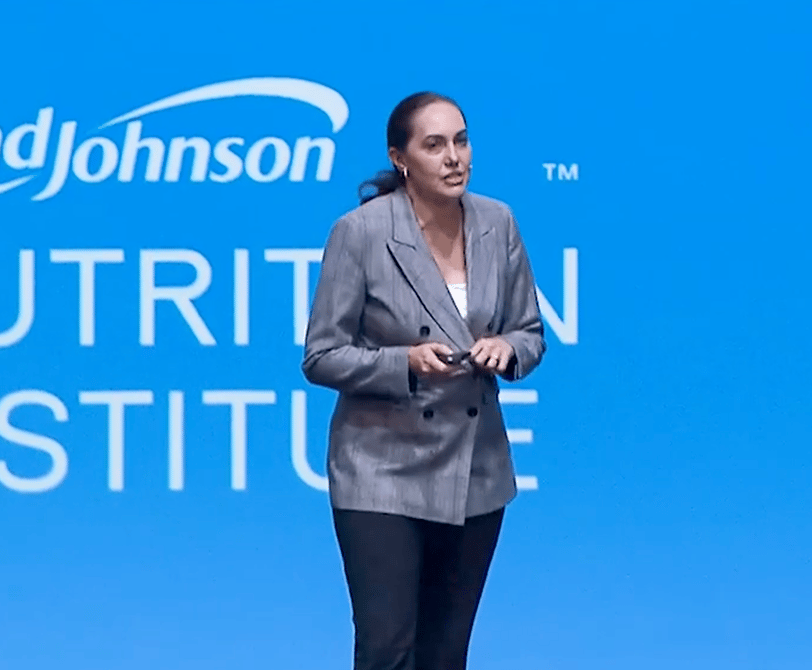
Narrator:
Welcoming Doctor Ericka Montijo, a distinguished pediatric gastroenterologist based in Mexico City, affiliated with the Institute Nacional de Pediatria. Doctor Montejo holds master's degrees in medical sciences and child nutrition, which she obtained at the Universidad Nacional Autonoma de México. She has an advanced specialty in gastrointestinal endoscopy. She is the coordinator of the Pediatric Gastroenterology Committee in México Asociación Mexicana de Gastroenterología and Professor of Fellowship in Gastroenterology and Nutrition, Universidad Nacional Autonoma de México. Doctor Montijo is an editor for the Journal of Pediatric Gastroenterology and Nutrition, and serves on the North American Society for Pediatric Gastroenterology, Hepatology and Nutrition Ethics Committee. She is the gastroenterology coordinator at the La Sociedad Latinoamericana de Gastroenterología, Hepatología y Nutrición Pediátrica. Please welcome Doctor Montijo.
Dr. Ericka Montijo:
Hola, Hola. Hello everyone. I'm really happy to be here and I really want to thanks for the invitation to the organiser of this summit. So, well, we are going to start with one of the most fascinating topics that I think is complementary feeding and microbiome impact. So let me show you these are babies. All of them are beautiful, from different countries, are doing different things, but they have something in common. What do you think they have in common?
They are initiating complementary feeding. So it's very interesting to say that complementary feeding is to introduce solid and semi-solids. And of course, that's why we are saying is that World Health Organization (WHO) define it like they providing foods in addition to milk, when breast milk or formula is not enough to maintain the nutritional requirements. They say that they you have to do it at 6 months if you want it, you kind of scan the QR and you can check the WHO recommendation.
And of course, in all cases, complementary feeding represents a key shift in diet and microbial exposure. Even we are seeing global differences in complementary feeding initiation all around the world. For example, in Latin American where I am, we use traditional homemade foods. And what we are saying not all the physical doctors need to adherence to the guides, but we have to connect, we have to combine well, our customs, our traditions today is specifically a recommendation. For example, in Mexico, well there was a question before, that we have a population that were very deficient in iron and zinc. So that's why recommendations say that we have to initiate it with meat, with red meats, for example, to maintain or to obtain more about this micronutrient.
But going on that complementary feeding has to be a healthy eating patients. So we have to guide a taste education. And of course, we have to engage the entire family in supporting good nutrition. For this I want to introduce Chris. Chris is a patient, that baby born by C-section in a large urban hospital. He was exclusively formula fed due to maternal medical issues. So, he's 6 months age, his parents were coming today to the hospital, and they say that they want to delay complementary feeding until anymore because they are very afraid about allergens. Over the next year experienced recurrent wheezing and eczema. And by the age of 3, he was diagnosed with multiple food allergies and atopic dermatitis.
So what went wrong? We have to think about this. We have to say that was the timing or quality of the complementary feeding was a factor in him. Or maybe, early microbial exposure have influenced his immune development. How could we intervene differently to promote long term health?
This is another baby. It's Bayani. Bayani is a baby girl born in a rural village. She was born at term, but now delivery and breastfeed exclusively. Due to limited food access, she and her family delay the introduction of solid foods until 9 months. Her first complementary solid food was until 9 months and it was a porridge and tea. Of course, at 12 months she was underweight with low length-for-age and frequent infections and delayed motor development.
What does this patient tell us? Well, I think that how does food insecurity and like complementary feeding affect microbiota. Could early microbial diversity help protect her immune system and support growth? And how critical is the weaning window for long-term metabolic and immune programming. Well, all of these we can respond with the first thousand days.
We are listening before that the importance of the diversification of microbiota is so important. For example, in pregnancy, we know that we are going to colonize at delivery. Then we have the breastfeeding and then we have a very important moment of that is complementary feeding. It's from 6 [months] to 2 years. It's a lot of time to show diverse food for the babies.
So that we know it's an early microbial colonization shaped immune, metabolic and cognitive development. And this is very important. Thus, we are connecting the investigators say, the researchers say, the scientific say, to the clinical practice and why we need that because we need the mature microbiota. And the question is what is a mature microbiota? Well, it's about richness or its about evenness or maybe composition or stability.
Well, all of them are very important. We have to have an equilibrium. We have to have a resilience in microbiota. And now I'm going to ask you if you can take your phones, please and please answer this question. At what stage of life does the greatest increase in gut microbiota diversity typically occur, during exclusively breastfeeding, at the introduction of complementary feeding, maybe at birth, after 2 years of age. Please show us, we are people from all the world, so we can see what happened in almost all the world.
Perfect. So of course, almost all the phases are so important in life, but probably the introduction of complementary feeding is going to be one of the most important because we have a lot of different foods that we are going to show to the gut mucosa and that one affects the immune system.
So here we have again the phases that we listened before for example the new one. Look at the differences between when you are vaginal delivery or when it was a C-section delivery. They are so different. Then we have breastfeeding of course, or formula feeding. And they have other differences to. Look at the breastfeeding baby, who has a lot of Bifidobacterium there. And then we have weaning.
Weaning is one of the most diverse or the most important part, because some of the consensus say that is that the introduction of complementary foods increases microbial diversity and reduce the abundance of some of the taxa. For example, the Bifidobacterium, because it was very good in one moment. So they have to go down to maintain the equilibrium of the resilience of microbiota. So that's why they say that complementary feeding is an explosion, is the most diverse moment to have a new differences in that. That's why some articles say that the weaning reaction, this is the explosion that I was mentioned, to Microbiota is required for resistance to immunopathology's in the adult.
This is what's shown in learning tools. So I want to just to refer that if you can look the first part of the picture, you can see the flatline. And then in blue there is going to be a big mountain that say that explosion that we are expressing before. So the weaning reaction is a crucial immunologic event during the transition to solid foods.
Proper activation during this window of opportunity supports long term immune health. Of course, if we have a disruption or we have an inhibition of that, well, we can lead to abnormal immune imprinting or increased susceptibility to inflammatory diseases, allergic event and even cancer. So we have to know that development of the microbiota in infants and its role in maturation of the gut mucosa and the immune system is going all about time.
In the picture, we can say that the prenatal phase If you can see there is not a lot of immune cells. And then for example, in postnatal, in infants and in childhood, we are seeing that is increasing this time. And we have a lot of system of immune cells. So that's why the gut microbiota promotes Ig A production which plays a key role in mucosal immunity. So it also regulates the expansion of regulatory T cells essential for maintaining immune balance. Early life exposure to diverse microbiota helps to establish immune tolerance. And of course, we said that it aids against inflammatory and earlier allergic diseases in life.
So again please help us and tell me what do you think about this question. What type of food do you usually introduce first during complementary feeding? One, its grains, 2, infant cereal, 3 fruits, 4 vegetables and 5 is going to be meats. Please tell us what happened in the world.
Wow interesting. I think it is going to be infant cereal or grains, and now I look and it is vegetables. What about meats? What we are saying about for example, we are a lot of people from Latin America. Okay. Raise the hands from Latin America, please. Okay. If you can’t see, there are a lot of people from Latin America and we are a population with very, very problems with iron and zinc. So it's supposed for the recommendations to say that we have to use meats. But there said there is a strong food and it's difficult to know if I can give to the babies. So we are going to check something about that.
For example, imagine carbohydrates and infant gut microbiota. Almost all we give to the children impact microbial. For example. Look at this table. First, we have wholegrains. Look at the differences between the microbiota and the diversity that we have when we use whole grains. But then look at the free sugars. Look for example the processed food that we sometimes give to the babies. There is very different from a high fiber cereals. Imagine what happened, for example, with fat and oils and what happened with proteins and even what happened if you use vegetable proteins or animal proteins, there are going to be a big difference too.
So it's very interesting to know that there maybe there is not a reason to use one or the other one or not. At the moment there is not research enough to say what is best to use, but what we think to do is what is better for my baby. What's better for my population? What are the needs both in micro and micronutrients from that baby?
Maybe I want to decide almost with the impact that that food maintained on microbiota. It's very interesting to know the different articles that say, for example, you have our QR here and you can read it if you want. This is a very interesting study about early introduction of allergens in babies. What is important is that from 3 months of age, the gut microbiota undergoes a major transformation in diversity and complexity.
Maturing toward a predominance of ‘adult-like’ bacteria. So as the recommendation says, we have to start different or solid foods until 4 or 6 months. But it's very interesting when you use, for example, if you see the picture, you have to see the standard introduction versus early introduction, and we can say that the diversity of the microbiota in babies who have early introduction of food. Not necessarily at 3 months, it could be at 4 or 6 months, as almost all the recommendations said. And of course, this diversification is enhanced by the introduction of allergenic foods leading to Bacteroides-rich communities by 12 months of age.
So when we return to Chris, what went wrong? Was the timing or quality of complementary feeding a factor? Well, the studies say that early introduction of allergenic foods was associated with early maturation and diversification of the gut microbiota, particularly toward Bacteroides-rich communities.
The next question was could early microbial exposure have influenced his immune development? Well, where we think that specific microbial patterns in early infancy, such as increased Clostridium or Heamophilus, were linked to atopic dermatitis and skin barrier dysfunction. So suggesting an influence on immune outcomes.
So what could be different from Chris? Well, maybe by promoting timely and the various complementary feeding that support gut microbiota maturation and considering microbiota targeted strategies to support immune and growth development, maybe Chirs can be different and maybe can be a healthy Chris.
So on the other hand, we have that gut microbiota maybe would be a promising target in the relation between complementary feeding and malnutrition. Why? Because we know that solid foods have a very important interaction with gut microbiota. And of course in healthy children, it has a lot of different resources to have better health than the other ones. But what happened with malnourished babies or the babies that are a long way from or have a failure to thrive. So in these cases, it's very important to have a proposal for that that kind of babies.
What happened with Bayani? How does food insecurity and complementary feeding affect microbiota maturation. So we know that this immaturity limits the microbiota ability to support growth, immunity and metabolic function.
There are some articles that say that microbiota direct complementary foods can help them. You have to understand that in a place with insecure feeding you have to know how many or how kind of foods you can use to help these babies. And could early microbial diversity have protected her immune system and supported growth?
Well, these studies suggest that promoting microbial diversity early can support immune and development and growth recovery. So that's why we think, or we have to think, that target complementary food will promote the establishment of beneficial bacteria taxa, improve metabolic and inflammatory profiles. So that's why maybe we can help Bayani to be a healthy girl.
Finally, we have to return, and we have to say that complementary feeding is a unique opportunity to build healthy eating patterns and guide taste education, and of course, we have to be that the home environment plays a central and important role in shaping food preferences and long-term habits.
Some take home messages. Early microbial colonization is shaped by very birth mode, breastfeeding and diet. Of course, complementary feeding at that time is very important. Introducing solid food increases gut microbiota, diversity and richness. The weaning reaction, the explosion that we are saying plays a crucial role in the immune system development. Consider each infant's feeding history (breastfeeding, formula-fed, mixed formula) and health status to guide tailored dietary recommendations. Delayed microbiota maturation may have long term negative health impacts in the babies. Be aware that delays in microbiota development, especially in malnourished, or food insecurity infants. Encourage a diverse diet rich in fiber and vegetables and fermented foods to foster a resilient microbiota during and after weaning. And of course, you have to reinforce the importance of establishing good eating habits in infancy.
As early dietary pattern influenced long term metabolic and immune health. Most importantly, you have to remember that nutritional education for family is essential in shaping lifelong eating habits. Thank you very much.


.webp?width=1200&quality=75&auto=webp)