Puntos Clave
Ashley C. Patterson, PhD
Menos del 3% de los niños pequeños estadounidenses cumplen con las recomendaciones de los expertos sobre la ingesta de DHA
Expertos internacionales recomiendan que los niños pequeños consuman entre 70 y 100 mg de ácido docosahexaenoico (DHA) al día.1,2 Sin embargo, el análisis de los datos de la Encuesta Nacional de Examen de Salud y Nutrición (NHANES) indica que la mayoría de los niños pequeños estadounidenses consumían menos de lo recomendado por los expertos, consumiendo solo alrededor del 25% de la cantidad recomendada.3,4 Se cree que la disminución del consumo se debe en parte a la transición de la leche materna o una fórmula infantil fortificada con DHA, a la leche de vaca. Se han observado deficiencias dietéticas similares en niños mayores.3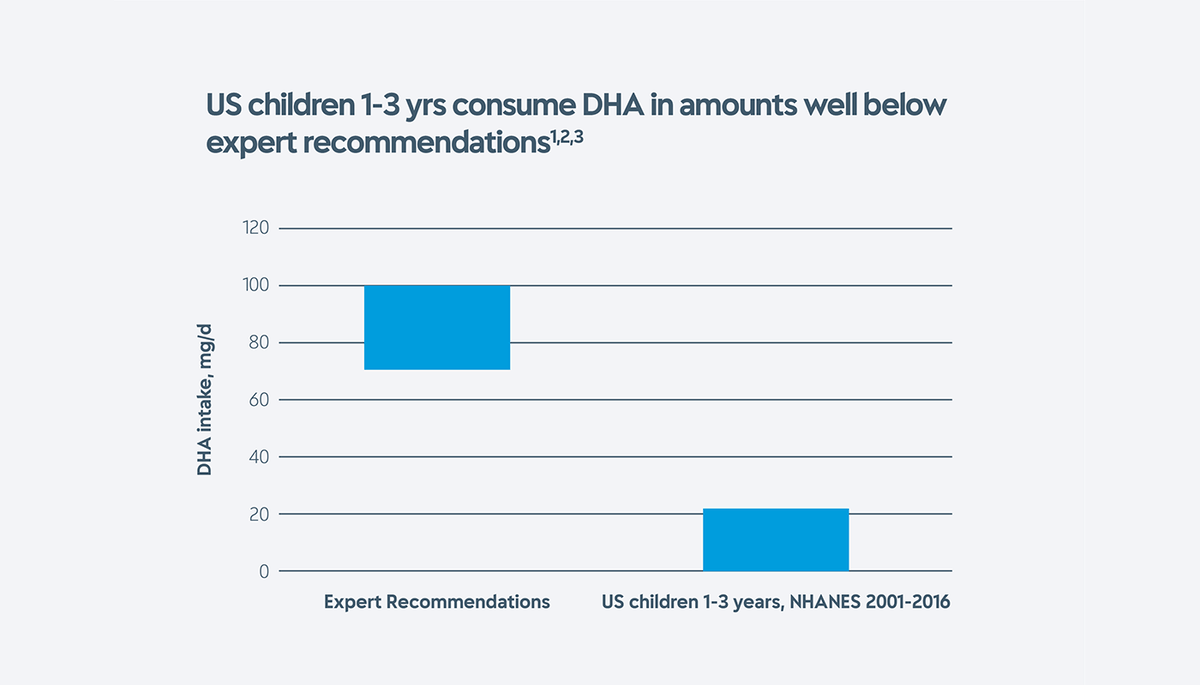
¿Cómo aumentar la ingesta de DHA de un niño pequeño?
Dado que la principal fuente de DHA es el pescado azul (p. ej., salmón, caballa, trucha), se debe animar a los niños pequeños a consumir algunas porciones a la semana.3 Algunas fuentes dietéticas conocidas de DHA se incluyen en la imagen a continuación.
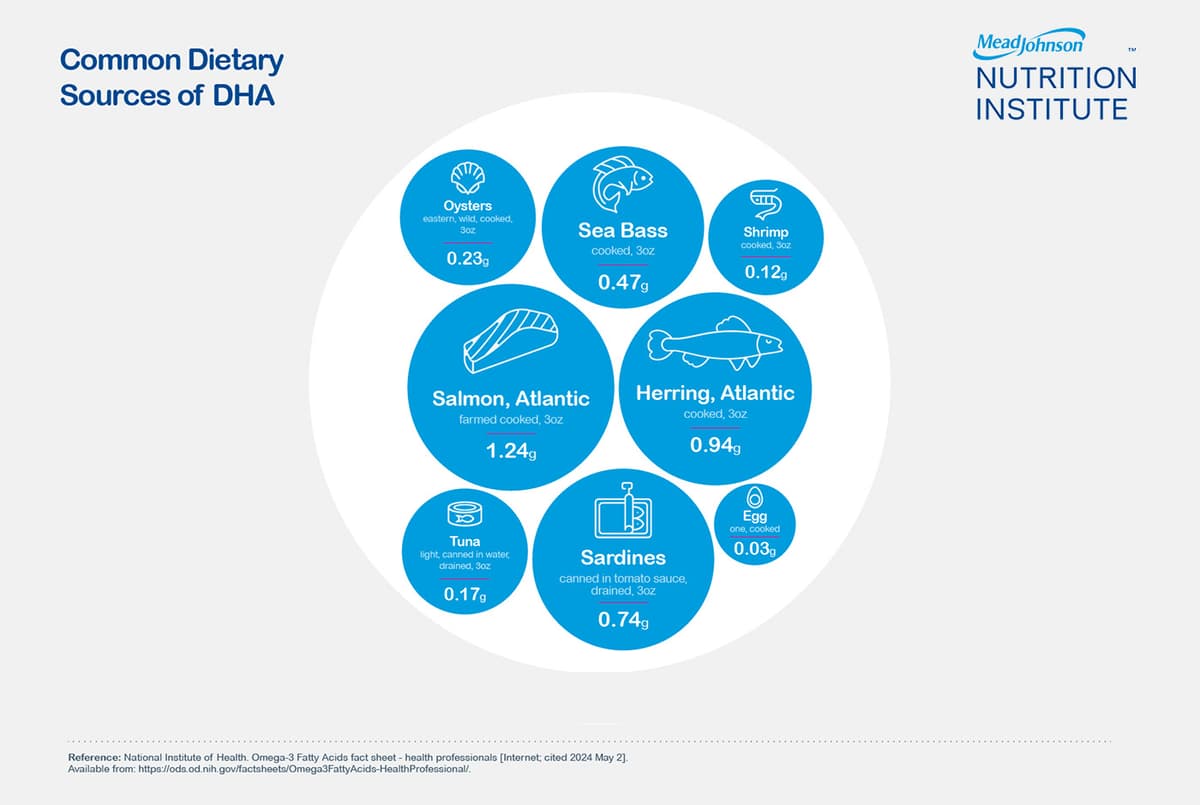
Gráfico que muestra fuentes comunes de DHA.5
El papel del DHA en el desarrollo infantil
Los primeros 1000 días de vida son una etapa importante para el desarrollo cerebral. Al nacer, el cerebro tiene aproximadamente el 25 % de su tamaño adulto y, a los tres años, ha alcanzado el 85 % de su tamaño adulto.6 Durante este período de crecimiento acelerado, el DHA se acumula rápidamente como el principal lípido estructural del sistema nervioso central.7 Un panel de expertos de la Autoridad Europea de Seguridad Alimentaria (EFSA) ha concluido que existe una relación causa-efecto entre la ingesta de DHA y el desarrollo cerebral normal. 8
El DHA no solo contribuye al desarrollo cerebral; también puede reforzar el sistema inmunitario. Influye en la composición y función de la membrana celular inmunitaria, lo que puede reducir la incidencia de enfermedades respiratorias en niños pequeños. 9 En un estudio controlado aleatorizado, los niños pequeños que consumieron una fórmula con 130 mg de DHA por ración durante 60 días presentaron una incidencia significativamente menor de enfermedades respiratorias (es decir, un 17%) en comparación con aquellos alimentados con la fórmula de control (es decir, un 46%).10
Descargue el PDF como guía rápida sobre las fuentes dietéticas de DHA.
- EFSA Panel on Dietetic Products, Nutrition, and Allergies (NDA). Scientific opinion on dietary reference values for fats, including saturated fatty acids, polyunsaturated fatty acids, monounsaturated fatty acids, trans fatty acids, and cholesterol. EFSA J. 2010, 8:1461. https://doi.org/10.2903/j.efsa.2010.1461
- AFSSA (France). Opinion of the French Food Safety Agency on the update of French population reference intakes (ANCs) for fatty acids. AFFSA-Request No. 2006-SA-0359. [Internet; cited 2024 May 10]. Available from: https://www.anses.fr/en/system/files/NUT2006sa0359EN.pdf
- Bailey A, Fulgoni III V, Shah N, Patterson A, Gutierrez-Orozco F, Mathews R, Walsh K. Nutrient intake adequacy from food and beverage intake of US children aged 1–6 years from NHANES 2001–2016. Nutrients 2021, 13(3):827. https://doi.org/10.3390/nu13030827
- Walsh K, Ye Q, Piekarz A. Dietary intake of omega-3 long-chain polyunsaturated fatty acids (n-3 LCPUFA) by US toddlers. FASEB J 2012, 26(S1). https://doi.org/10.1096/fasebj.26.1_supplement.811.6
- National Institute of Health. Omega-3 Fatty Acids fact sheet – health professionals [Internet; cited 2024 May 2]. Available from: https://ods.od.nih.gov/factsheets/Omega3FattyAcids-HealthProfessional/
- Dobbing J, Sands J. Quantitative growth and development of human brain. Arch Dis Child 1973, 48(10):757-767. https://dx.doi.org/10.1136%2Fadc.48.10.757
- Martinez M. Tissue levels of polyunsaturated fatty acids during early human development. J Pediatr 1992, 120(4):S129-S138. https://doi.org/10.1016/s0022-3476(05)81247-8
- EFSA. Scientific opinion on the substantiation of a health claim related to DHA and contribution to normal brain development pursuant to Article 14 of Regulation (EC) No 1924/2006. EFSA J 2014, 12(10):3840. https://doi.org/10.2903/j.efsa.2014.3840
- Calder P. The relationship between the fatty acid composition of immune cells and their function. Prostaglandins Leukot Essent Fatty Acids 2008, 79(3-5):101-108. https://doi.org/10.1016/j.plefa.2008.09.016
- Minns L, Kerling E, Neely M, Sullivan D, Wampler J, Harris C, Berseth C, Carlson S. Toddler formula supplemented with docosahexaenoic acid (DHA) improves DHA status and respiratory health in a randomized, double-blind, controlled trial of US children less than 3 years of age. Prostaglandins Leukot Essent Fatty Acids 2010, 82(4-6):287-293. https://doi.org/10.1016/j.plefa.2010.02.009
- Patterson, A. C. (2024, September 10). Are toddlers getting enough DHA and why does it matter? Mead Johnson Nutrition Institute. https://www.mjni.com/are-toddlers-getting-enough-dha-and-why-does-it-matter