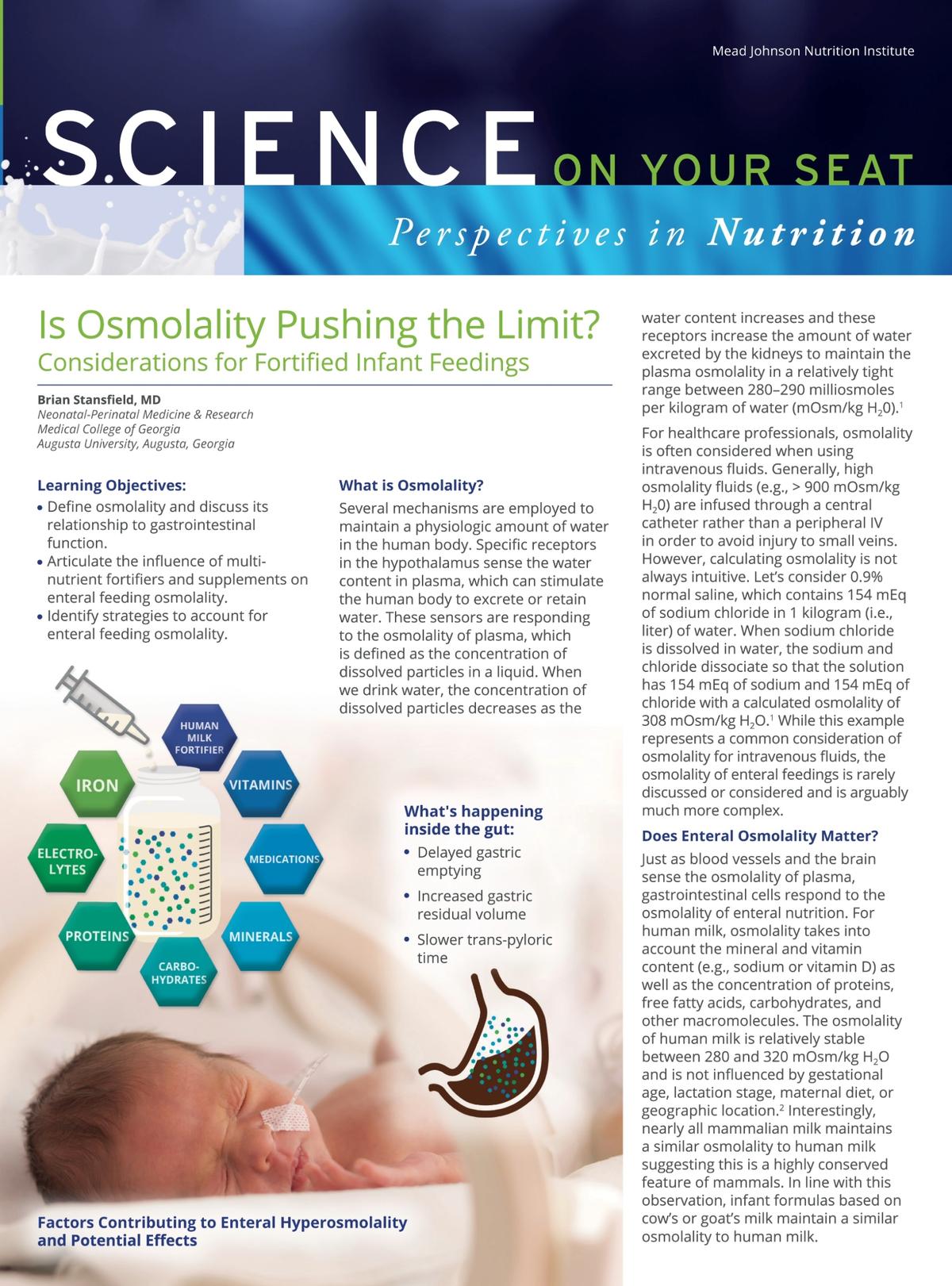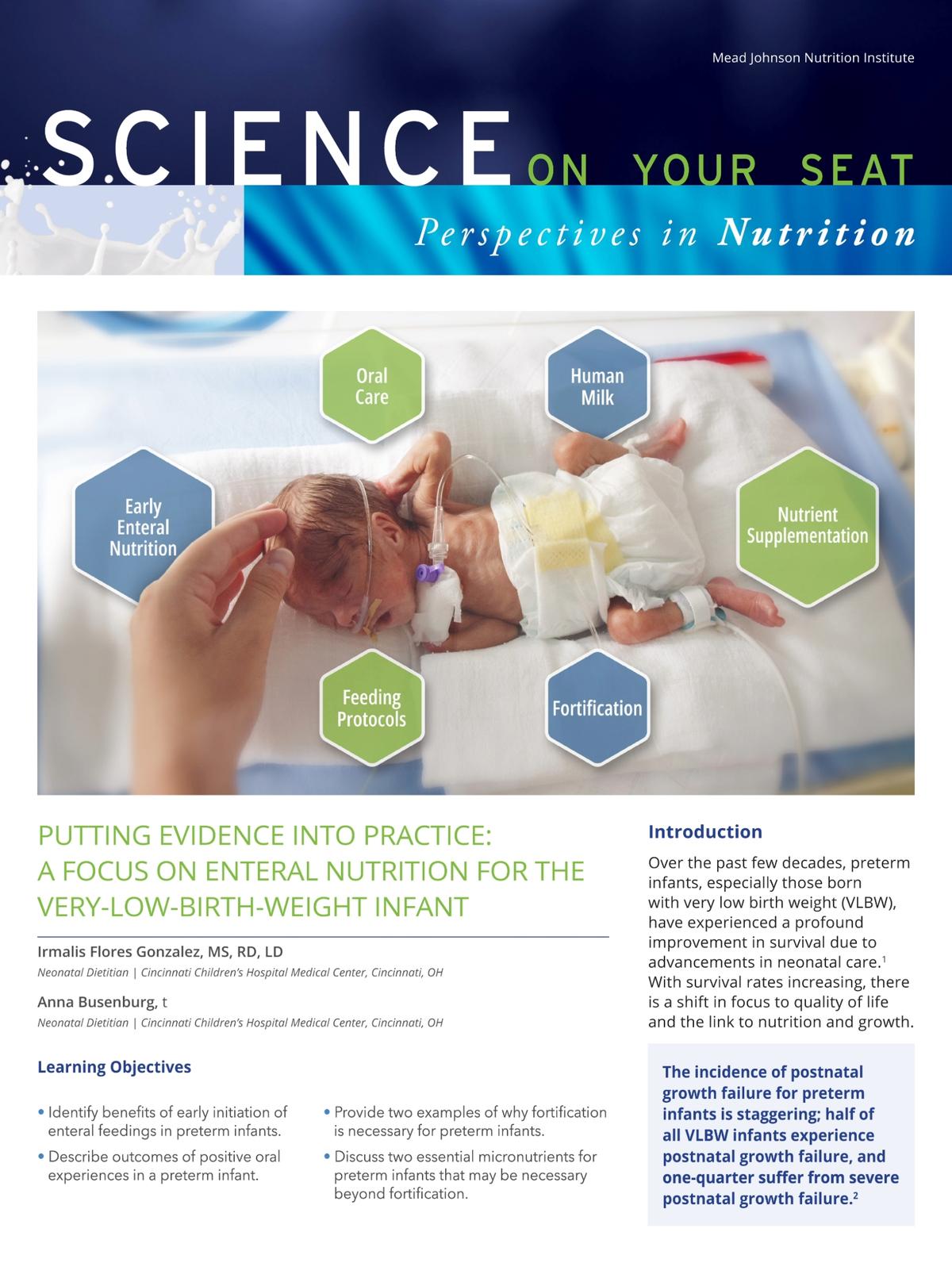
This presentation explores novel feeding strategies that support growth and better long-term outcomes in preterm infants. Growing clinical evidence support high-volume feeding and full enteral nutrition from day one in stable preterm infants - marking a shift toward more proactive, evidence-based nutritional care.
This presentation is by Dr. Ariel Salas, attending neonatologist at the Children's
Hospital of Alabama and an Associate Professor of Pediatrics at the University of Alabama at Birmingham, USA.

GNS US 2025: Novel Feeding Practices to Improve Outcomes
Ariel Salas, MD
Narrator
Introducing Doctor Ariel Salas, Associate Professor of Pediatrics at the University of Alabama at Birmingham, and Attending Neonatologist at Children's Hospital of Alabama. Doctor Salas earned his MD at Universidad Mayor de San Andres in La Paz, Bolivia, and an MSPH from the University of Alabama at Birmingham, completing his pediatric residency at the Children's Hospital of Philadelphia and a fellowship in neonatology at the University of Alabama at Birmingham.
He is a physician scientist with expertise in randomized trials of enteral nutrition and preterm infants and has authored over 50 peer reviewed publications. Doctor Salas is an active member of the Society for Pediatric Research, the Perinatal Research Society, and the American Society for Nutrition, and studies human milk diets and body composition outcomes. He currently serves as President Elect of the Southern Society for Pediatric Research.
Please welcome Doctor Salas.
Doctor Salas
Thank you. Thank you very much for the invitation and thank you for being here. I'm really glad that we had this opportunity to summarize what can be done at NICUs because I'm sure, you know, every time that you visit a place, there's always that resistance to change. And that's not different to what I experience in my personal practice when I decided to challenge some of our traditional methods to feed infants. And what I'm going to do here today is to share our story as a unit to lead change, because one of the things I notice as a neonatologist is that we've been focused on the lung for a long time. Most people get into neonatology because we lack intensive care, and that's our priority. I feel like a lot have been done in the past 30 years, and very little in comparison in the area of nutrition. That's how I picked that field.
As I was trying to develop my career in that field, I realized that there is a very important reason why people were so skeptical about nutrition research, and that was because most of what was being done about research in nutrition was observational studies. Observational studies have a very important limitation when we talk about nutrition, especially when we want to advance enteral nutrition, because it's obvious that babies that are more stable are going to receive better nutrition, because everybody feels comfortable giving starting feeds, advancing feeds, and all that.
But when the baby is sick and no one wants to start feeds, the baby stays NPO for a long period of time. When you look at those studies, it's very frustrating sometimes trying to get some of that evidence because that problem always comes out: ‘they got better nutrition because they were more stable.’
And I said, “if we're going to do this, we have to use a gold standard”, so we have to do side-to-side comparisons with randomization. One group gets one intervention, regardless of how sick they are, the other ones get the traditional approach, and then we see what happens after following them for a certain period of time.
That was the concept really that was implemented in our NICUs. They are novel in a sense, but I think the implementation aspect of this, to me, was interesting; it was systematic.
So here are my disclosures: I've done some work for Mead Johnson, for Abbott and for a company that is working on a probiotic as well, so there it is.
What I did for this presentation is divide it into two sections. I'm going to share with you what we have done to address the problem of the extremely preterm population – those infants that are born 28 weeks of gestation or less, and the opportunities that we found in the moderate size, preterm infants – those born between 28 and 32 weeks of gestation.
To start all of this, first I have to talk about enteral nutrition in general. For this, I'm going to start with one question (one of two), briefly. I'm just going to go over this and then hopefully you can answer this. ‘What is the primary reason for initiating early minimal enteral nutrition, also known as trophic feeding, in preterm infants?
Is it to provide full caloric needs immediately? Is it to stimulate gut maturation and motility? Are we just trying to prevent the use of parental nutrition or, are we trying to reduce the risk of reflux in this infants by doing that. So, a couple seconds for this.
Great, awesome, I think this is a good start. My presentation is going to be shorter now! So, you see, there are gains with this with these types of questions.
Now you can see, and this has been shown before in much more detail, this is a very oversimplified vision of what I think is happening in the intestine whenever we feed a baby. This is what I think is the most important aspect, for me, for neonatal care. Very commonly, our colleagues in the neonatal intensive care unit said that they're going to make the baby NPO because they want to prevent NEC.
And when I hear that, I really think about these type of figures and I say, “are we really preventing or are we actually favoring it?” because at the moment that you promote fasting, you're dealing with all those problems that we’ve heard about already. So how that leads to atrophy in the intestine that leads to apoptosis, and the mucus itself starts changing. Because the intestine has nothing in it, it just promotes gut dysbiosis and, because it's so thin at that point, it just favors translocation. Then no wonder why they developed this complication, necrotizing enterocolitis, associated with this.
So, to me, this concept needs to be reanalyzed. It just doesn't make sense that what we do to prevent NEC – what is considered NEC prevention – is NEC treatment as well. That’s how we treat NEC, we treat NEC with NPO and antibiotics, just to add dysbiosis to the problem. I think that's an important consideration: if we know that giving some nutrition is important to preserve intestinal function, we can definitely start thinking about ways to provide that nutrition.
When you look at all the things that have been studied so far in terms of different ways to provide enteral nutrition, the one thing that can be said with a decent degree of certainty is that when maternal milk is available, and this is a big one, so when you don't have access to maternal milk and the only options have available are formula or donor milk, given donor milk seems to be associated with a lower risk of necrotizing antibodies. That seems to be conclusive on those two studies that have been conducted here in North America, and that's what we know in terms of evidence about enteral nutrition and NEC. The only one with conclusive results.
But it's important to notice that that matters for those babies that don't get any exposure to maternal milk. The one study in the middle, from 2016, was conducted in Europe. And unlike those other two studies conducted in North America, those babies were allowed to have some maternal milk. The part that they randomized was the supplement, so you have maternal milk, you provide some of that volume, and if there's a shortfall, you supplement with either donor milk or formula. When you do that, that practice has not shown to increase the risk of NEC.
And that's why the statement here says, ‘when maternal milk is not available’. If maternal milk is available, that's a different question. I think the message should be very clear when we talk about this, because there is enough equipoise about this concept that currently in the UK, they are launching a trial to test this concept again – not to randomize babies to get either formula/donor milk, but to incentivize moms to provide their own milk and then randomize the supplementation aspect of it.
So, it’s not as obvious as it sounds and I think these two statements are very clear: “it is the absence of providing maternal milk that could increase the risk of NEC” and “not necessarily the exposure to preterm formula.” Those are not my words, those are statements that have been released by the FDA, CDC, NIH when they got together last year and they analyzed all the evidence available.
There's also an editorial talking about this: “is there anything toxic in preterm formula that causes NEC?” That doesn't seem to be the case. It seems to be that we are not allowing infants to get the maternal milk that they need.
So, maybe we need to reframe that question. Maybe, it’s about what we are doing to help moms to produce milk so they can provide it to their infants? If we are in that, framework – giving nutrition seems to be good, and now we don't only have to depend on what mom produces but also have access to donor milk. So, the question is, “should we go slow, or should we start going a bit faster, since we have either donor milk or maternal milk to advance the feeds?”
And that was the question for our first study on this, because until that time, there had been studies about advancing feeds earlier and faster, but most of them were studies in larger babies. If you ask people why they don't implement those studies in their practice, they say “because those were bigger babies; I see sicker infants in my unit. That's why we don't think that that practice matters.”
For that reason, we did this trial where we looked specifically at those infants, so less than 28 weeks.
What we did, basically, was to compare the traditional approach of doing minimal enteral trophic feeding, which is 3-to-8 days right after birth, versus just one day of trophics and advanced daily, so no longer extending enteral trophic feeds. Here's how it looked.
In the intervention group, and remember this was a randomized trial, so half of babies will get one day of trophics and then advanced at the second day of feeding, and the control group would just get the traditional 3-to-5 days of trophics, and then advanced daily.
Not surprisingly, we found that when you start early and advance fast, you get two full feeds earlier. That means that you require less parental nutrition and that means that you don't need central venous access when you go fast on feeds.
Now, I'm going to spend one minute to explain this other outcome that I think is relevant, the number of days that the baby spends on full enteral feeding in the first 28 days, because some people argue that if we get them to full feeds fast and early, they might develop intolerance later on. Then we might not capture that if we only look at time to full feeds, because we will shorten that period, but then if the baby develops intolerance afterwards, that will not be captured by that outcome.
But, when we look at full enteral feeding days, we're talking about, out of the first 28 days of those infants, how many of those days were under full enteral nutrition, receiving just maternal milk? And as you can see there, those babies that got more, early, full feeds (they spent more time on full feeds), that means that they actually have less intolerance. Because if they had developed intolerance because we advanced the feeds faster and earlier, they would have developed, emesis or distension, there would be a lot of orders of NPO, and that would have led to fewer days on full feeds. But that's not what happened. I think it's an important consideration.
We saw that signal in sepsis. So only 10% of sepsis in the intervention group and 27% in the traditional, extended trophic feeding phase. When you put that in context with other randomized trials that have been done, the signal against suggesting that promoting this practice would increase the risk of necrotizing enterocolitis, are not clear, so it’s very inconclusive. Some studies suggest that delaying could increase it, some others suggest that early advancement of feeds could decrease it, but there's no conclusive evidence.
But what we already know about this concept of advancing early is that if you delay the advancement of feeds, and you stay on trophic for too long (so you extend it), you might increase the risk of sepsis. When you pull all the data from randomized clinical trials, there is a 40% relative increased risk of sepsis just as a result of extended duration of feeding. That means that for every 10 babies that do not get advanced daily, as recommended, one of those will develop sepsis, just as a result of that practice.
To me, that's a very important outcome.
Now, it is true, and we have evidence from randomized clinical trials, that when you don't feed a baby, you don't have feeding intolerance. So, yes, if when the nurse asks in the middle of the night, “can we just now see this baby so we don't deal with feeding intolerance”, she's right, it will work. But then I have to argue that “if we don't feed this baby, they might actually get sepsis, so we have to keep trying”. That’s when it starts making sense.
For me, there's not even a trade-off. I think we can deal with intolerance by preventing sepsis in pre-term infants, especially in this high-risk population, it’s quite relevant. If you ask that patient, remember if we give the patient the choice, I'm sure that baby will choose not to get sepsis versus not having an intolerance that night. Something to consider.
Then we did some studies about protein supplementation because we wanted them to grow faster.
So, here's my next question, and I want you to share with us why you think giving protein is important in preterm infants? And here are the options: helps us to maintain glucose homeostasis, promotes lean mass accretion and neurodevelopment, is it because preterm infants require a lot less protein than term infants, or that protein intake doesn't actually have an impact on growth? All right, 10 seconds for this, and then we'll move on to the next one.
I think that’s plenty of time. So yes, protein intake certainly seems to have an impact on how much lean mass babies accrete, and also long-term neurodevelopment. This next slide is going to just show you another randomized trial that we did just to test that concept.
We selected babies 25 to 28 weeks gestation – again, those that are considered a high risk. Once they were receiving fortified milk, what we did is add extra liquid protein in the intervention group to see if that will have an impact on growth. But we didn't want to see just weight gain or length gain, we wanted to see body composition outcomes, so we measured those at different time intervals, and you can see there, we did that at 32 weeks, again at 36 weeks, and 3 months.
What we found is that, yes, when you add protein to their diet, you end up delivering more protein. The protein intake is higher, and that seems to correlate with fat-free mass accretion.
So, we were able to show that this intervention leads to more fat-free mass accretion. And the question was, “why not have a product that has more protein instead of adding this process of fortifying milk and adding another product on it?” I was very glad when I heard that the high-protein fortification product came out because that solves, sort of, that issue.
But last month we published the follow-up of these infants. And even though there is this evidence that better lean mass leads to better growth and better development, we were not able to see that. Now, we did have a lot of loss to follow-up because this study was done through COVID, but at least we can say that it didn't make the outcomes worse. It prompted that question of ‘what happens after discharge’? We optimize nutrition in the NICU, but then if we have no control whatsoever on what happens after discharge and optimizing nutrition, maybe those early gains eventually just start fading. Something to consider.
Then we sort of challenge the concept of fortification. As you probably have heard, a lot of physicians are concerned about fortifying the diet. That's the most common justification to delay it. So, we thought about this problem and said “we need to do a randomized trial about it”. This was, again, the population of less-than 29 weeks gestation babies, and we randomized them to get either early fortification or late fortification.
Now, we're going to spend a couple minutes on this particular study because it leads to wrong interpretations. I want to explain to you ‘why’ so you can be very clear about what happened. At that time when we did the study, our standard practice was to start fortification at 14 days with a bovine-derived product. That’s why you see that here: both arms end up receiving the bovine fortifier as usual at 14 days. But because we wanted to test the concept of early fortification and we wanted to keep the study masked so clinicians would not know what the baby is receiving in those first 14 days, we use a human-derived fortifier during the first two weeks.
That way the syringe, the feeding syringe, will come exactly the same, it will be just human milk. The only difference will be that one was fortified; the other was unfortified. And then, not knowing that helps us make sure that clinicians would initiate the bovine fortifier as they normally would do.
The study was a combination of a human-derived fortifier with the bovine-derived fortifier. It wasn't just human-derived fortifier throughout the study period. Something to keep in mind. Even though there's always question whether you can use a human-derived versus a bovine-derived fortifier, we didn't see any signal. We didn't see a lot of cases of necrotizing enterocolitis. In those 4 cases that you see there, they didn't even happen around the time that we were transitioning from a human-derived product to a bovine-derived product.
In terms of effects on growth, no surprises here. Definitely better growth on those infants: better length, better head circumference, better weight. It makes sense, right – if you get more nutrition, you should expect better growth.
And that's exactly what we saw. But more interesting was to see the effect on severity-of-illness, because when we saw the effect of early fortification on BPD, we found a significant effect on reducing the severity of illness. We didn't see that early fortification cured these infants from BPD, but if you see those infants randomized to the early fortification group, they had milder forms of the disease. When they were about to be discharged, most of those infants were just getting respiratory support with a cannula, versus babies in the control group with late fortification that were getting support with CPAP or high-flow nasal cannula.
This study is now published. It was an abstract at our national meeting this year, but this is now published in The Journal of Pediatrics. I'm hoping that this message will stick with our neonatologist because now we have evidence from randomized trials, double-blind randomized trials, showing that giving more nutrition, more energy, more protein during those first two weeks have an impact on a disease that we care a lot about – BPD. So even though you don't cure it, you can reduce the risk of it – the severity of it, at least. No signals in the relationship to the risk of necrotizing enterocolitis, so I think that's something that is to be considered.
Now with very pre-term infants I'm going to go a bit faster because they tend to be a bit more stable, so we basically thought, “why don't we give them more nutrition?”. Very pragmatic approaches. One of them was just giving them more volume, because the traditional recommendation is to use 120 to 166 per kilo.
But now, new recommendations from Europe suggest that we could go up to 200cc. Back in 2021, we did a trial in our unit and we did just that. We compared 180-200cc per kilo versus 140-160, and we looked at body composition. Those infants got more volume, more calories, more fat as well, but when we look at body composition, body fat was very similar between the two groups. So, they gained more weight but they didn't accumulate more fat, which was one of the concerns. With that in mind, we think that that's a practice that should be considered.
Then we challenged the idea of even doing trophics in this more stable infant, because traditionally these infants will get 20-30cc per kilo on day 1, day 2, and we said “why don't we just double that volume?” and start them on what we would consider full-volume feeds, 60 to 80. Again, randomized trial, and look at body composition outcomes. And this is a study that found that even though those babies were not getting that much parental nutrition because they were on full feeds early-on, they had better fat-free mass z scores; they had better length as well. By doing this transition from the high acuity unit to the step-down unit, we were able to reduce healthcare costs with that practice.
But then we had a follow-up study where we looked at, ‘if you start feeds earlier and faster, when should you fortify?’ because traditionally most people would say, “well we fortify at 100 cc per kilo”, but if 100 cc per kilo is day 2 of life, would you fortify that early? So that was our question.
This is the most recent chart that we've done.
For this one, all infants were receiving 60 to 80 cc per kilo of milk on day 1. Then, the randomization was early fortification with a bovine product either between day 4 or 7, versus fortification a bit later, between day 10 and 14. Body composition was the primary outcome, and as you can see here, the studies were well balanced, the babies looked pretty similar and we gave more protein as expected because they were being fortified early. That resulted in more protein intake, but not energy intake, because our clinicians stopped advancing volumes when they knew that a baby was receiving fortified milk.
But overall, despite that problem, we found that there was a significant effect on fat-free mass accretion, weight (when we were assessing it), and length.
So, yes, early fortification, now consistently in two trials, has shown to have an impact on length.
All that to say that doing this systematically has helped us change our practices. In 10 years, we were able to introduce all these novel practices in our current recommendations. As you can see here, based on those studies that I just described, now we start on day 1 of feeds because we have donor milk available. We do 25 cc per kilo instead of the traditional 20.
We don't have a specific duration of trophics – our clinicians can start on day 2 of feeds if that's their preference. It is definitely mine. During the first 2 weeks, we don't give them plain donor milk. If they need supplementation of maternal milk, we give them this human-derived fortified donor milk, basically. And then we push for volumes 180 to 200.
For babies 28 to 32 weeks, we are even more aggressive. We start with volumes between 30 and 60cc based on those randomized trials that I just showed you, and we advance them by 30cc so these infants are on full feeds by day 4. With that, we haven't really seen any changes.
To finalize, I just want to show you that things are changing, things are evolving, and it's not just my unit. We were, I should say, systematic to change all of this, but now when you see what's happening across other NICUs, everybody is starting to advance their feeds a bit faster.
This figure on the right is analysis of more than 15,000 infants born in the United States over the past ten years, and all we did was to look at how long was taken to get to full feeds, whether they got to full feeds within the first ten days or not. Back in 2012, only 6% of these infants, 28 weeks or less, will get the full feeds. Now we're getting close to 26, 27% of them. So almost 1 out of 4 infants born less than 28 weeks in the United States is probably now getting to full feeds.
And this was 2021 so right now, in 2025, I'm hoping that will close to 40% of babies getting to full feeds in those first ten days. Just to confirm what randomized trials have shown, with that increase in full feeds and more babies getting full feeds, the rates of sepsis have decreased: we started with 21% baseline and now we're down to 16%. And then NEC rates have really not changed much in those years. Advancing feeds earlier and faster has decreased the late-onset sepsis incidents and has kept the rate of necrotizing enterocolitis safe.
So, I'm hoping that all this information can help you to convince the people that you get to talk to about nutrition to get comfortable with it. And now it's not observational data; we have randomized clinical trials suggesting that this practice of starting and advancing feeds earlier is beneficial.
Thank you.