Long-term effects of nutrition on executive function
Learn how the latest data from clinical trials, presented by Dr. Colombo, examine the effects of long-chain polyunsaturated fatty acids (LCPUFA) and MFGM supplementation on executive function, a cognitive process that develops as the brain matures. He highlights findings from the DIAMOND and LIGHTHOUSE trials, showing that early LCPUFA and MFGM supplementation improves executive function, cognitive abilities, and IQ, with lasting benefits beyond the feeding period.
This presentation was delivered by Prof. John Colombo, MD, Department of Psychology at the University of Kansas.

Narrator:
With over 125 peer reviewed articles, six books, and presentations on five continents. Professor Colombo is a highly regarded expert in his field. In addition to his research contributions, Professor Colombo has held significant roles, including editor of Infancy, Associate Editor for Child Development, and serving on grant panels for major U.S. federal agencies. Currently serving as Professor of Psychology at the University of Kansas, USA. He is also the director of the Schiefelbusch Institute for Lifespan Studies. Please welcome Professor Colombo.
Professor JohnColombo:
Good afternoon. It's great to be here. I want to thank, the organizers for inviting me and, thank all of you for taking time out of your busy schedules to, come and, listen, today I'm going to try to do three things in 20 minutes.
We're going to talk about what executive function is, in terms of development of cognitive functions and in, and in young children. I'm going to tell you how we measure it. At least give you some examples. And then, what I'd also like to do is to show you how, in fact, different nutrients have, been used to improve executive function in infants and children.
In particular, looking at, LCPUFA and MFGM. And I'm very grateful to follow doctor Fontecha for his beautiful talk about MF GM. I won't have to do a whole lot more in terms of detail about that. These are my disclosures are work is sometimes, supported by different companies. We'll start out with executive function and talking about what it is.
My own work in over the course of my career has been involved in, in, very simple cognitive measures like attention and short term memory and or working memory. We call it working memory. Executive function is, is is a later developing part of the cognitive system that actually serves to generate a lot of what we typically think about as characteristically human cognition.
So when when an event occurs in the environment here, it goes through a sequence of of of events or sequence of processes. The the event is detected by our sensory systems. It's organized and then it's selected for input. Then that's the attention part. And that's the part that I've worked on quite a bit during my career. We then put it in different types of storage.
There's a working memory storage that we keep and we use all the time based on, to, to hold things in, in that we're working on at the time. There's also a long term store that that involves consolidation. And it's quick. It's very, very related to sleep and all sorts of other kinds of aspects. And in the long term. And finally, we choose an action to express in response to these things. Now, this is the typical information processing scheme that was developed in the 1960s, in the 1970s, and talked about by psychologists all over the place. But they very quickly recognized that this was not enough to explain how all of these things were work coordinated alone these things are extremely are extremely reactive.
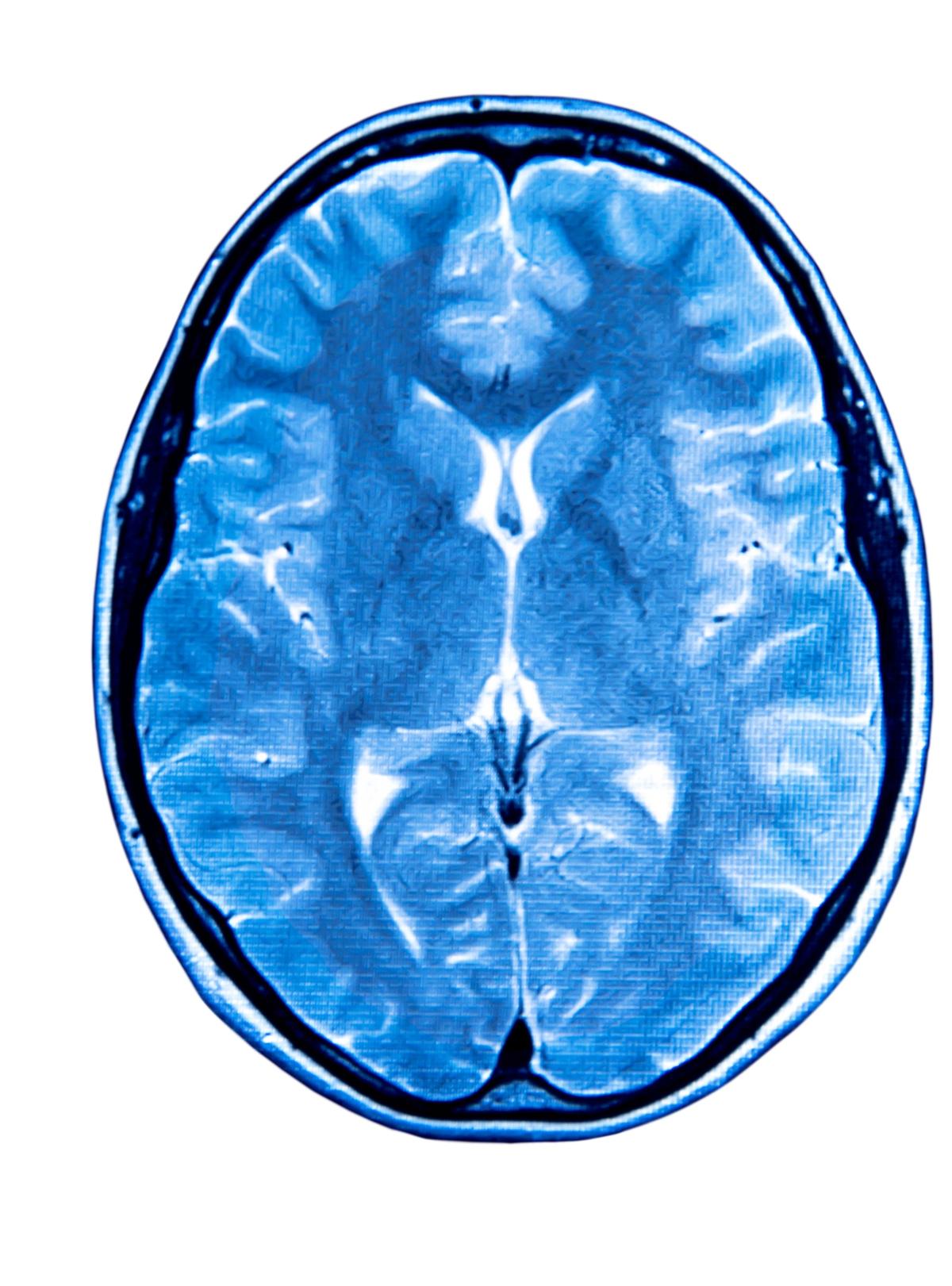
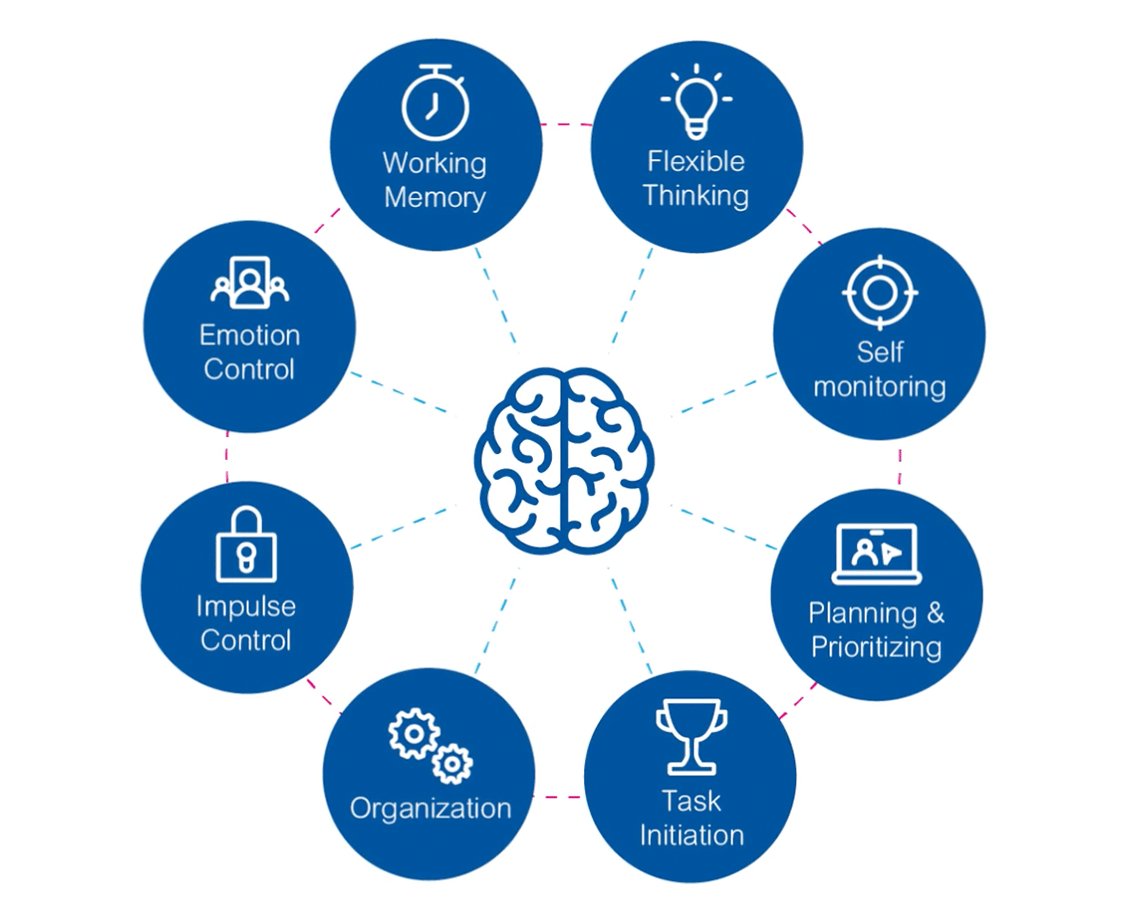
They're basically, processes that are kicked into place as a function of an event happening. But that's not how most cognition occurs in humans. We are actually proactive. We are actually strategic. And so there's nothing here that allows for that. And that's why a part of what happens is, sorry, I'm not getting this. To build here. Am I? Spent too long on this slide. Here we go. The what we have to talk about really is, a process that coordinates all of these of lower order cognitive functions. And that's called executive functions. This more sophisticated, higher order cognitive component is actually, a function of the, the maturation, the frontal lobes in the brain.
And, and it involves our ability to do more complicated things like inhibit responses. In other words, we want to act all the time. But sometimes based on conditions in the environment, we have to hold back and not not act. That's called inhibition. There are goal directed responses. That is, if we're trying to solve a problem, we're trying to get something and getting that, getting that, getting to that end state goal involves a series of series of actions that that have to be sequenced.
We have to hold the goal in mind before we get to the point of of achieving it. Rule directed behavior, rule or rule govern behavior. We understand that we can act based on a particular rule. Are we are we flexible? We can we change our minds? Can we do things under certain conditions but not under others?
And then finally, all the way to problem solving, all of these things are, are are part and parcel of the higher order cognitive system that we call executive function. And again, they're mostly considered to be a function of the maturation of the frontal lobes. One of the ways we measure this in children and infants and children, is, is using something called a Stroop task.
And it's, it's, named after the discoverer of, of this this, of a task back in the 1930s with, with adults. But we use it with toddlers and, and preschoolers. And what we use is it's a measure of inhibition and also rule learning. And the idea here is, can you can you inhibit a normal response or a pre potent response or in or what is the sort of the normal sort of intuitive response in order to give a response that isn't that that is that is counter to what you would expect.
And in and we run this task all the time. And, and what we try to tell the child is like, okay, I'm going to give you a card. And when you see the card and it's red, I want you to say yellow. And when you see the word, when you see the card that's yellow, I want you to say red.
I want you to fool me. And children go through this. And they make mistakes occasionally on the first couple, but they get it. And then you can go quicker and more and quicker and you can see them. See them catch on. Another example of this, and maybe this makes the point clear is the night day task.
I'll show a child a picture of a a moon and they have to say day. And then I'll show them a picture of a sun and they have to say night again. It's the inhibition of the intuitive or natural response in. And so it involves rule learning and inhibition and, and suppression of a response.
So this is part of the simple parts of, of executive function. The second test that we use a lot is the dimensional change card sort. And this is appropriate for about 30 months and up. And as children get older they have you have to make the task more and more and more difficult. So we use stimuli that are, that are created by by crossing different dimensions. So for example we have these four stimuli. If I ask you to if I, if I present this to you, this on a card or something like that, and it's really is a sorting task where we ask the child to sort based on either color or based on shape. You can see each one of these stimuli could be sorted on either of those dimensions.
And so that's what we do. We asked children to go through a task where they learn a simple rule. We want them to sort based on, for example, color. You put blue things with blue things and red things with red things. Or we can do this. We can say short on shape, put all of the all of the circles with all of the circles, put all the squares with all squares. This is really easy and most kids can sort of learn this, although surprisingly at about 30 months it's not that easy. After the child masters this part, we switch it. So this measures. So this first part measures rule learning. The second part measures mental flexibility. So after you've learned how to sort on color, we ask you to sort on shape and or and after we've learned you've learned to sort on shape, we ask you to sort on color.
And so you know, put now put red things with red things and blue things with blue things. After you've done shape, and then hope that the point is, is made here that this is getting progressively more difficult because children have to now inhibit the rule they learned before in order to perform well. And now the last one, and I recommend that you try this last one with your spouses, because it's, is it actually is more difficult. You put a border around the stimuli and, and if the border is present, you choose one dimension to, to sort on. If the border is absent, you choose the other dimension. And so, for example, you present the stimuli and you don't this, this is a lot more difficult than it seems. But if there's a border present you sort on shape, and if there's no border, then you sort on color, for example. So that's the kind of thing that measures sort of the conditional responding. If this is true, then I do this. If that's true, then I do this. So again and this children don't get very good at this until about five and a half or six, at which point they tend to pass this. But what's really interesting is that they, they still make mistakes and, and actually I find that, a lot of adults have trouble with this kind of task.
In any case, that's the dimensional card sort test. The last task I'll talk about is the no, the go no go task. And this is quite straightforward. It's a measure of inhibition, but we use it mostly with, with measurements of electrophysiology. We have a child sit and in rapid succession we say we're going to present you with some stimuli, and we want you to hit the spacebar in the computer as quickly as you possibly can when you see the stimuli and here are the stimuli. They're all fish. But when you see a shark you're not you're not supposed to you're supposed to hold back. Got it. Okay. And so children going going going going. And they see a shark and they go and they have to stop and this again, it works mostly best. It works best with electrophysiology. It's often used in conjunction with like ERPs or EEGs or event related potentials.
And we get brain measures and I'll show you some of those data in a bit. So this is a measure of pure inhibition. They're going going, going going. I've had to stop going going to stop. And we can actually look at the electrical activity of the brain during this time. Two trials I'll talk about in which we have used these measures to great to great elucidation and with respect to the activity of the of nutrients.
The first one you may know about is the diamond trial. We ran this in Kansas City for many, many years. And here what we did is we, we supplemented children with, for 12 months with, long chain polyunsaturated fatty acids. We put DHA and ARA in their formula there. There is a there was a control group that didn't receive any either, either of those.
And interestingly enough, you can't do that anymore, at least not in the U.S., because it's considered to be unethical. And if that's you want a measure of impact, that that is actually a clear indicator. One of the ways you measure the effects of, of a nutrient is to actually talk about, talk about, developmental status.
And we often have a measure called the Bayley Scales of Infant Development. I'm sure some many of you know about it. It has repeatedly been shown not to be sensitive to LCPUFA supplementation. And in fact, it in fact, is documented in many, many meta analyzes. And occasionally it makes the, the, the the news. We have argued, my colleague and I, Susan Carlson, and I have argued that the Bayley is not a good measure of this because it's a global crude measure.
Let's take a look at more sophisticated measures like executive function on the Stroop, for example, baby infants who were supplemented for 12 months actually did much better at at three and a half, four and five years of age on the Stroop tasks that I just described. Remember, though, we stopped feeding them at 12 months. So this is an interesting effect because it goes all the way up to age five.
Similarly, when we look at these children on the on the dimensional card sort, we also show that and the, the, the solid line of the supplemented children, that they are ahead of the non supplemented children by over a year on the dimensional card sort. And this is the very simple parts of the, of the, of the card sorted at ages three, four and five.
So despite the fact that the Bayley didn't come out, we did see these effects on on executive function and we saw them far after the end of the feeding period. When we follow these children later on, we found that their verbal IQ was better, and also some aspects of their, of their of their preschool IQ, in particular, full scale IQ and verbal IQ.
On the, on the, on the WPPSI were also positively affected by this LCPUFA supplementation. So again indicators that that that they that that this really made a big difference. Finally we did the go no go task with them. And what we did is we measured their brain responses. On the right is the LCPUFA on the left of the controls. And as they are getting deciding what to do in response to the presence of a shark, what you should expect is to see greater activity in the frontal cortex, or at least in frontal areas, and as they're making that decision, you can see the LCPUFA group, lighting up more on the frontal lobes than, than the controls, indicating that this nutrient has had a positive effect on this particular executive function at the level of the brain.
The second piece I want to talk about is MFGM and its effect on on executive function as well. Again, I'm very fortunate to have Doctor Fontecha set this up for me. I don't have to talk very much about, the actual aspects of MFGM this is work that, I did with a number of colleagues, and, in Shanghai, and we set this up, in, in 2014 and, and again, I don't have to talk much about the MFGM biology or physiology, but MFGM, as you know, has now been shown in actually five different clinical trials to be to have positive effects on on outcomes here. The Bayley actually does show this, which is surprising to me because the Bayley is such a crude, sort of a crude measure of cognitive outcome or developmental outcome to me. And I interpret this as a measure of the power of MFGM in terms of its ability to change, to change cognitive outcomes. The actual lighthouse trial that we ran began with 451, infants in Shanghai. And, in the end, by the time when we were done, we had about 150 in each group. One group received MFGM, the other one didn't receive standard formula. And that's and they also received milk lactoferrin So so it's a very simple two to arm clinical trial. And they were fed until about 12 months of age.
And this is significant because as you see they these effects go on and on. The the persistency effects indicates the power of the measure. And we measured safety, anthropometrics, but we measured developmental status. And I'll quickly go through those results. The ages and stages questionnaire, which is a parent report measure. What we found essentially on all of the at all of the dimensions, on the ages and stages at ages four, six and nine months of age, we found that the the MFGM and lactoferrin group was were reported by their parents who were blind to the condition, reported to be better at on the Bayley. When we measured it at 12 months. We did see significant effects in the cognitive, language and motor aspects of the test. Interestingly enough, when we measured them back at 18 months, they didn't, but at 18 months, we also did a measure called the MacArthur Communication Inventory and we did see significant effects there on a number of critical, complex aspects of language, including one that we write here with the, well, call language, sentence complexity, as well as some syntactic things and some use of, of, use of use of, complex concepts in language which suggested to us that the results it wasn't that it went away. And this suggested to us that we should follow these infants further, which we did in 2020, and we followed them initially on, on, on the, on the WPPSI, IQ test, where we saw significant effects on verbal comprehension, a marginal effect on visual spatial. Interestingly enough, a very big effect on processing speed. You add all these, to get, a composite where full scale IQ and that was affected positively with MFGM supplemental infants doing much better. So and I'd like to make this point because a lot of the other work that I do is in the area of, of, intellectual and developmental disabilities, it is really hard to change IQ. People have tried to do this for years and years. It's it's not very easy to do. And now with nutrients we're able to do these quite I've seen it twice in my career. On the Stroop tasks that I've already described to you, we again found that the MFGM and lactoferrin groups did better. And finally, if you remember this task here, what we did see on the last one, the last, most, most difficult part, we saw a significant effect of, of supplementation on performance on the, the border aspect of the, of, of the dimensional change card sort. So once again, we are seeing the effects of nutrition far after we've stopped feeding. We've, we've seen brain measures that suggest that, in fact, we have changed the structure and function of the brain. And finally, we are actually looking at, we're looking at meaningful differences in executive function, which will which will help the child through the rest of their lives.
So to summarize, executive function is the higher order cognitive ability in humans. We measure it through behavioral assessments. We measure it in physiological measurements. And interestingly enough, both LCPUFA and MFGM supplementation in infancy has have been shown to positively affect executive function as well as a number of other aspects of human cognition of early cognition. And I cannot make this point any more forcefully than I that I can. I would like to here the effects of this early nutrition persist well beyond the end of the feeding process, suggesting that these nutrients are actually engaging in programing the brain and, and, and, and having long term effects on, on, on, on these children's outcomes well beyond childhood.
So I want to thank you all for, for your attention today. And, and I appreciate your help, your, your attendance.