Nourishing the brain: Enhancing brain myelination and cognition in children
Uncover the vital connection between early childhood nutrition and brain development with Dr. Deoni as he explains the importance of early brain and cognitive growth, focusing on nutrients that enhance myelination and cognitive development.
This presentation was delivered by Dr. Sean Deoni, Associate Professor of Pediatrics & Diagnostic Imaging, Brown University.
Narrator
Introducing Doctor Sean Deoni, a globally recognised doctor in medical biophysics. Doctor Deoni has authored more than 80 peer reviewed journal articles and was the senior program officer for the Bill and Melinda Gates Foundation's Maternal, Newborn, and Child Health Discovery and Tool sections from 2018 to 2022. His research focus includes the process of myelination in healthy infants and toddlers in relationship to behavioural development.
Doctor Deoni currently serves as an associate professor of Paediatrics and Diagnostic Imaging at Brown University, Rhode Island. Please welcome Doctor Deoni.
Dr Sean Deoni:
All right. Thank you very, very much. It's a tremendous honour to be here with you all today, although I also have been given the unenviable task of following Doctor Ghishan and preceding Doctor Wu and basically the juggling clown that has come on between LED Zeppelin and Pink Floyd for you.
So, I'll try to make this as entertaining as possible to keep your attention, but nonetheless, we're going to follow along a little bit from what Doctor Ghishan, began to talk about. And I think you'll see that it follows into, what Doctor Wu we'll talk about afterwards. This was really thinking about, how we can help, children build a better brain and ultimately become all the amazing things that they are going to be.
I'll start off really quickly just, mentioning some disclosures. As well as our disclaimer here. But really, you know, what are we going to try to talk about over the next 20 to 25 minutes? Really? Again, it's kind of what brings us all together, which is really trying to make and help children become the greatest version of themselves and really, really going to try to nail down thinking about things around neurodevelopment and the factors that that shape development and how nutrition is such an important tool, that we can modify to help improve neurodevelopment and cognitive outcomes.
As we just heard a little bit about from Doctor Ghishan, but also the two talks this morning and we'll hear about again as we go throughout, throughout the weekend. So, we heard a lot about the first thousand days and how this is such an important period of development, and sets up really lifelong trajectories of health, be it cardiovascular health, metabolic health.
But it also plays a role, obviously, in neurodevelopment and cognitive health. And we know we can plot out things and we can look at different charts of how different things are happening, but how I'd really like to ground us in really thinking about the importance of neuro of the thousand days for neurodevelopment is to introduce you to my kiddos.
So, this is a picture that's a couple of years old, but this is my son Sethen, who was about two years of age when he, welcomed our new his new daughter or new sister home, Neela from the hospital. And the reason I show this is because this is the postnatal portion of the first thousand days.
And I think it really nicely exemplifies all the amazing things that you learn over the first two years of your life. You go from being a very vulnerable child who's dependent on their mother and father for everything, to learning how to crawl. Take your first step, say your first words, go off to daycare, learn how to make new friends.
Learn how to manipulate your brother and get him into trouble. Learn how to wrap your father around your finger so you get whatever you want. All of these amazing things, these cognitive and behavioural changes, are going to happen over those first 2000 or first thousand days. And just to sort of amplify that, a little bit, when we think about even all the major domains of cognitive development, they all have their infancy within those first two years of life.
Even things like pure social skills, which, if she's a physicist like her father, may never develop. But in general, have their infancy again over those first those first two years of life. Now and of course, as an imaging scientist, I'm interested in really what's going on under the hood that's driving all of this development. And so, if I asked you if you have children, if you have any pictures of your children, if you're old school, you might have a wallet, right?
You pull out and have some actual physical paper, physical images. But you'll have images that look somewhat like this, right? Of your infant and then getting a little older. Nice. Bluey, for those who are seeing all the Australians around and getting a little bit older. As a physicist and an imaging physicist, I have slightly different images of Neela, which are these.
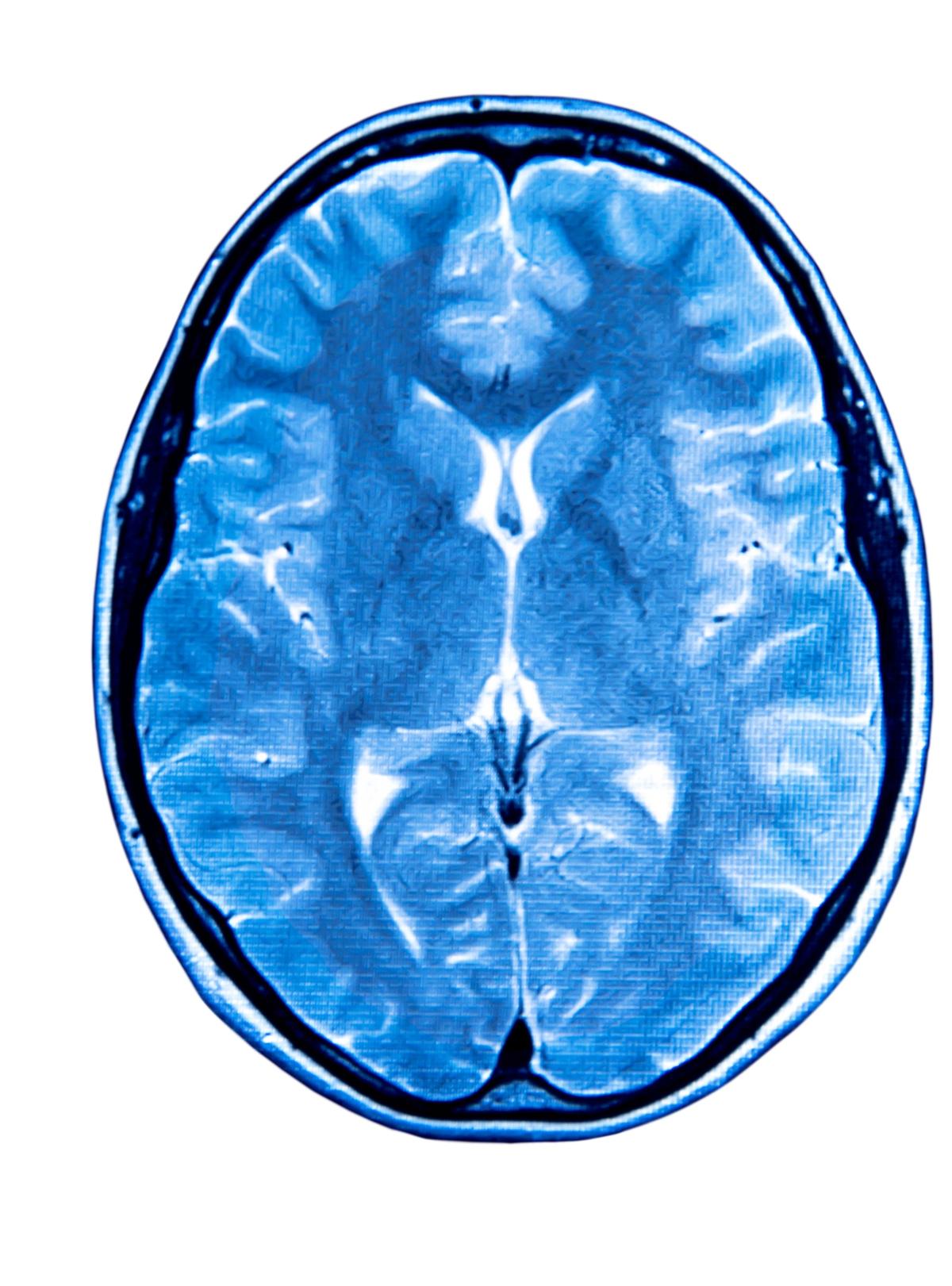
So, these are actually images taken, of Neela as she's grown up from three months of age, up to two years of age. And again, alongside all that immense cognitive and behavioural change, we have just immense behavioural neurodevelopmental change that's happening. The first thing you notice is just how the brain grows. So, it's expanded in volume by about three times or 300% over those first two years.
You can also see if you look along the cortex, which is that sort of surface of the brain. You can see that at three months of age, it's very smooth, right? It's not very complex. But as she gets older, you see how it becomes far more. There’re more folds, more wrinkles if you will, along that surface that's just really driven again by all those synapses and neurons that are developing that neurogenesis that's occurring.
So, more thinking power being brought into the brain. And then you can also see how you go from this very grey, almost homogeneous tissue up and you see the development of the myelinated white matter, that white stuff in the centre of the brain. And that's really being driven by that process called myelination, which Doctor Ghishan really talked about a little bit earlier.
And again, when you think about what that's doing is you go and think about the white matter really being the wiring of the brain and transmitting information across the brain from the spinal cord up into various cortical regions across different cortical regions. And then back down the spinal cord, all that's being transmitted by these wires. And early on when you're born, all those wires are bare there, like electrical cables inside your house and sending electrical signals all across them is very, very slow.
It's slow and it's energy inefficient. Takes a lot of energy, a lot of heat to send that signal across. So, in order to send it a lot of information across our brain, we've come up with this biology has given us this adaptation called myelin, which is this fatty layer that wraps around those neuronal axons. And now the information hops along that axon like a kangaroo a thousand, 10,000 times faster.
So, as we said in that video, it's like going from going for a nice slow jog or a nice little walk to hopping into an F1 car and speeding off. Right. So, you can just shuttle far more information around your brain. And this really links into function. So shown here now are functional images where the balls that you see are different cortical regions that are associated with a particular function.
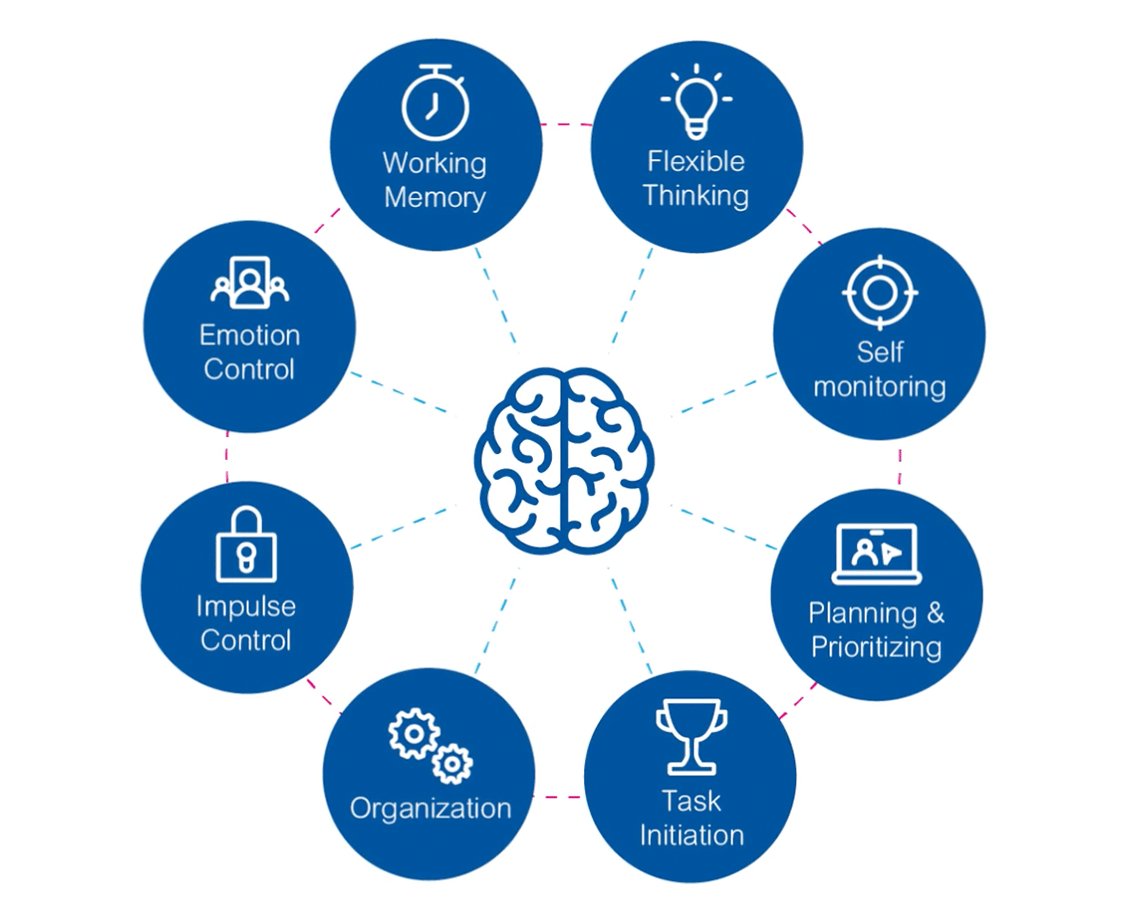
So yellow in the back is your visual function in visual cortex the purple balls at the top there are your motor areas and involved in motor function. The black balls along the side are your language systems. And then blue and red are things like executive functioning skills, attention, memory, these sorts of things. And so, when you're born, when you can't send information very quickly across the brain, what you see is those networks are almost like islands in the brain.
There's lots of connectivity, lots of green lines within them, but not a lot of green lines connecting them. So, there's a lot of focus of connectivity within those, those functions, but not a lot of cross function talk, which is why if you toss a ball to a baby, they see it. It bounces off their head and then they move their hand, right.
However, if as we get older, as we use those functions, we lay down myelin, information is able to flow far more rapidly across the brain. That means that we get more connectivity across those different functions. We can integrate that information. And now when you toss a ball to an older child, a toddler, they reach up, catch it and throw it back to you.
Okay. So again, this process of myelin being incredibly important for all of this. So that leads us to our first question which is myelination is important for brain messaging. Making your brain mildly fat, increasing synaptic density or promoting cell toxicity.
Okay. And we have… Well done, well done. Well, we're kind of split between the two, so if you wouldn't mind, if you could put my slides back to the beginning and we'll just walk through that whole process again. Maybe. But yeah. Not too bad. It was basically around, brain messaging. Synaptic density comes along with that.
But the primary role is for brain messaging. So great job to the almost 41%. The other 55%. Come see me afterwards during lunch. Okay. Can we go back to the slides. Perfect. Okay. So again, just kind of just, you know, just at the risk of beating a dead horse, really thinking about, again, the importance of the first thousand days. If you're looking at this, these processes of, of cortical thickness or neurogenesis, myelination, these are, these are, charts across the first six years of life.
And if I just throw this down, that's the end of the first, thousand days or the age two. And so you can see across the brain that most of these processes, you're really achieving that 80 to 90% of adult level values. Now, my wife would say that I haven't changed at all. I've matured since I was two.
But in general, we do still have a lot of maturation. Right? 20% of your brain's maturation occurs over the next two decades of life. So, there's still a lot that you can do. But again, really emphasizing the importance of this first two-year period. So, and of course, this process, and all these processes of brain maturation are really driven by the environment.
Right? You're set up with various genetics, and then the environment begins to play on that. And that environment begins in utero with maternal health. We heard a lot about the impact of maternal nutritional deficiencies. For example, we also have obviously early infant nutrition and early infant bonding. And that's all the social emotional development that occurs when you're bonding with your parents.
And then, of course, it moves on into older childhood, depending on the environment that child experiences. And this can be everything from the school they go to, how many siblings they have, whether they go to the grandparents’ house for childcare versus an actual daycare centre, what kind of school they go to, etc. so lots of different things that factor in to developing that human brain.
And so today, obviously we're really focusing on the importance of nutrition and thinking through how that is such an important factor. And so just to delve into this a little bit, you know, how we go about studying a lot of these factors, is through…is through this device. Right. Does anyone ever seen an MRI scanner before? Anyone got into an MR scanner?
MRI, magnetic resonance imaging? Yeah. Okay, so this is our predominant, tool that we're going to use to go and study neurodevelopment. But if anyone has had an MR scan, you know, that they're not too easy to put kiddos into, right? They make a lot of noise. They are really, really kind of intimidating. You have to lie really still for a long period of time.
It's really, really not easy to put this little monkey into that big device, right? Because they just typically go together kind of like this, right? Like oil and water. They just don't really mix too well. And so, and if you try to do this, if you just try to take that little monkey, you put them in that scanner and say, please don't move.
You're going to get a lot of, a lot of, this. Right, which is just a lot of tears, both on the child side, the family side, and your research staff side. Right. Everyone's going to be really grumpy and unhappy, because, again, we need them to lie really, really still for 30 to 40 minutes inside of a machine that's making loud banging sounds.
Right. And so how do we do that? Well, if we were clinically, we would have access to the make-go sleep now. Drugs. Right. We could give them a little bit of sedation. They’d fall asleep. We scan them. Life is good. These are healthy, typically developing kids that we study, so we can't do that. So instead, we have to wait for nature sedation to kick in.
We have to wait for these kiddos to fall asleep, either by reading them a book or by allowing them to do their usual nighttime routine. And then we move them into the scanner. And we've done a lot of work on the scanner side of things to make the scanner a lot quieter, so it doesn't wake them up when we put them in.
But we basically have how we set this up is that we bring in eight to nine, sometimes 10, 11, 12 families over a course of an evening. We bring them in at their usual nighttime, right? When they usually go to bedtime, they go through their usual nighttime routine, so they might have a bath, they might read some books, breastfeed, formula feed, etc. then they lay them down into these pack and plays or cribs.
Inside of that crib you can see this big blue bag here. That's an immobilizer. It's basically a big blue bag with a million styrofoam balls in it. When you suck the air out, it becomes like an air cast doesn't vacuum pack, and we're not trying to preserve them like jam, right? It just becomes a little bit hard so we can move them around without them flopping and flailing all about.
Every other child falls asleep in that we wait 10 to 15 minutes. Our team sneaks in under the cover of darkness, cinches up that immobilizer, sucks the air out, pulls the whole bottom of the pack in play out of that, out of the pack and play puts it on our glorified mail cart. Move it into the scanner, put on some headphones, put the head coil on, put a pulse oximeter, and then move them into the scanner.
Get them into the scanner. We start monitoring their vitals. Their parents can be in the room of their MR safe. We have research staff in there. Start scanning. If they start to wake up, we stop the scan. Let them try to settle back down. If we missed that, we'll pull them out, try to settle them on the bed.
If they still awake up. We move them back to the room and it's like monopoly. Do not pass go, do not collect $200. They go back to the room. We move on to the next family that's fallen asleep, and we just keep going through the cycle until we get all of them done. Or the parents say enough is enough. I have to go to work tomorrow.
Okay. For older kids, we can't let them fall asleep because they just won't sleep in our lab. So there we turn to the next usable approach, which is bribery. We allow them. We give them, you know, $20 for a scan, we give them an ice cream cone, etc., so they get into the scanner, to make it a little bit more fun, we do have these motifs, either a space shuttle, princess or King Castle. We have a jet. We have an Eminem, dude. We have a train. All sorts of things that they can go into. And of course, we have uniforms that we can wear again, just to make the child a little bit happier. We do all that. It takes about three hours to collect a scan, but we can start to look at how brain matures over the first, five to six years of life and how it's maturing.
And we can use MR to get a lot of different measures of brain structure of the first row. There being that myelination pattern, we can also make that into movies and show how the brain is maturing. So here again just showing higher, higher values are brighter colours, just how the brain matures and wires up as we grow. So, it follows this very characteristic pattern of centre out back to front, which basically follows motor system visual system, language system planning system. Right. Which doesn't happen until adolescence. Usually. Now are those just pretty pictures or do they mean something? I mean, it's great to put those up on our marital bedroom and on the ceiling, but do they actually mean anything? And so, for that, we then also associate all of our imaging measures with neurocognitive assessments and behaviour. This allows us to, for example, link up different brain regions that have very different brain trajectories, for example. And we can link those up to changes or longitudinal patterns of cognitive function. So, this for example, is the Mullen scales of early learning and the motor scale. And we can look at how well does that relate to these different developmental patterns. We do that and we link out the brain into a number of different brain regions. We got a couple of interesting little findings. So, the first one there is at the top is sort of main white matter pathways. The major white matter pathways in the brain really being associated with all functions. So, motor, vision, language, cognition, which means if you have an injury in those regions you're going to have pretty broad-based functional deficits. But then we also have these very specialized regions. So, in the middle left here these are really your somatosensory cortices. Moving over to your primary and secondary motor cortices. Again, being associated with gross motor and fine motor. Down here in the bottom left this is arcuate fasciculus and temporal lobes which we know are associated with language in adults and as indeed is associated with expressive and receptive language development. And then shown here the bottom right. Well, this is your visual cortex. So not surprising that this links up with your visual function.
This is true over the first two to three years and really sort of main developmental, domains. But we can also show this for example in more complex behaviours. So, at the top there is phonological processing. Your ability to assess language shown here is academic achievement. So interestingly it takes all of this to learn how to read. And it only takes this to do math. Okay. So, anyone who says, oh I don't have a math brain. Not true. Not true at all. Right. Math is pretty easy, as it turns out. And then you have these things down here, which is kind of your inhibition, which my wife says I don't have.
Okay. So now we can take all this and say, well, how do we alter these patterns? Can we drive these patterns? And how does nutrition play a role? And so, for this, we'll start off just with a quick question to begin nutrients that you think help promote myelination. Although this is kind of been given away from some of the earlier talks on sphingomyelin choline or all of the above have at it.
We got our cool tunes going.
Very long 15 seconds.
Okay, I think we can go from there because if you haven't got it yet, you're not going to get it. Hey, sweet. Perfect. Okay, I'm a better lecturer second half, as it turns out. Okay. Perfect. Great. Well done. Yes, indeed. All of those. And we're going to show you exactly that in just a second. Although I'm not sure what phingomyelin is, but I'm pretty sure it says sphingo.
Okay, can we go back to the slides? Perfect. Okay, so we think about nutrition. Obviously, the gold standard is breastfeeding. So, what do we know about breastfeeding and child development. Well, certainly the brain really requires a really carefully orchestrated delivery of key nutrients at different time periods to build a healthy brain. And so this is the things, for example, like your usual suspects, your lipids and fatty acids that we've heard a lot about DHA etc..
But also requires minerals. We heard a lot about iron and zinc. Vitamins B12, vitamin K, and also micronutrients like choline. And all of these are either involved directly in the process of myelination through either the synthesis of the myelin sheath or as components of the myelin sheath. And so, if you don't have them, then you can't build a healthy myelin sheath. And the key thing is that they need to be delivered at a key point in time. So, it's like building a house. You can't just have all the builders on site and no bricks, and you can't have all the bricks there with no builders. Right? You need to have them both at the same time. So, it's really key that these things are being delivered. And the challenge has been this, that formulas traditionally either don't have a lot of these, these, micronutrients or components or they're not given in sufficient quantities. And so, what do we know about the impact of breastfeeding on the brain? I think we alluded to a lot of the work in DHA on electrophysiology through EEG. But in terms of brain structure, it hasn't really been a huge amount. There's been a few studies, predominantly focused in on those older kiddos or older childhood and early adolescence, but they do show what we expect, right? That improved in increasing amounts of breastfeeding, increased exclusive breastfeeding and prolonged breastfeeding are associated with improved measures of brain structure, grey matter and white matter, and that those are linked on to IQ and cognitive maturation. But the challenge here is that all of this work has been done in older kids and adolescence because again, it's a lot easier to put an eight-year-old into an MRI scanner than an eight-month-old. So, the key question, though, is what's happening down here? Right. Do we have any information to show how these things are occurring simultaneously. And that's where a lot of our work has really focused on. And so on our first foray into this, we just took a really broad cross-sectional approach, just looking at children who had been, either exclusively formula fed or exclusively breastfed for the first three months of age and then plotted out myelination trajectories across the first, five years of life, matching them for as many socioeconomic and birth outcome indicators that we had.
The results of that analysis showed this, that it basically across the brain, particularly in those later maturing regions that are associated with executive functioning skills, motor skills and social emotional development. The kids who were breastfed had greater myelination than those who were formula fed. And this was mirrored by what we found in terms of looking at cognitive measures, be it fine motor, visual reception, expressive and receptive language again all being greater and the kids who are exclusively breastfed.
The challenge here was that this was all cross-sectional data, right? So, we could have been biased by different kids at different ages. So, we went back to our data. We waited for kids to come back in. Our studies are naturally longitudinal, so they come back every six months for additional scans. And we redid this analysis about two years later. Now, instead of having a single measure per child, we had five, six, seven measures per child. And we can do more sophisticated measuring and analysis. But again, what we found was across the board improved myelination, improved myelination patterns in children who were exclusively breastfed versus those who exclusively formula fed. And again, those were mirrored by results that we saw looking at overall cognitive development, be it overall cognition. The ELC value or in verbal the VDQ or motor non NBQ measures. So again, increased brain maturation in children who are breastfed that it continues on throughout early childhood.
But the key question is this really just breastfeeding or is it something else that's going on. And so really what we wanted to do was think about are all formulas equal. And traditionally when we do these analyses, we lump all the formula fed kiddos together and all the breastfeeding kits together. And we don't look at individual different formulas. But in understanding or trying to understand whether nutrition is actually important, we can make use of the fact that different formulas have different combinations of nutrients, and we can see do different formulas lend themselves to different developmental patterns. And indeed, we see that we see across the board some, formulas that are quite close, to breastfeeding, that breastfeeding reference in blue, and some formulas, for example, the green one that are much further away from achieving that breastfeeding level. And this is mirrored in when we look at cognition in these children, where again, those that are looking like breastfeeding, those formulas that are close to breastfeeding have higher cognitive outcomes and those that are further away from breastfeeding have much worse, cognitive outcomes.
So, this leads to the idea that indeed, nutrition is probably incredibly important. But what nutrients is important, right. What's playing a role here. So, for this we can go back, we can go down to the store, or we can buy different cans of formula. We can run the analysis, and we can get a sense of just looking at which formula concentrations are associated with those or predictive of those maturation trends. And so, we see things like DHA and ARA playing a role across many different brain regions. Folic acid, iron, choline also being involved. But we also see sphingomyelin and phosphatidylcholine playing a role, across the brain as well. And this makes sense if we think about the path of building a brain. So, if you're going to build a brain, you start down here at the bottom and you work your way up. So, you take your fatty acids to ceramides to sphingomyelin, to myelin. And so, it makes sense then that fatty acids are important because they're coming in right at the beginning. And that makes sense that sphingomyelin is playing a role because it's coming in right here. So, if you provide this you can help drive myelination. So not surprising then that we see that there's an important role here.
So, that then leads to our third question. Well, we've talked about nutrition but as early childhood development is influenced by not only nutrition but also potentially sleep reading and play or all of the above.
Okay.... All right. So shall we give them a go....I'm going to be hearing this song in my sleep tonight. I reckon.
Okay. Hey! Fantastic. Exactly. Okay, so nutrition is incredibly important, but so is playing with your child. So, we're talking a lot today about nutrition. But remember there's a lot of other things that go on. So we'll get to that okay. Back to our slides for if we could for a couple seconds.
So, the key thing now is that we've kind of looked through. We get a sense that we can that certain nutrients are important for maturation. Can we now promote brain development through nutrition and a bit of a bit of a stunner because Doctor Ghishan already gave it away. Indeed. We think we can. And so, to do that and again, this comes back to this, this lovely milk fat globule membrane that's been talked about this morning, with all of its components that are very close, to what we need, those sphingomyelin, phospholipids, etc., that we know are important.
And the key thing here, that we can look at, we didn't actually have it. We haven't done an RCT directly on the effect of FGM, but we've done what I'll call a random, a temporally controlled trial. So, if we think about our overall study, it's been running continuously since about 2009, and we've been continuously enrolling new kiddos, throughout that time period. Up until about 2021 when we had that horrible pandemic. Obviously, we have MFGM. That was added in 2018. So, if we kind of break this apart, we have three sets of kids. We have kids who have recruited that were that were formula fed with a formula, brand without added MFGM. We have kids that were formula fed with the same formula with added MFGM. And then we have kids who grew up in a pandemic environment which completely screwed everything up. So, if we just forget about that last little bit there for a second, we have here basically two groups of kiddos that are pretty much the same, but it's not an RCT, so we call it a temporally controlled trial of convenience. Or for those who are social media savvy for a TikTok trial, to really look at whether the MFG addition was helping infant brain development.
So basically, we just went back, we looked at kids who were taken after MFGM was added versus those who were before did exactly the same analysis that we just talked about and looked at overall brain maturation and what we found here was that these were all brain regions where we saw significant improvements in brain maturation, in myelination, in children who were fed the MFGM added formula.
We looked at the overall growth curves. You can see about a, 15 to 22, almost 30% increase in myelination across those brain regions. And when we look at overall cognition, although we didn't see a difference in overall cognition or verbal cognition, we did see a very significant difference in nonverbal. And we think that's just because we're only looking at them over the first two years.
And our study size was a little bit small. So again, kind of adding to the work that Doctor Ghishan talked about earlier and that Doctor Wu will talk about it in about three seconds.
So just to take home what we've learned hopefully what I've managed to convince you over the last 26 or 27 minutes, apologies for going over, is that nutrition plays an incredibly important role in early neurodevelopment. And is it a modifiable factor that we can change to help improve maturation in healthy kiddos. As well as, particularly sensitive, populations. Certainly, I want to emphasize that all formulas are not equal. And while that's great for certain formulas who are doing their best, I think it's also a rallying call to the formula makers that are doing a little bit less good to start upping their game and improving things.
And certainly, we were starting to see that formulas that are high in DHA, high in sphingomyelin content, phospholipids, etc. seem to promote, myelination and brain cognition. And so again, thinking through how we can improve that, the delivery of these formulas. But again, I want to stress at the end that nutrition is only one of many factors that influence a child's development. So, you need to put optimal nutrition alongside loving reading and playing with your child. I realize that sounds like a hallmark card. But it's entirely true. So, with that, thank you so much for having me here, and I look forward to speaking with you after.