Uncover how early stimulation and targeted nutrition may shape infant cognitive development. This presentation highlights the role of face-to-face interaction and key nutrients like DHA and (milk fat globule membrane) MFGM in supporting executive function and IQ, while cautioning against screen exposure in infants under 18 months. New findings suggest that enriching formula with MFGM may help close developmental gaps between formula-fed and breastfed infants.
This presentation is by Dr. Peter Willatts, Honorary Research Associate in the Division of Psychology of at the University of Dundee, Scotland.

GNS Vietnam 2025: Stimulation and Nutrition Two Major ways of Promoting Development of Cognitive and Executive Function
Peter Willatts, PhD
Narrator
Introducing Doctor Peter Willatts, Honorary Research Associate in the Division of Psychology at the University of Dundee. Doctor Willatts is a developmental psychologist known for his research on cognitive development in infants and young children. His problem-solving tests have become widely used tools in developmental studies. Doctor Willatt's research has demonstrated that long chain polyunsaturated fatty acids and early life support attention, memory, and problem solving.
His recent work also explored the impact of thyroid hormone insufficiency and iodine supplementation in extremely preterm infants. Doctor Willatts has served on the Scientific Panel on Dietetic Products, Nutrition and Allergies at the European Food Safety Authority and continues to advise on infant nutrition and cognitive health. Please welcome Doctor Peter Willatts.
Doctor Peter Willatts
Well, good morning, everybody, and thank you to Mead Johnson, for inviting me here to talk to you about exciting ways, important ways we can improve development in our children. That's going to be the topic of my talk, and I'm going to talk about two ways of improving development. There are many, many factors that play a key role in children's development.
But the two I'm going to focus on are stimulation and nutrition. We've been hearing about nutrition already, but I'm going to look at ways in which we can stimulate development in children. And the best stimulation involves play and interaction with other people. Other people are absolutely crucial to promoting the best development in babies. And the interaction with other people is key, because it's two way. The baby does something and affects the other person, and the other person responds, and that response is absolutely crucial to encouraging development.
So a two way interaction is what we're looking for. And there are many, many benefits. Research has shown that this kind of interaction promotes the development of social and interpersonal skills. Babies ability to learn about emotions, to express emotions, and also read them in other people. And it encourages language development and communication. And I'm going to give two examples.
I'll give you really two pieces of advice that you can give to parents, which have been proven to improve development in children. The first we're going to look at young babies three months old, and we're going to look at what are known as infant caregiver conversations. So what happens is its a face to face interaction and the baby, maybe does something makes a little expression, smiles.
And the caregiver smiles back. And then the baby does something else makes a noise and the caregiver does something back, makes the same kind of noise. It's like a conversation. It goes to and from. But the key thing is that the other person is reacting to the baby and babies, at three months pick up on this very, very quickly.
So both partners can take turns. They can do baby things, they can vocalize, they can move, they can touch each other. They can make facial gestures. These conversations last longer and are more intense when the caregivers respond to the infant. That response is absolutely crucial. And that kind of responsive interaction when the interactions early on are very intense, they don't have to go on for very long periods, but they need to be effective.
They promote very good social attachments between the baby and the caregiver. Now, a lot of parents often say it's difficult to get the baby involved. This is particularly true of children at risk for developmental problems later in life, for example, preterm infants. Parents often say they're not responsive. You know, I try and do more and more and they actually turn away. They cry. They don't like the interaction.
Well, the research has shown there are four things that parents can do to produce better, more intense, more successful face to face interaction. So this interaction coaching is highly successful and has benefits for later development. So here's the first thing you do. You face the infant and you wait till the baby makes eye to eye contact.
And parents very interestingly say that moment, it's a magic moment at around three months when for the first time, they feel they're actually engaging with another person. They're not just having to clean up and feed and try and get some sleep. There is another person there. So eye to eye contact is critical. Wait till the baby looks. Then the second piece of advice is respond by copying what the baby does.
You imitate. The baby makes the vocalization says something like ah, you do the same ah. Then the third piece of advice is repeat what you've done at least three times, ah, ah, ah. And the fourth piece of advice do this slowly. And by doing that, repeating and doing it slowly. You give the baby time to process the information, to notice that you have reacted, you've responded to what they've done, and the results of the research show a numerous benefits on development, increased maternal sensitivity, and responsive behavior to the infant.
Improvements in social communication and emotional behavior. Emotional control in the infant. Improvements in cognitive development and better quality of attachment between the infant and the caregiver, which is the springboard to improve social relationships later in life. What about older babies? Well, turning to around 12 months, one very simple and effective interaction is reading to babies. You need a large picture book.
You can point to the pictures. You can name them. You can talk about them. Turn the page. Get the baby to learn that you can turn the page and look at something new. You can go back and look at something that was there before. But again, this is interactive. You are responding to what the baby is doing. The earlier reading to babies starts the greater the benefits.
The research is very clear on this. And these effects persist later into childhood. Certainly when children go to school. It's been shown they have better language skills and are more interested in reading as a result of being involved with reading from picture books with parents. The earlier it starts, the better. I've suggested 12 months, but nine months is perfectly okay.
And reading to infants is highly recommended by the American Academy of Pediatrics. The research is very clear. So two very simple things to do. Interact with your babies face to face when they're three months old. Read to them later on in the first year. Before I move off this topic. I want to give you one warning. Screens for babies are banned.
They are completely out, mobile phones, tablets have no role to play in promoting development in infants. And the reason for this is they're not interactive. The baby sees a lot of activity on the screen, but the screen doesn't respond to the baby. It doesn't recognize the infant, so there's no two way interaction. And research has shown, for example, Kuhl's research on language development that infants learn nothing from simple video language, just video displays from screens.
Instead, if somebody else is interacting with them, then they learn a lot of language. This is known as the video deficit screens. No learning at all. Screen time recently for children has been found. At one year of age to be related to a number of developmental delays at two years of age and as late as four years of age.
So the more screen time, the greater the developmental delay. The recommendation is obvious screens should be banned. And certainly the World Health Organization recommends no screen time at all for babies up to or during the first year. And the American Academy of Pediatrics recommends no screen media use for infants under 18 months of age, with one exception. If they're involved with another person appearing on the screen, then there is a benefit.
You can talk to your family, grandparents who are remote, but the screen interacts with the baby. That's the key.
Moving on to nutrition, I want to talk about two nutrients. We know there are many nutrients that have an effect on brain and cognitive development. But two, I'm going to focus on are long chain polyunsaturated fatty acids LCPUFAS. And the second is MFGM, which we've already heard about. I want to give you a little bit more information about the studies, which show effects on cognitive development and cognition.
So to start with LCPUFAS, I'm going to talk about two, which are very important for brain development and cognitive development. DHA, docosahexaenoic acid, which is a member of the omega three family of fatty acids and ARA arachidonic acid, which is a member of the omega six family of fatty acids. These are both important structural membranes in the nervous system.
They occur in high levels. Both of them occur naturally in breast milk, and now of course, are added to infant formula. Now both of them contribute to the growth of neurons and synapses. So they're going to be important at a time of very rapid brain growth and development. They also affect the operation of neurotransmitters. So they're going to affect the functioning of the brain.
And DHA we know is involved in myelination. And we've heard just recently in the previous talk how important myelination is for increasing processing speed. And we also know DHA influences the development of what we can call higher order cognition, such as executive function, which I'll talk about in a moment. Unfortunately, we know almost nothing about the role of ARA in cognitive development.
The research simply hasn't been done. It's not there. I can't tell you anything about it. But we do know about the role of DHA. There have been a lot of studies. It's very clear DHA plays an important role in cognitive development. If you look at the DHA content in brain, 7.2% of total fatty acids in brain cortex is DHA.
That's an incredibly high proportion. It must be necessary. It must be doing something very important. When you look at different regions of the brain, it varies and one in which its incredibly high, 15% of total fatty acids in frontal cortex is DHA. And we think that's important for a number of reasons, because dopamine is a key neurotransmitter in frontal cortex, and animal studies show that newborn animals, rats, pigs raised on an omega three deficient diet have significantly lower levels of dopamine in their frontal cortex compared to controls. And dopamine is being a neurotransmitter in frontal cortex. It's going to be important because frontal cortex it controls and regulates the development of executive function.
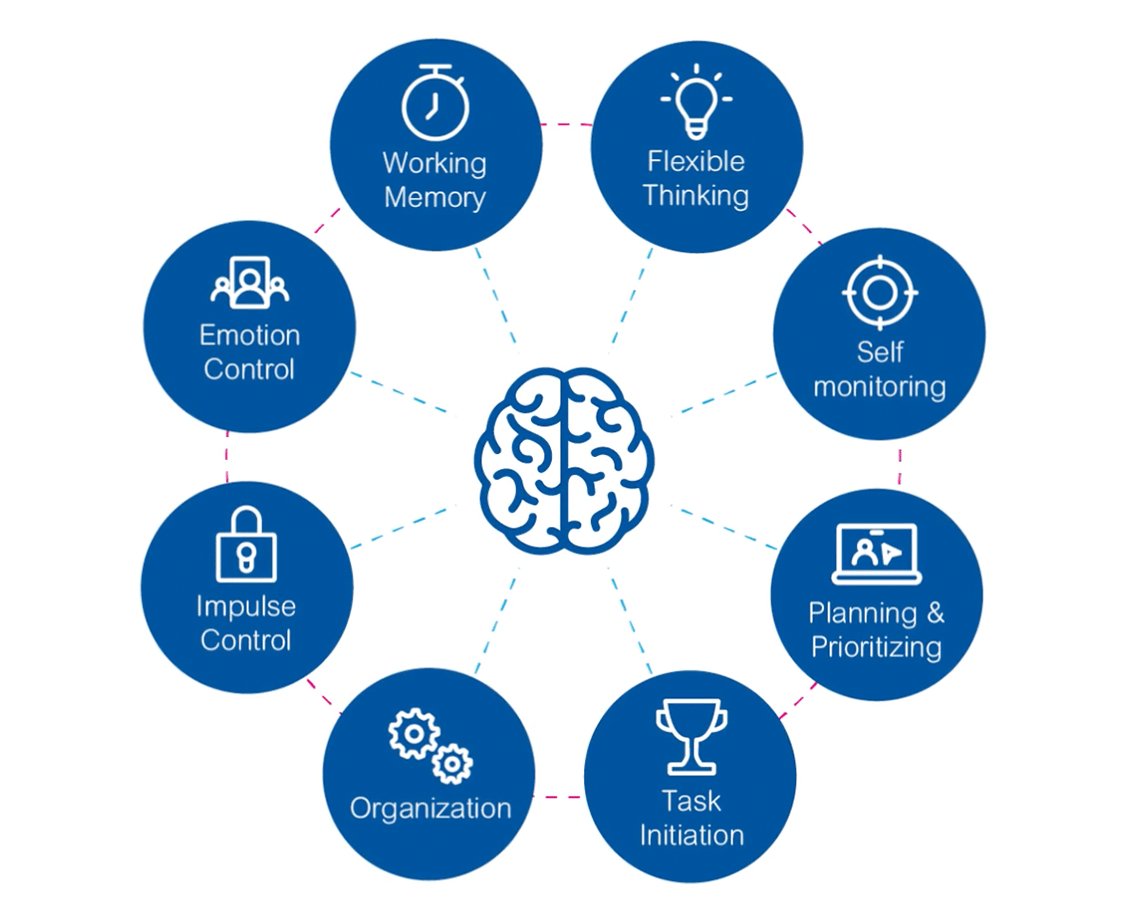
So what is the executive function? What do we mean by this term? It refers to a set of processes, not just one process but a mixture which are involved in regulating goal directed behavior and also organizing and controlling our thought processes. So these executive functions have a very critical role. I'll pick on three of them, which are particularly important: planning, thinking ahead, organizing behavior for the future is one key executive function.
Its mediated by frontal cortex. Working memory, maintaining information while your working on a problem while you're thinking, and then getting rid of it when you don't need it any longer. That is a key executive function. Again, frontal cortex is involved and attention control ability to ignore distracting irrelevant information to focus attention and concentrate on what you're doing.
That's a key executive function. And again frontal cortex is involved in its regulation. So I'll go straight to describing a test of executive function that I developed and it's been widely used now with infants during the first year of life. And it involves what we can call a means end problem. Infants use a number of objects as a means to achieving an end, achieving a goal.
So if you look at the picture on the screen, this baby's got a problem. I've taken his toy away. I've put it on the far end of a cloth and then I've covered it. It's hidden from view. And then between the baby and the near end of the cloth, I've put a block of foam. So to get his toy back, he's got to do three things.
And he's got to think ahead about what he's going to do. He's going to remove the block to get the cloth. Pull the cloth to get the cover, lift the cover to get the toy. So he's got to develop a plan. He's got to remember it, keep it in working memory. And he's going to ignore all those distractions, all these nice things that he's picking up and focus on getting the toy back.
And what we found in our study was we had two groups of infants. Control group received a formula with no LCPUFAs. Or in fact very low levels of ARA, no DHA and a supplemented formula which contained both LCPUFAs. And what we found was the problem solving scores was significantly better at ten months of age in the infants who received the LCPUFAs, their problem solving was improved by the LCPUFAs in their diet in their milk.
And here's a little video of one of the infants in the LCPUFA group. And you can see how it improved problem solving ability. So first we set the problem up and look at how she goes. Removes the barrier gets the cloth, gets the cover. Finds the toy. Now she's thinking ahead. She's solving the problem. We'll do it again.
Set it up just to show you it wasn't an accident. It's a very noisy toy. She makes a funny face.
And you see, she's very intent, focused on the task and solves the problem. We call that an intentional solution. She knows exactly how to get her toy back. And that was typical of the infants in the supplemented group. In this slide, here's a video of a baby in the control group. And again this is typical. And watch what happens.
We set the problem up. Different toy. She was interested in the different toy starts well, gets the block out of the way. And then look what happens. Oh, it falls apart.
Yeah. Yes. It gets very messy when you're working with babies aged ten months and doesn't solve it. Now, what went wrong? What was different between these two infants? Well, we think the infants in the control group were planning ahead. She started well, she removed the obstacle, the block, but then it fell apart. It could be two things. It could be a working memory problem.
She forgot what she was trying to do. This is not uncommon. Actually. It's a failing in the old as well as the young. I'm sure people have had the experience of walking into a room with the intention of doing something, and then forgetting why you were there. And that is a failure of working memory. But it could also be a problem of attention not being able to ignore the objects she's picking up and focus on the task in hand.
So this means problem solving. It involves planning. It involves working memory it involves attention control. And we're looking here at the early development of executive function. And LCPUFAs are playing a role in that early development mainly controlled by prefrontal cortex. It does suggest strongly that LCPUFAs and DHA in particular, influence the early development of prefrontal cortex.
But it's not just in infancy that we see these effects. There are long term benefits. And this is a wonderful study by John Colombo and his group working at University of Kansas. And it's the first study to look at different levels of DHA and their effects in infant development. So in this study, the diamond trial randomized controlled trial, there were four groups of infants.
One control group had standard formula with no LCPUFAs. The other three all had LCPUFAs, the same amount of ARA, 0.64% of total fats, but varying increasing amounts of DHA. So one was 0.32%, the other the next one was 0.64% twice the amount, and then the third one three times the amount, and 0.96% of DHA. And among the outcome measures, they looked at executive function at ages 3 to 5 years.
And they also measured vocabulary at five years.
And here's one of the executive function tests. It's a measure of attention control. It's known as the Stroop task, named after the psychologist who first developed this kind of task. So we have, two sets of cards at the top. We have cards which show the sun and the moon and the stars, and you tell the child when you see this card, the one with the sun, you have to say night.
And then when you see this card, the one that has the moon and the stars, you say day. You see the problem. The card suggests one response, but the child's been told to say something different. We have to ignore the picture on the card as attention control and pay attention to what they've just been told. At the bottom we have another set of cards.
These are fruits. So we've got the red card they have to say banana yellow card they have to say apple. And this is a summary of the results across all the ages for the different groups. It was supplemented with formula in the first year of life control group performing worse. The next group that have 0.32% DHA no better than control, not worse.
So it's not a harmful effect, but not better. But the next two groups, .64% DHA and .96% performing significantly better, getting more answers correct, between 3 and 5 years. So this is a long term effect of nutrition in infancy on attention control later in childhood. This is the second test of executive function been widely used.
It's called, it's a bit of a mouthful, the dimensional change card sort test. It involves attention switching. But let me explain how you do it. You have two sets of cards at the top. You can see we have red…. Sorry. You know, I'm having trouble with gee whiz. All right, let's go back. We have blue rabbits and we have red trucks.
Okay, so that's on the cards. In the box that the cards are to be sorted into, we have a red rabbit and a blue truck. Same colors, same object, same shapes, but different combinations. And that's the trick. So first of all, we say to the child, now we're going to play the shape game. Rabbits go in the rabbit box.
Trucks go in the truck box. Very simple. You hand them a small set of cards randomly sorted. Even young children three and a half years get most of it correct. So they do very well. But then we make it harder. We say, okay, we're not going to play the shape game anymore. We're going to play the color game.
And in the color game, we're going to put blue objects in the blue box, red objects in the red box, and notice same cards get sorted in a different way. It's a switch. And this is what gives children problems. The younger children have great difficulty forgetting the first rule. They got to ignore it. They've got to control attention and they should focus on the second rule.
They can't do that. They make a lot of errors. As they get older, they get much better. And this task is good up to the age of five and all children are doing pretty well. But we can make it even more complicated for older children. And in this version it's called the border task. Okay, now follow this very carefully.
If there's a black border, you play the shape game. And if there's no black border, you play the color game. All right. So the conditions are quite complex. You have to pay attention. You've got to look at the card. You've got to ignore what it might be suggesting, remember it's a demanding task of executive function. So in the diamond study they only gave the first two rules.
They didn't use the border task because these children were tested up to age of five. And here we can see for the different age groups at three years, 36 months, no differences between them. And they're making a lot of errors. This is the number correct they get but by three and a half one group is moving ahead.
And that's one of the groups that had DHA and ARA doing significantly better than controls by four years. Two groups are doing significantly better than controls. And those are the groups that have point, let me just get this right. Yes, 0.32% and 0.64% DHA. Both groups got the same amount of ARA. We don't think it's the ARA that's producing this effect, it's the DHA.
And you'll notice that the group that had the highest amount of DHA 0.96% not doing better than controls, not worse, so it's not a harmful effect. But, they're not doing better. And also, just to round this off, they measured vocabulary using a well-known test Peabody Picture Vocabulary Test at five years. And again, we see it's the DHA, the LCPUFA groups, that are doing better than controls.
Their language learning has been improved several years, four years after they start receiving the formula, long term benefit. Again, you can see the group that received the highest amount of DHA not doing better than controls. We don't know the exact reason for that. It could be there's too much DHA that's not a benefit. It could be the ratio between DHA and ARA.
This was the only group to have more DHA than ARA, and it could be that is the problem. That's why we're not seeing a benefit here. Not a harmful effect, but it's not a benefit. So impressive results I think from the diamond trial. There are other studies as well I don't have time to talk about, but it's very clear.
LCPUFAs affect cognitive development both in infancy and have long term benefits. That's one of the key findings, I think. Now, moving on to Milk-Fat Globule Membrane (MFGM). We've already heard about this. I don't need to describe it again. We had a beautiful explanation of what it is, and why it should be important.
It contains many substances, many components that are important and have an impact on early brain development. It's occurring in breast milk. Breastfed children are getting MFGM. But until recently, it was discarded, not included in infant formula. And we now think that's a mistake. And one of the reasons comes from several studies which are showing benefits for cognitive development.
This one by Timby and colleagues, had two groups of infants, one for a standard formula, one a formula supplemented with MFGM for six months. And then neurodevelopment was measured with the Bayley scales at 12 months of age. And the MFGM group, the supplementary group, had significantly higher cognitive scores than the control group. There were no differences in the language motor scores, but a significant effect on cognitive development.
So this is a very clear finding, a very impressive finding. And it's replicated here in this study by Lee and colleagues. Again the outcome measure with Bayley Scales at 12 months of age, we had one control group fed a standard formula, this time for 12 months, not six months, but 12 months. And the supplemented group received MFGM.
They also received Lactoferrin. That's an important protein. We don't know anything about the cognitive effects of Lactoferrin, but we do know something about MFGM. The previous study has shown us that it improves development in the first year of life. And here are the results. So looking at three scales the important scales from the Bayley we have the cognitive scale, the language scale and motor scale.
And the supplemented group were performing significantly better than the control group. All three of these subscales of the Bayley. So clear evidence that providing MFGM and Lactoferrin is producing an effect in infancy. We don't know whether the Lactoferrin was contributing to this effect. And as I said, we have no information at all about possible benefits on cognitive development.
But we do know that MFGM alone can improve Bayley scores. We saw that with the previous study, the Timby et al study. So I think it's a safe conclusion that it's MFGM is producing these effects. And just with LCPUFAs, we see long term benefits in this study again by Colombo and his group working at University of Kansas and also in China, clearly demonstrates the long term effects of MFGM and Lactoferrin.
So a number of children from the previous study were followed up, followed up at five and a half years, and their cognitive abilities measured with the Wechsler preschool and primary scale of intelligence and executive function as well. With the two tasks I've just described. And the results with the Wechsler IQ test are, I think, extremely impressive. You look on the right of the screen, we see a significantly higher IQ scores for the supplemented children compared to controls for full scale IQ.
That is a very impressive result. Four and a half years after they stopped receiving the formula. It's a long term effect on later development, and there were other benefits on some of the subscales in particular and important processing speeds. And also we see an improvement in the visual spatial ability, ability to organize visual material. Now, I think these two findings improved IQ, improved processing speed, particularly significant because these are children entering school.
And if you are better at processing, you're more efficient. And you have a higher IQ, you're going to be at an advantage when it comes to mastering complex skills, like learning to read and mathematics.
Then looking at the results for executive function, here are the results for the Stroop test that I described earlier. Again, significantly higher scores for the children who received the MFGM and the Lactoferrin. So better attention control four and a half years later on, and again with the dimensional change cards sort test, no differences on the simple parts of the test.
But these were older children. We're looking at a ceiling effect here, but they also gave them the border task. The much more demanding task, and significantly better scores, higher scores on the children who received the supplement. So again, better attention control as a result of the supplement. So just to conclude, just to remind you of what or just to summarize what I've been saying, stimulation is crucial to promote early development, and stimulation involves two way interaction with others.
That's absolutely essential. Face to face interaction with young infants, reading to older infants. Both of these encourage the development of social, cognitive and language skills, and screens have no role at all during the first 18 months because they don't provide two way interaction and infants learn nothing from them. Executive function involves planning, working memory, and attention control, and it's regulated mainly by prefrontal cortex, and a number of randomized controlled trials now have confirmed the positive effects of LCPUFAs, especially DHA, on cognitive development in infants. DHA and infant diet has long term benefits for the development of cognition and executive function in later childhood and in Europe it's a required component in all infant formula.
Finally, Milk Fat Globule Membrane MFGM, it contains bioactive components which play a role in brain development to function, and randomized controlled trials have found positive effects of MFGM on cognitive, language and motor development in infants and also MFGM in infant diet has long term effects, long term benefits for the development of cognition and executive function in later childhood.
Thank you for listening. I'll be delighted to answer any questions.